

compared with the oceanic mixing time of B10
3
years. This is in contrast to the Sr isotopes which
show a constant
87
Sr/
86
Sr ratio in seawater because
of homogenization by oceanic mixing during its
residence time of B10
6 years. Some additional
sources of REEs appear to exist in the ocean to
maintain geochemical consistency for Nd isotopes.
The concentrations of REEs in hydrothermal fluids
venting from hot springs at mid oceanic ridges have
recently been investigated. They are generally 1–2
orders of magnitude higher than those of ambient
seawater with a distinctly positive Eu anomaly, but
are also intensively removed by scavenging in the
vicinity of hydrothermal vent fields. Consequently,
the effective hydrothermal flux of REEs to the ocean
is negligibly small compared to the fluvial flux.
Atmospheric input due to fallout of terrestrial
aerosols and subsequent solubilization into seawater
has been thought to be important, or even predominant in the open ocean for some reactive heavy
metals such as iron and aluminum. However, the
eolian fluxes are poorly quantified for the REEs as
yet. Available estimates (Table 3), though highly
uncertain, suggest that the eolian fluxes are 30–
130% of the fluvial input of REEs. Terrestrial aerosols are transported through the atmosphere for
relatively long distances from the sources by longitudinally prevailing winds such as the westerlies and
the trade wind. This is in contrast to the fluvial input
which enters the ocean across the land–sea interface.
Thus, the relative importance of these REE sources
may be reflected in the geographical distribution of
REEs in the surface waters. The distribution of dissolved Nd in the surface waters (Figure 2) shows the
higher concentrations in regions of strong coastal
influence, such as Baffin Bay, the Bay of Bengal, and
the South China Sea. In the open ocean, there is a
general tendency of Atlantic4Indian Ocean4Pacific
for the surface dissolved Nd. The surface waters of
- La
Ce Nd Eu
Er
Lu
nCO
2 _
nCO
2 _
Seawater
Complexes
Detrital
materials
Oceanic
Particles
Oceanic removal
via Particle Settling
Coatings
(organic or oxide)
Ce (III)
Ce (IV)
....
....
....
....
....
-
3
3
Figure 5 A conceptual model of REE fractionation between
particles and seawater. Main features include (1) the systematic
variation in the relative affinity of trivalent REEs for complexation
to solution carbonates and binding to particles, (2) the enhanced
formation of particulate Ce due to the oxidation of Ce(III) to
Ce(IV), and presence of surface active coatings on detrital
particles. These features lead to fractionation of REE between
seawater and particles and to fractionation via the settling of large
particles. After Sholkovitz et al. (1994).
La
Pr
Ce Nd
Pm
Sm
Eu
Gd
Tb
Dy
Ho
Er
Tm
Yb
Lu
0.0
0.2
0.4
0.6
0.8
1.0
1.2
1.4
1.6
Seawater/NPDW
Bay of Bengal
(3600 m)
South China Sea (4200 m)
Sulu Sea
(4950 m)
AABW
(5500 m)
AAIW (990 m)
Andaman
Sea (3780 m)
Figure 6 The characteristic features of NPDW-normalized
patterns of dissolved REEs in different oceanic basins. Data from
Alibo and Nozaki (unpublished) and Nozaki et al. (1999).
Depth (m)
N.W. Pacific
Southern Ocean
N. Atlantic
5000
4000
3000
2000
1000
0
0.0
0.1
0.2
0.3
0.4
0.5
Ce/Ce*
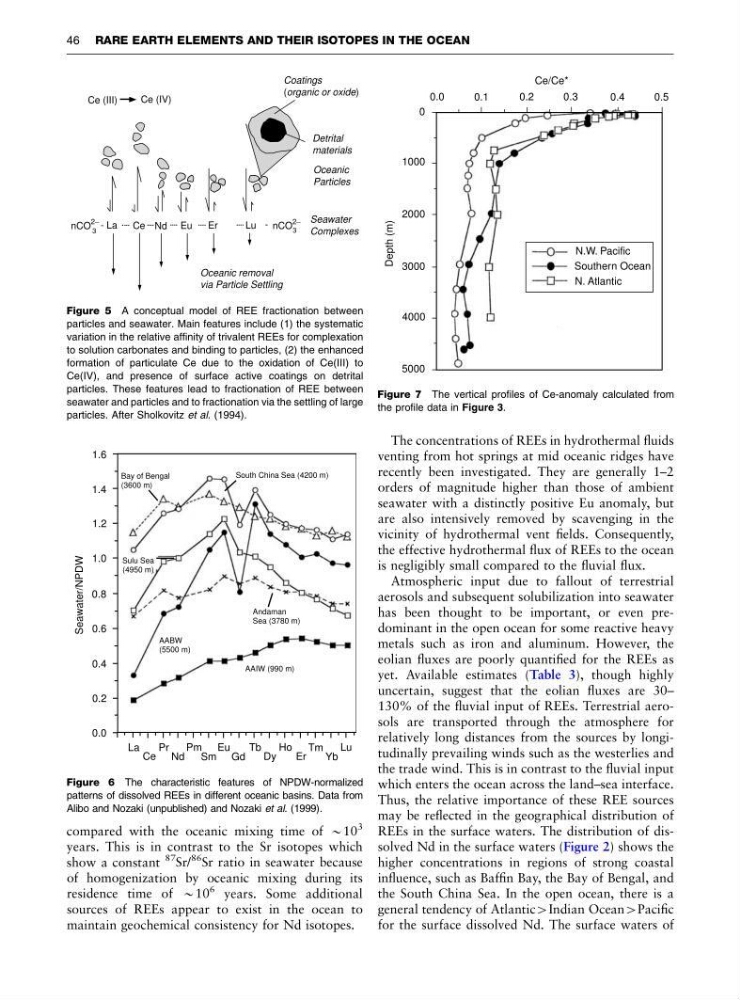
Figure 7 The vertical profiles of Ce-anomaly calculated from
the profile data in Figure 3.
46 RARE EARTH ELEMENTS AND THEIR ISOTOPES IN THE OCEAN
3
years. This is in contrast to the Sr isotopes which
show a constant
87
Sr/
86
Sr ratio in seawater because
of homogenization by oceanic mixing during its
residence time of B10
6 years. Some additional
sources of REEs appear to exist in the ocean to
maintain geochemical consistency for Nd isotopes.
The concentrations of REEs in hydrothermal fluids
venting from hot springs at mid oceanic ridges have
recently been investigated. They are generally 1–2
orders of magnitude higher than those of ambient
seawater with a distinctly positive Eu anomaly, but
are also intensively removed by scavenging in the
vicinity of hydrothermal vent fields. Consequently,
the effective hydrothermal flux of REEs to the ocean
is negligibly small compared to the fluvial flux.
Atmospheric input due to fallout of terrestrial
aerosols and subsequent solubilization into seawater
has been thought to be important, or even predominant in the open ocean for some reactive heavy
metals such as iron and aluminum. However, the
eolian fluxes are poorly quantified for the REEs as
yet. Available estimates (Table 3), though highly
uncertain, suggest that the eolian fluxes are 30–
130% of the fluvial input of REEs. Terrestrial aerosols are transported through the atmosphere for
relatively long distances from the sources by longitudinally prevailing winds such as the westerlies and
the trade wind. This is in contrast to the fluvial input
which enters the ocean across the land–sea interface.
Thus, the relative importance of these REE sources
may be reflected in the geographical distribution of
REEs in the surface waters. The distribution of dissolved Nd in the surface waters (Figure 2) shows the
higher concentrations in regions of strong coastal
influence, such as Baffin Bay, the Bay of Bengal, and
the South China Sea. In the open ocean, there is a
general tendency of Atlantic4Indian Ocean4Pacific
for the surface dissolved Nd. The surface waters of
- La
Ce Nd Eu
Er
Lu
nCO
2 _
nCO
2 _
Seawater
Complexes
Detrital
materials
Oceanic
Particles
Oceanic removal
via Particle Settling
Coatings
(organic or oxide)
Ce (III)
Ce (IV)
....
....
....
....
....
-
3
3
Figure 5 A conceptual model of REE fractionation between
particles and seawater. Main features include (1) the systematic
variation in the relative affinity of trivalent REEs for complexation
to solution carbonates and binding to particles, (2) the enhanced
formation of particulate Ce due to the oxidation of Ce(III) to
Ce(IV), and presence of surface active coatings on detrital
particles. These features lead to fractionation of REE between
seawater and particles and to fractionation via the settling of large
particles. After Sholkovitz et al. (1994).
La
Pr
Ce Nd
Pm
Sm
Eu
Gd
Tb
Dy
Ho
Er
Tm
Yb
Lu
0.0
0.2
0.4
0.6
0.8
1.0
1.2
1.4
1.6
Seawater/NPDW
Bay of Bengal
(3600 m)
South China Sea (4200 m)
Sulu Sea
(4950 m)
AABW
(5500 m)
AAIW (990 m)
Andaman
Sea (3780 m)
Figure 6 The characteristic features of NPDW-normalized
patterns of dissolved REEs in different oceanic basins. Data from
Alibo and Nozaki (unpublished) and Nozaki et al. (1999).
Depth (m)
N.W. Pacific
Southern Ocean
N. Atlantic
5000
4000
3000
2000
1000
0
0.0
0.1
0.2
0.3
0.4
0.5
Ce/Ce*
Figure 7 The vertical profiles of Ce-anomaly calculated from
the profile data in Figure 3.
46 RARE EARTH ELEMENTS AND THEIR ISOTOPES IN THE OCEAN