

more silicate than surface waters in tropical and
temperate regions. The magnitude of the deep-ocean
silicate concentration depends on the location within
the deep thermohaline circulation system. In general,
deep water originates in North Atlantic and Antarctic surface waters. The deep water forming in the
North Atlantic moves southward, where it joins with
Antarctic water, on its way to feeding the deep Indian
Ocean basin and then flowing from south to north in
the Pacific basin. All along this ‘conveyor belt’ of
deep-ocean water, siliceous biota are continually
settling out from surface waters and dissolving at
depth, which further increases the silicate concentration of the deep water downstream. Consequently,
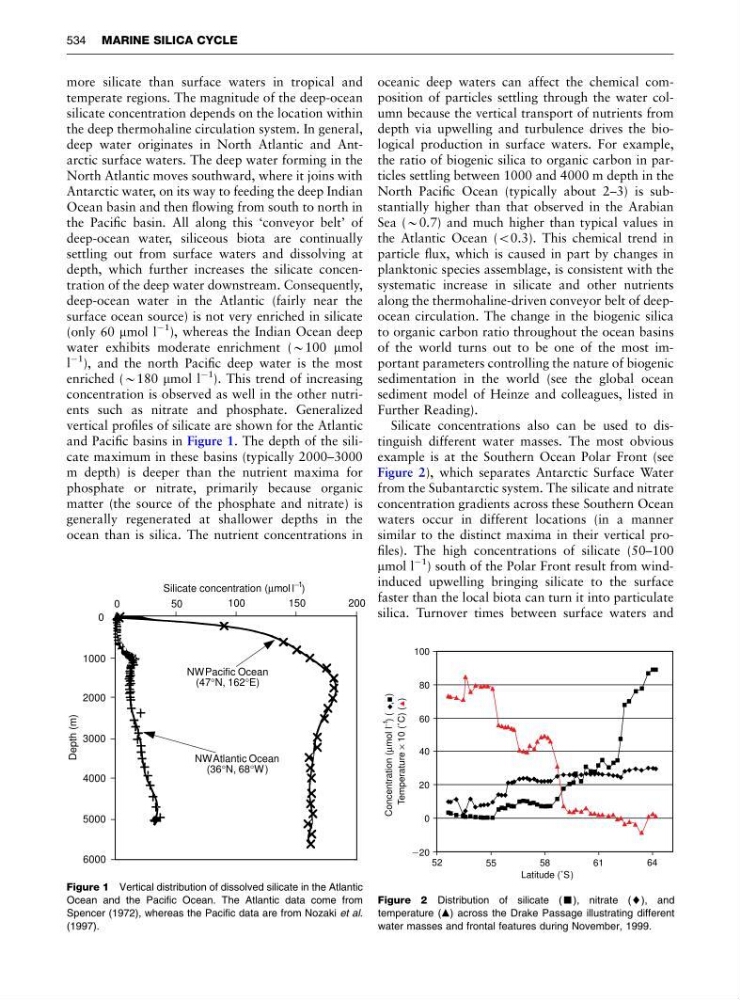
deep-ocean water in the Atlantic (fairly near the
surface ocean source) is not very enriched in silicate
(only 60 mmol l
À1
), whereas the Indian Ocean deep
water exhibits moderate enrichment (B100 mmol
l
À1 ), and the north Pacific deep water is the most
enriched (B180 mmol l
À1
). This trend of increasing
concentration is observed as well in the other nutrients such as nitrate and phosphate. Generalized
vertical profiles of silicate are shown for the Atlantic
and Pacific basins in Figure 1. The depth of the silicate maximum in these basins (typically 2000–3000
m depth) is deeper than the nutrient maxima for
phosphate or nitrate, primarily because organic
matter (the source of the phosphate and nitrate) is
generally regenerated at shallower depths in the
ocean than is silica. The nutrient concentrations in
oceanic deep waters can affect the chemical composition of particles settling through the water column because the vertical transport of nutrients from
depth via upwelling and turbulence drives the biological production in surface waters. For example,
the ratio of biogenic silica to organic carbon in particles settling between 1000 and 4000 m depth in the
North Pacific Ocean (typically about 2–3) is substantially higher than that observed in the Arabian
Sea (B0.7) and much higher than typical values in
the Atlantic Ocean (o0.3). This chemical trend in
particle flux, which is caused in part by changes in
planktonic species assemblage, is consistent with the
systematic increase in silicate and other nutrients
along the thermohaline-driven conveyor belt of deepocean circulation. The change in the biogenic silica
to organic carbon ratio throughout the ocean basins
of the world turns out to be one of the most important parameters controlling the nature of biogenic
sedimentation in the world (see the global ocean
sediment model of Heinze and colleagues, listed in
Further Reading).
Silicate concentrations also can be used to distinguish different water masses. The most obvious
example is at the Southern Ocean Polar Front (see
Figure 2), which separates Antarctic Surface Water
from the Subantarctic system. The silicate and nitrate
concentration gradients across these Southern Ocean
waters occur in different locations (in a manner
similar to the distinct maxima in their vertical profiles). The high concentrations of silicate (50–100
mmol l
À1
) south of the Polar Front result from windinduced upwelling bringing silicate to the surface
faster than the local biota can turn it into particulate
silica. Turnover times between surface waters and
Silicate concentration ( mol l
μ
_ 1
0
1000
2000
3000
4000
5000
6000
100
150
200
NWAtlantic Ocean
(36°N, 68°W )
NWPacific Ocean
(47°N, 162°E)
Depth (m)
50
0
)
Figure 1 Vertical distribution of dissolved silicate in the Atlantic
Ocean and the Pacific Ocean. The Atlantic data come from
Spencer (1972), whereas the Pacific data are from Nozaki et al.
(1997).
Concentration ( mol l ) (
)
μ
_
1
100
80
60
40
20
0
Latitude (˚S)
_ 20
52
55
58
61
64
Temperature 10 (˚C) ( )
×
,
Figure 2 Distribution of silicate (’), nitrate (~), and
temperature (m) across the Drake Passage illustrating different
water masses and frontal features during November, 1999.
534 MARINE SILICA CYCLE
temperate regions. The magnitude of the deep-ocean
silicate concentration depends on the location within
the deep thermohaline circulation system. In general,
deep water originates in North Atlantic and Antarctic surface waters. The deep water forming in the
North Atlantic moves southward, where it joins with
Antarctic water, on its way to feeding the deep Indian
Ocean basin and then flowing from south to north in
the Pacific basin. All along this ‘conveyor belt’ of
deep-ocean water, siliceous biota are continually
settling out from surface waters and dissolving at
depth, which further increases the silicate concentration of the deep water downstream. Consequently,
deep-ocean water in the Atlantic (fairly near the
surface ocean source) is not very enriched in silicate
(only 60 mmol l
À1
), whereas the Indian Ocean deep
water exhibits moderate enrichment (B100 mmol
l
À1 ), and the north Pacific deep water is the most
enriched (B180 mmol l
À1
). This trend of increasing
concentration is observed as well in the other nutrients such as nitrate and phosphate. Generalized
vertical profiles of silicate are shown for the Atlantic
and Pacific basins in Figure 1. The depth of the silicate maximum in these basins (typically 2000–3000
m depth) is deeper than the nutrient maxima for
phosphate or nitrate, primarily because organic
matter (the source of the phosphate and nitrate) is
generally regenerated at shallower depths in the
ocean than is silica. The nutrient concentrations in
oceanic deep waters can affect the chemical composition of particles settling through the water column because the vertical transport of nutrients from
depth via upwelling and turbulence drives the biological production in surface waters. For example,
the ratio of biogenic silica to organic carbon in particles settling between 1000 and 4000 m depth in the
North Pacific Ocean (typically about 2–3) is substantially higher than that observed in the Arabian
Sea (B0.7) and much higher than typical values in
the Atlantic Ocean (o0.3). This chemical trend in
particle flux, which is caused in part by changes in
planktonic species assemblage, is consistent with the
systematic increase in silicate and other nutrients
along the thermohaline-driven conveyor belt of deepocean circulation. The change in the biogenic silica
to organic carbon ratio throughout the ocean basins
of the world turns out to be one of the most important parameters controlling the nature of biogenic
sedimentation in the world (see the global ocean
sediment model of Heinze and colleagues, listed in
Further Reading).
Silicate concentrations also can be used to distinguish different water masses. The most obvious
example is at the Southern Ocean Polar Front (see
Figure 2), which separates Antarctic Surface Water
from the Subantarctic system. The silicate and nitrate
concentration gradients across these Southern Ocean
waters occur in different locations (in a manner
similar to the distinct maxima in their vertical profiles). The high concentrations of silicate (50–100
mmol l
À1
) south of the Polar Front result from windinduced upwelling bringing silicate to the surface
faster than the local biota can turn it into particulate
silica. Turnover times between surface waters and
Silicate concentration ( mol l
μ
_ 1
0
1000
2000
3000
4000
5000
6000
100
150
200
NWAtlantic Ocean
(36°N, 68°W )
NWPacific Ocean
(47°N, 162°E)
Depth (m)
50
0
)
Figure 1 Vertical distribution of dissolved silicate in the Atlantic
Ocean and the Pacific Ocean. The Atlantic data come from
Spencer (1972), whereas the Pacific data are from Nozaki et al.
(1997).
Concentration ( mol l ) (
)
μ
_
1
100
80
60
40
20
0
Latitude (˚S)
_ 20
52
55
58
61
64
Temperature 10 (˚C) ( )
×
,
Figure 2 Distribution of silicate (’), nitrate (~), and
temperature (m) across the Drake Passage illustrating different
water masses and frontal features during November, 1999.
534 MARINE SILICA CYCLE