

not only allows equilibration of the carbon and alkalinity budgets on the geological timescale, but also
stabilizes the Earth’s climate. When the degassing
increases suddenly, for instance as a result of a
higher spreading rate of the oceanic floor, the
amount of carbon in the ocean and atmosphere will
first increase, increasing the atmospheric PCO 2 . Because CO 2 is a greenhouse gas, the climate will become warmer, and this will enhance the weathering
of silicate rocks. As a result, any increase in the input
of carbon will be counterbalanced by an increase of
the output through silicate weathering, thus stabilizing the system through a negative feedback loop.
The PCO 2 will stabilize at a somewhat higher level
than before the perturbation. Similarly, the decline
in PCO 2 through the Cenozoic could be due to a
decreasing degassing rate, which acts as the driving
force of changes. This simple process is the basis of
all existing long-term geochemical cycle models. It
was first identified in 1981 by Walker, Hays, and
Kasting. Breaking this feedback loop would result in
fluctuations in calculated PCO 2 and thus presumably
in climate, that are not reflected in the geological
record.
Himalayan Uplift,
87 Sr/
86 Sr Record, and Possible
Implications for Weathering History
M.E. Raymo in 1991 put forward another explanation of the global Cenozoic PCO 2 decline. Instead of
a decreased degassing rate, she suggested that continental silicate weathering rates increased drastically
over the last 40 million years, although degassing
conditions remained more or less constant. This assertion was originally based on the Cenozoic carbonate record of
87
Sr/
86
Sr. The isotope
86 Sr is stable,
whereas
87 Sr is produced by the radioactive b-decay
of
87 Rb. Strontium ions easily replace calcium ions in
mineral lattices, since their ionic diameters are
comparable. The present-day sea water
87 Sr/
86 Sr
equals 0.709. Two main processes impinge on this
ratio: the chemical weathering of continents, delivering strontium with a mean
87
Sr/
86
Sr of 0.712,
and the exchanges between seafloor basalts and sea
water, resulting in the release of mantle strontium
into the ocean (
87 Sr/
86 Sr ¼ 0.703). In other words,
chemical weathering of continental rocks tends to
increase the strontium isotopic ratio of sea water,
while exchanges with seafloor basalts at low or high
temperature tend to decrease it.
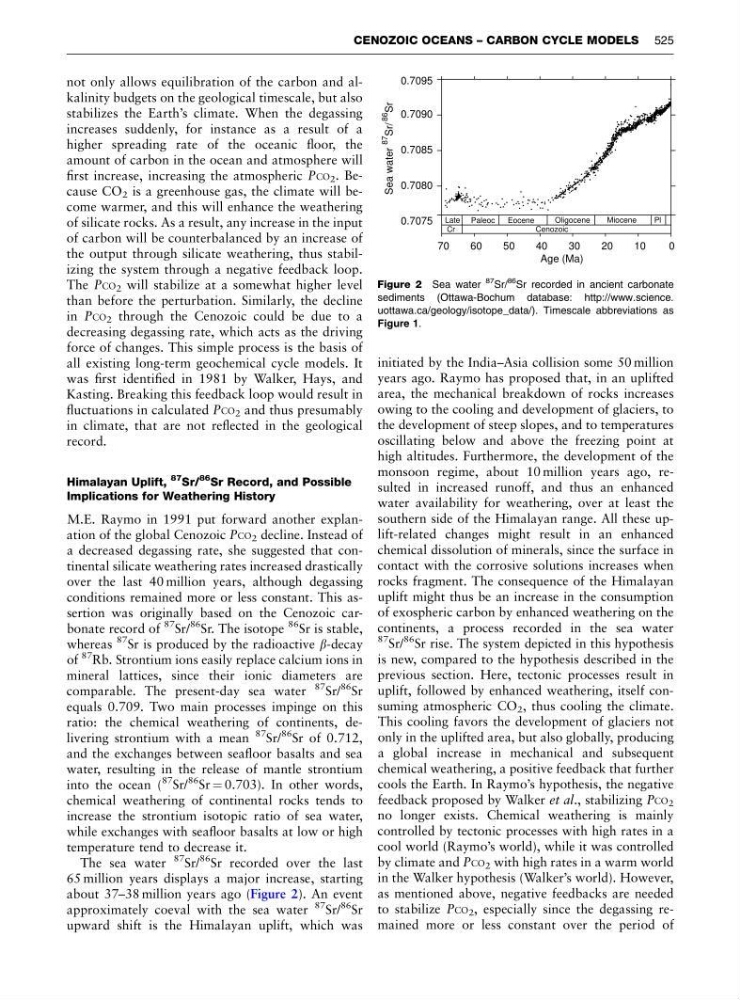
The sea water
87 Sr/
86 Sr recorded over the last
65 million years displays a major increase, starting
about 37–38 million years ago (Figure 2). An event
approximately coeval with the sea water
87 Sr/
86 Sr
upward shift is the Himalayan uplift, which was
initiated by the India–Asia collision some 50 million
years ago. Raymo has proposed that, in an uplifted
area, the mechanical breakdown of rocks increases
owing to the cooling and development of glaciers, to
the development of steep slopes, and to temperatures
oscillating below and above the freezing point at
high altitudes. Furthermore, the development of the
monsoon regime, about 10 million years ago, resulted in increased runoff, and thus an enhanced
water availability for weathering, over at least the
southern side of the Himalayan range. All these uplift-related changes might result in an enhanced
chemical dissolution of minerals, since the surface in
contact with the corrosive solutions increases when
rocks fragment. The consequence of the Himalayan
uplift might thus be an increase in the consumption
of exospheric carbon by enhanced weathering on the
continents, a process recorded in the sea water
87 Sr/
86 Sr rise. The system depicted in this hypothesis
is new, compared to the hypothesis described in the
previous section. Here, tectonic processes result in
uplift, followed by enhanced weathering, itself consuming atmospheric CO 2 , thus cooling the climate.
This cooling favors the development of glaciers not
only in the uplifted area, but also globally, producing
a global increase in mechanical and subsequent
chemical weathering, a positive feedback that further
cools the Earth. In Raymo’s hypothesis, the negative
feedback proposed by Walker et al., stabilizing PCO 2
no longer exists. Chemical weathering is mainly
controlled by tectonic processes with high rates in a
cool world (Raymo’s world), while it was controlled
by climate and PCO 2 with high rates in a warm world
in the Walker hypothesis (Walker’s world). However,
as mentioned above, negative feedbacks are needed
to stabilize PCO 2 , especially since the degassing remained more or less constant over the period of
70
60
50
40
30
20
10
0
Age (Ma)
0.7075
0.7080
0.7085
0.7090
0.7095
Sea water
87
Sr/
86
Sr
Pl
Miocene
Oligocene
Eocene
Paleoc
Late
Cr
Cenozoic
Figure 2 Sea water
87 Sr/
86
Sr recorded in ancient carbonate
sediments (Ottawa-Bochum database: http://www.science.
uottawa.ca/geology/isotope_data/). Timescale abbreviations as
Figure 1.
CENOZOIC OCEANS – CARBON CYCLE MODELS 525
stabilizes the Earth’s climate. When the degassing
increases suddenly, for instance as a result of a
higher spreading rate of the oceanic floor, the
amount of carbon in the ocean and atmosphere will
first increase, increasing the atmospheric PCO 2 . Because CO 2 is a greenhouse gas, the climate will become warmer, and this will enhance the weathering
of silicate rocks. As a result, any increase in the input
of carbon will be counterbalanced by an increase of
the output through silicate weathering, thus stabilizing the system through a negative feedback loop.
The PCO 2 will stabilize at a somewhat higher level
than before the perturbation. Similarly, the decline
in PCO 2 through the Cenozoic could be due to a
decreasing degassing rate, which acts as the driving
force of changes. This simple process is the basis of
all existing long-term geochemical cycle models. It
was first identified in 1981 by Walker, Hays, and
Kasting. Breaking this feedback loop would result in
fluctuations in calculated PCO 2 and thus presumably
in climate, that are not reflected in the geological
record.
Himalayan Uplift,
87 Sr/
86 Sr Record, and Possible
Implications for Weathering History
M.E. Raymo in 1991 put forward another explanation of the global Cenozoic PCO 2 decline. Instead of
a decreased degassing rate, she suggested that continental silicate weathering rates increased drastically
over the last 40 million years, although degassing
conditions remained more or less constant. This assertion was originally based on the Cenozoic carbonate record of
87
Sr/
86
Sr. The isotope
86 Sr is stable,
whereas
87 Sr is produced by the radioactive b-decay
of
87 Rb. Strontium ions easily replace calcium ions in
mineral lattices, since their ionic diameters are
comparable. The present-day sea water
87 Sr/
86 Sr
equals 0.709. Two main processes impinge on this
ratio: the chemical weathering of continents, delivering strontium with a mean
87
Sr/
86
Sr of 0.712,
and the exchanges between seafloor basalts and sea
water, resulting in the release of mantle strontium
into the ocean (
87 Sr/
86 Sr ¼ 0.703). In other words,
chemical weathering of continental rocks tends to
increase the strontium isotopic ratio of sea water,
while exchanges with seafloor basalts at low or high
temperature tend to decrease it.
The sea water
87 Sr/
86 Sr recorded over the last
65 million years displays a major increase, starting
about 37–38 million years ago (Figure 2). An event
approximately coeval with the sea water
87 Sr/
86 Sr
upward shift is the Himalayan uplift, which was
initiated by the India–Asia collision some 50 million
years ago. Raymo has proposed that, in an uplifted
area, the mechanical breakdown of rocks increases
owing to the cooling and development of glaciers, to
the development of steep slopes, and to temperatures
oscillating below and above the freezing point at
high altitudes. Furthermore, the development of the
monsoon regime, about 10 million years ago, resulted in increased runoff, and thus an enhanced
water availability for weathering, over at least the
southern side of the Himalayan range. All these uplift-related changes might result in an enhanced
chemical dissolution of minerals, since the surface in
contact with the corrosive solutions increases when
rocks fragment. The consequence of the Himalayan
uplift might thus be an increase in the consumption
of exospheric carbon by enhanced weathering on the
continents, a process recorded in the sea water
87 Sr/
86 Sr rise. The system depicted in this hypothesis
is new, compared to the hypothesis described in the
previous section. Here, tectonic processes result in
uplift, followed by enhanced weathering, itself consuming atmospheric CO 2 , thus cooling the climate.
This cooling favors the development of glaciers not
only in the uplifted area, but also globally, producing
a global increase in mechanical and subsequent
chemical weathering, a positive feedback that further
cools the Earth. In Raymo’s hypothesis, the negative
feedback proposed by Walker et al., stabilizing PCO 2
no longer exists. Chemical weathering is mainly
controlled by tectonic processes with high rates in a
cool world (Raymo’s world), while it was controlled
by climate and PCO 2 with high rates in a warm world
in the Walker hypothesis (Walker’s world). However,
as mentioned above, negative feedbacks are needed
to stabilize PCO 2 , especially since the degassing remained more or less constant over the period of
70
60
50
40
30
20
10
0
Age (Ma)
0.7075
0.7080
0.7085
0.7090
0.7095
Sea water
87
Sr/
86
Sr
Pl
Miocene
Oligocene
Eocene
Paleoc
Late
Cr
Cenozoic
Figure 2 Sea water
87 Sr/
86
Sr recorded in ancient carbonate
sediments (Ottawa-Bochum database: http://www.science.
uottawa.ca/geology/isotope_data/). Timescale abbreviations as
Figure 1.
CENOZOIC OCEANS – CARBON CYCLE MODELS 525