

efficient biological pump? Not necessarily, since net
primary production is limited by the availability of
other inorganic nutrients such as nitrogen,
phosphorus, silicon and iron. Because these
inorganic nutrients are continuously being removed
from the surface waters with vertical export of
organic particles, their concentrations are often
below detection limits in highly stratified water
columns. As a result, primary production becomes
limited by the rate at which these nutrients can be
re-supplied to the surface ocean by mixing, by
atmospheric deposition, or by heterotrophic
recycling. Primary production supported by the
recycling of nutrients in the surface ocean is referred
to as ‘regenerative’ production and contributes little
to the biological pump. Primary production
supported by the introduction of new nutrients
from outside the system, via mixing from below or
by atmospheric deposition (e.g. dust), is referred to
as ‘new’ production. New nutrients enhance the
amount of net production that can be exported
(new production). Because CO 2 is not considered to
be a limiting nutrient in marine systems, the
increase in atmospheric CO 2 is not likely to
stimulate net production for most of the world’s
ocean unless it indirectly affects the introduction of
new nutrients as well.
Community structure Food web structure also
plays an important role in determining the size
distribution of the organic particles produced and
whether the organic carbon and associated nutrients
are exported from or recycled within the surface
waters. The production of large, rapidly settling
cells will make a greater contribution to the
biological pump than the production of small,
suspended particles. Factors such as the number of
trophic links and the size of the primary producers
help determine the overall contribution of sinking
particles. The number of trophic steps is inversely
related to the magnitude of the export flux. For
example, in systems where picoplankton are the
dominant primary producers there may be 4–5 steps
before reaching a trophic level capable of producing
CO 2
CO 2
HCO 3
–
CaCO 3
CaCO 3
Simplified Carbonate Pump
Calcification
Aggregation
Base of euphotic zone
Upwelling
Passive
sinking of
CaCO 3
CO 2
HCO 3
–
1–4 km
Dissolution
of CaCO3
Seabed
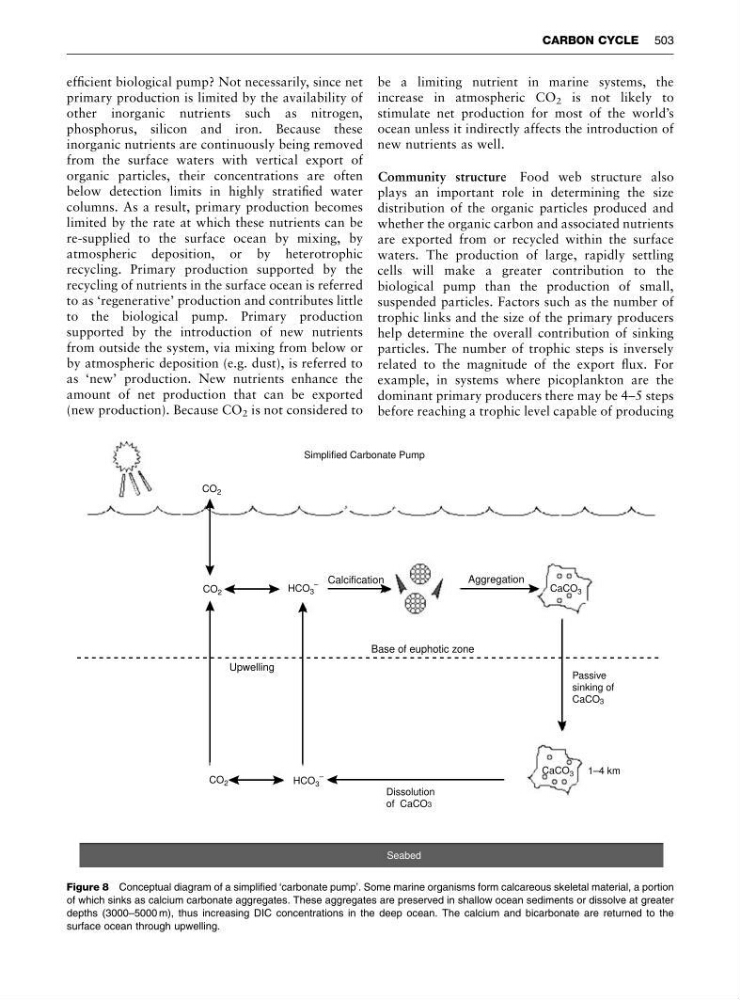
Figure 8 Conceptual diagram of a simplified ‘carbonate pump’. Some marine organisms form calcareous skeletal material, a portion
of which sinks as calcium carbonate aggregates. These aggregates are preserved in shallow ocean sediments or dissolve at greater
depths (3000–5000 m), thus increasing DIC concentrations in the deep ocean. The calcium and bicarbonate are returned to the
surface ocean through upwelling.
CARBON CYCLE 503
primary production is limited by the availability of
other inorganic nutrients such as nitrogen,
phosphorus, silicon and iron. Because these
inorganic nutrients are continuously being removed
from the surface waters with vertical export of
organic particles, their concentrations are often
below detection limits in highly stratified water
columns. As a result, primary production becomes
limited by the rate at which these nutrients can be
re-supplied to the surface ocean by mixing, by
atmospheric deposition, or by heterotrophic
recycling. Primary production supported by the
recycling of nutrients in the surface ocean is referred
to as ‘regenerative’ production and contributes little
to the biological pump. Primary production
supported by the introduction of new nutrients
from outside the system, via mixing from below or
by atmospheric deposition (e.g. dust), is referred to
as ‘new’ production. New nutrients enhance the
amount of net production that can be exported
(new production). Because CO 2 is not considered to
be a limiting nutrient in marine systems, the
increase in atmospheric CO 2 is not likely to
stimulate net production for most of the world’s
ocean unless it indirectly affects the introduction of
new nutrients as well.
Community structure Food web structure also
plays an important role in determining the size
distribution of the organic particles produced and
whether the organic carbon and associated nutrients
are exported from or recycled within the surface
waters. The production of large, rapidly settling
cells will make a greater contribution to the
biological pump than the production of small,
suspended particles. Factors such as the number of
trophic links and the size of the primary producers
help determine the overall contribution of sinking
particles. The number of trophic steps is inversely
related to the magnitude of the export flux. For
example, in systems where picoplankton are the
dominant primary producers there may be 4–5 steps
before reaching a trophic level capable of producing
CO 2
CO 2
HCO 3
–
CaCO 3
CaCO 3
Simplified Carbonate Pump
Calcification
Aggregation
Base of euphotic zone
Upwelling
Passive
sinking of
CaCO 3
CO 2
HCO 3
–
1–4 km
Dissolution
of CaCO3
Seabed
Figure 8 Conceptual diagram of a simplified ‘carbonate pump’. Some marine organisms form calcareous skeletal material, a portion
of which sinks as calcium carbonate aggregates. These aggregates are preserved in shallow ocean sediments or dissolve at greater
depths (3000–5000 m), thus increasing DIC concentrations in the deep ocean. The calcium and bicarbonate are returned to the
surface ocean through upwelling.
CARBON CYCLE 503