

‘anthropogenic’ carbon is added to the atmosphere
every year. About half of the anthropogenic CO 2 is
retained in the atmosphere, while the remaining
carbon is transferred to and stored in the ocean and
the terrestrial biosphere. Carbon reservoirs that remove and sequester CO 2 from the atmosphere are
referred to as carbon ‘sinks’. The partitioning of
anthropogenic carbon between oceanic and terrestrial sinks is not well known. Quantifying controls
on the partitioning is necessary for understanding the
dynamics of the global carbon cycle. The terrestrial
biosphere may be a significant sink for anthropogenic carbon, but scientific understanding of the
causative processes is hindered by the complexity of
terrestrial ecosystems.
Global ocean research programs such as Geochemical Ocean Sections (GEOSEC), the Joint Global Ocean Flux Study (JGOFS), and the JGOFS/
World Ocean Circulation Experiment (WOCE)
Ocean CO 2 Survey have resulted in improvements in
our understanding of physical circulation and biological processes of the ocean. These studies have
also allowed oceanographers to better constrain the
role of the ocean in CO 2 sequestration compared to
terrestrial systems. Based on numerical models of
ocean circulation and ecosystem processes, oceanographers estimate that 70% (2 Â 10
15 g C) of the
anthropogenic CO 2 is absorbed by the ocean each
year. The fate of the remaining 30% (0.75 Â 10
15 g)
of anthropogenic CO 2 is unknown. Determining the
magnitude of the oceanic sink of anthropogenic CO 2
is dependent on understanding the interplay of
various chemical, physical, and biological factors.
Oceanic Carbon Cycle
The ocean is the largest reservoir of the Earth’s active
carbon, containing 39 973 Â 10
15 g C. Oceanic carbon occurs as a variety of inorganic and organic
Atmosphere 750
R e s p ir a ti o n 5 0
P r im a r y P r o d u c ti o n 5 1
1 . 6
0 . 5
C h a n g i n g
l a n d
u s e
Vegetation 610
90
92
F o s s i l f u e l
b u r n i n g 5 . 5
Soil and detritus 1580
Surface sediments 150
Biota 3
5 0
4 0
DOC < 700
Surface ocean 1020
100
91.6
Deep ocean 38 100
2
8
0.2
Recoverable fossil
fuel 10 000
2
C in Earth′s crust
90 000 000
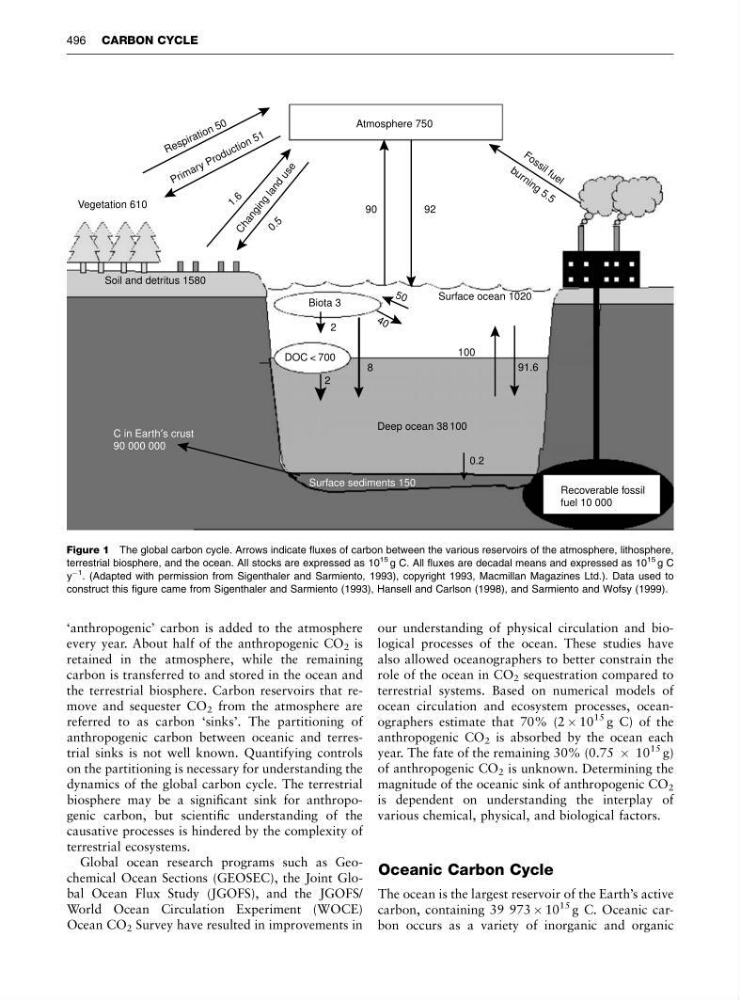
Figure 1 The global carbon cycle. Arrows indicate fluxes of carbon between the various reservoirs of the atmosphere, lithosphere,
terrestrial biosphere, and the ocean. All stocks are expressed as 10
15 g C. All fluxes are decadal means and expressed as 10
15 g C
y
À1
. (Adapted with permission from Sigenthaler and Sarmiento, 1993), copyright 1993, Macmillan Magazines Ltd.). Data used to
construct this figure came from Sigenthaler and Sarmiento (1993), Hansell and Carlson (1998), and Sarmiento and Wofsy (1999).
496 CARBON CYCLE
every year. About half of the anthropogenic CO 2 is
retained in the atmosphere, while the remaining
carbon is transferred to and stored in the ocean and
the terrestrial biosphere. Carbon reservoirs that remove and sequester CO 2 from the atmosphere are
referred to as carbon ‘sinks’. The partitioning of
anthropogenic carbon between oceanic and terrestrial sinks is not well known. Quantifying controls
on the partitioning is necessary for understanding the
dynamics of the global carbon cycle. The terrestrial
biosphere may be a significant sink for anthropogenic carbon, but scientific understanding of the
causative processes is hindered by the complexity of
terrestrial ecosystems.
Global ocean research programs such as Geochemical Ocean Sections (GEOSEC), the Joint Global Ocean Flux Study (JGOFS), and the JGOFS/
World Ocean Circulation Experiment (WOCE)
Ocean CO 2 Survey have resulted in improvements in
our understanding of physical circulation and biological processes of the ocean. These studies have
also allowed oceanographers to better constrain the
role of the ocean in CO 2 sequestration compared to
terrestrial systems. Based on numerical models of
ocean circulation and ecosystem processes, oceanographers estimate that 70% (2 Â 10
15 g C) of the
anthropogenic CO 2 is absorbed by the ocean each
year. The fate of the remaining 30% (0.75 Â 10
15 g)
of anthropogenic CO 2 is unknown. Determining the
magnitude of the oceanic sink of anthropogenic CO 2
is dependent on understanding the interplay of
various chemical, physical, and biological factors.
Oceanic Carbon Cycle
The ocean is the largest reservoir of the Earth’s active
carbon, containing 39 973 Â 10
15 g C. Oceanic carbon occurs as a variety of inorganic and organic
Atmosphere 750
R e s p ir a ti o n 5 0
P r im a r y P r o d u c ti o n 5 1
1 . 6
0 . 5
C h a n g i n g
l a n d
u s e
Vegetation 610
90
92
F o s s i l f u e l
b u r n i n g 5 . 5
Soil and detritus 1580
Surface sediments 150
Biota 3
5 0
4 0
DOC < 700
Surface ocean 1020
100
91.6
Deep ocean 38 100
2
8
0.2
Recoverable fossil
fuel 10 000
2
C in Earth′s crust
90 000 000
Figure 1 The global carbon cycle. Arrows indicate fluxes of carbon between the various reservoirs of the atmosphere, lithosphere,
terrestrial biosphere, and the ocean. All stocks are expressed as 10
15 g C. All fluxes are decadal means and expressed as 10
15 g C
y
À1
. (Adapted with permission from Sigenthaler and Sarmiento, 1993), copyright 1993, Macmillan Magazines Ltd.). Data used to
construct this figure came from Sigenthaler and Sarmiento (1993), Hansell and Carlson (1998), and Sarmiento and Wofsy (1999).
496 CARBON CYCLE