

ocean. This has led to a net transport of sulfur from
the land to the ocean via the atmosphere, completely
reversing the flow direction in preindustrial times. In
addition, the sulfate aerosol content of the atmosphere derived from human activities has increased.
Sulfate aerosols affect global climate directly as
particles that scatter incoming solar radiation and
indirectly as cloud condensation nuclei (CCNs),
which lead to an increased number of cloud droplets
and an increase in the solar reflectance of clouds.
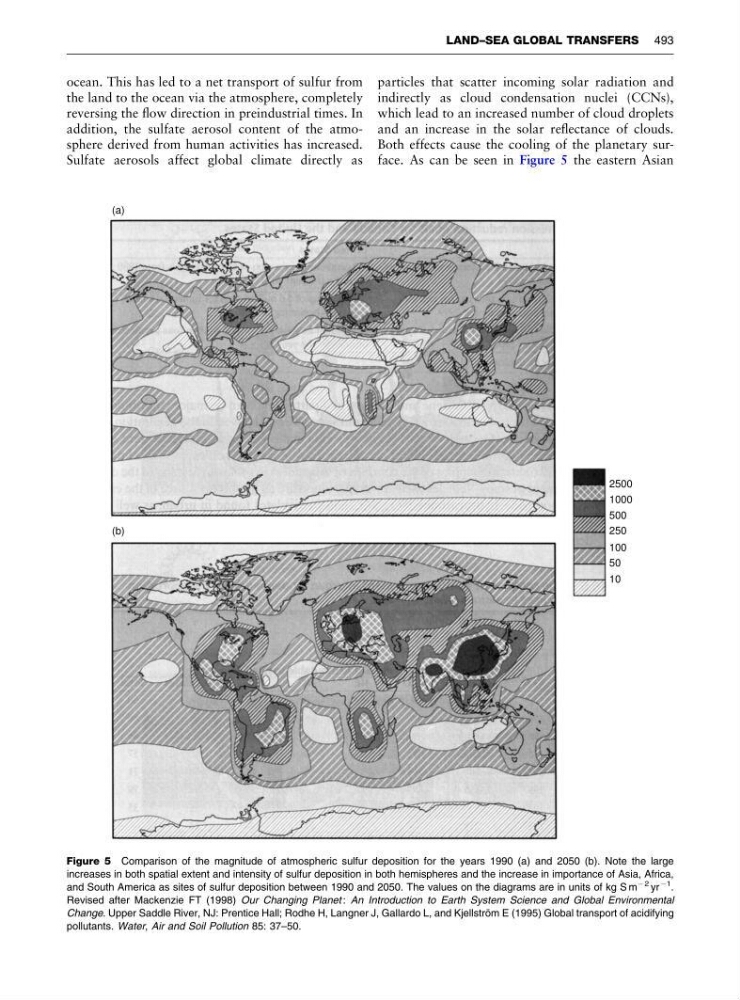
Both effects cause the cooling of the planetary surface. As can be seen in Figure 5 the eastern Asian
2500
1000
500
250
100
50
10
(b)
(a)
Figure 5 Comparison of the magnitude of atmospheric sulfur deposition for the years 1990 (a) and 2050 (b). Note the large
increases in both spatial extent and intensity of sulfur deposition in both hemispheres and the increase in importance of Asia, Africa,
and South America as sites of sulfur deposition between 1990 and 2050. The values on the diagrams are in units of kg S m
À 2 yr
À1 .
Revised after Mackenzie FT (1998) Our Changing Planet : An Introduction to Earth System Science and Global Environmental
Change. Upper Saddle River, NJ: Prentice Hall; Rodhe H, Langner J, Gallardo L, and Kjellstro ¨ m E (1995) Global transport of acidifying
pollutants. Water, Air and Soil Pollution 85: 37–50.
LAND–SEA GLOBAL TRANSFERS 493
the land to the ocean via the atmosphere, completely
reversing the flow direction in preindustrial times. In
addition, the sulfate aerosol content of the atmosphere derived from human activities has increased.
Sulfate aerosols affect global climate directly as
particles that scatter incoming solar radiation and
indirectly as cloud condensation nuclei (CCNs),
which lead to an increased number of cloud droplets
and an increase in the solar reflectance of clouds.
Both effects cause the cooling of the planetary surface. As can be seen in Figure 5 the eastern Asian
2500
1000
500
250
100
50
10
(b)
(a)
Figure 5 Comparison of the magnitude of atmospheric sulfur deposition for the years 1990 (a) and 2050 (b). Note the large
increases in both spatial extent and intensity of sulfur deposition in both hemispheres and the increase in importance of Asia, Africa,
and South America as sites of sulfur deposition between 1990 and 2050. The values on the diagrams are in units of kg S m
À 2 yr
À1 .
Revised after Mackenzie FT (1998) Our Changing Planet : An Introduction to Earth System Science and Global Environmental
Change. Upper Saddle River, NJ: Prentice Hall; Rodhe H, Langner J, Gallardo L, and Kjellstro ¨ m E (1995) Global transport of acidifying
pollutants. Water, Air and Soil Pollution 85: 37–50.
LAND–SEA GLOBAL TRANSFERS 493