

increases. The net result is the maintenance of the
role of the global oceans as a net sink for anthropogenic CO 2 .
The saturation index (O) for calcite or aragonite
(both CaCO 3 ) is the ratio of the ion activity product
IAP in coastal waters to the respective equilibrium
constant K at the in situ temperature. For aqueous
species, IAP ¼ aCa
2þ Â aCO
2À
3
(where a is the activity; note that for 15 mol.% magnesian calcite, the
IAP also includes the activity of the magnesium cation, aMg
2þ ). Most coastal waters and open-ocean
surface waters currently are supersaturated with respect to aragonite, calcite, and magnesian calcite
containing 15 mol.% Mg, that is, O calcite , O aragonite ,
and O 15%magnesian calcite are 41. Because of global
warming and the increasing land-to-atmosphere-toseawater transport of CO 2 (due to the continuing
combustion of fossil fuels and burning of biomass),
the concentration of the aqueous CO 2 species in
seawater increases and the pH of the water decreases
slightly. This results in a decrease in the concentration of the carbonate ion, CO
22
3 , resulting in a
decrease in the degree of supersaturation of coastal
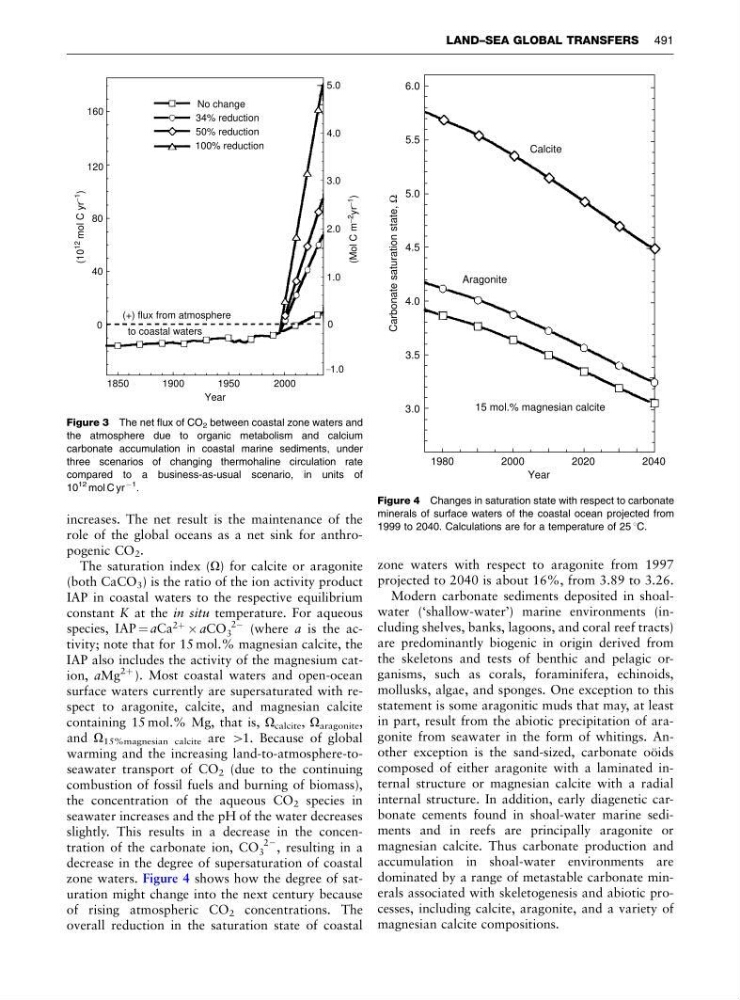
zone waters. Figure 4 shows how the degree of saturation might change into the next century because
of rising atmospheric CO 2 concentrations. The
overall reduction in the saturation state of coastal
zone waters with respect to aragonite from 1997
projected to 2040 is about 16%, from 3.89 to 3.26.
Modern carbonate sediments deposited in shoalwater (‘shallow-water’) marine environments (including shelves, banks, lagoons, and coral reef tracts)
are predominantly biogenic in origin derived from
the skeletons and tests of benthic and pelagic organisms, such as corals, foraminifera, echinoids,
mollusks, algae, and sponges. One exception to this
statement is some aragonitic muds that may, at least
in part, result from the abiotic precipitation of aragonite from seawater in the form of whitings. Another exception is the sand-sized, carbonate oo ¨ ids
composed of either aragonite with a laminated internal structure or magnesian calcite with a radial
internal structure. In addition, early diagenetic carbonate cements found in shoal-water marine sediments and in reefs are principally aragonite or
magnesian calcite. Thus carbonate production and
accumulation in shoal-water environments are
dominated by a range of metastable carbonate minerals associated with skeletogenesis and abiotic processes, including calcite, aragonite, and a variety of
magnesian calcite compositions.
0
40
80
120
160
No change
34% reduction
50% reduction
100% reduction
_ 1.0
0
1.0
2.0
3.0
4.0
1850
1900
1950
2000
(+) flux from atmosphere
to coastal waters
(10
12
mol C yr
−1
)
(Mol C m −2
yr −1
)
Year
5.0
Figure 3 The net flux of CO 2 between coastal zone waters and
the atmosphere due to organic metabolism and calcium
carbonate accumulation in coastal marine sediments, under
three scenarios of changing thermohaline circulation rate
compared to a business-as-usual scenario, in units of
10
12 mol C yr
À1
.
3.5
4.5
5.0
5.5
1980
2000
2020
2040
Aragonite
15 mol.% magnesian calcite
Calcite
Carbonate saturation state,
Ω
Year
6.0
4.0
3.0
Figure 4 Changes in saturation state with respect to carbonate
minerals of surface waters of the coastal ocean projected from
1999 to 2040. Calculations are for a temperature of 25 1C.
LAND–SEA GLOBAL TRANSFERS 491
role of the global oceans as a net sink for anthropogenic CO 2 .
The saturation index (O) for calcite or aragonite
(both CaCO 3 ) is the ratio of the ion activity product
IAP in coastal waters to the respective equilibrium
constant K at the in situ temperature. For aqueous
species, IAP ¼ aCa
2þ Â aCO
2À
3
(where a is the activity; note that for 15 mol.% magnesian calcite, the
IAP also includes the activity of the magnesium cation, aMg
2þ ). Most coastal waters and open-ocean
surface waters currently are supersaturated with respect to aragonite, calcite, and magnesian calcite
containing 15 mol.% Mg, that is, O calcite , O aragonite ,
and O 15%magnesian calcite are 41. Because of global
warming and the increasing land-to-atmosphere-toseawater transport of CO 2 (due to the continuing
combustion of fossil fuels and burning of biomass),
the concentration of the aqueous CO 2 species in
seawater increases and the pH of the water decreases
slightly. This results in a decrease in the concentration of the carbonate ion, CO
22
3 , resulting in a
decrease in the degree of supersaturation of coastal
zone waters. Figure 4 shows how the degree of saturation might change into the next century because
of rising atmospheric CO 2 concentrations. The
overall reduction in the saturation state of coastal
zone waters with respect to aragonite from 1997
projected to 2040 is about 16%, from 3.89 to 3.26.
Modern carbonate sediments deposited in shoalwater (‘shallow-water’) marine environments (including shelves, banks, lagoons, and coral reef tracts)
are predominantly biogenic in origin derived from
the skeletons and tests of benthic and pelagic organisms, such as corals, foraminifera, echinoids,
mollusks, algae, and sponges. One exception to this
statement is some aragonitic muds that may, at least
in part, result from the abiotic precipitation of aragonite from seawater in the form of whitings. Another exception is the sand-sized, carbonate oo ¨ ids
composed of either aragonite with a laminated internal structure or magnesian calcite with a radial
internal structure. In addition, early diagenetic carbonate cements found in shoal-water marine sediments and in reefs are principally aragonite or
magnesian calcite. Thus carbonate production and
accumulation in shoal-water environments are
dominated by a range of metastable carbonate minerals associated with skeletogenesis and abiotic processes, including calcite, aragonite, and a variety of
magnesian calcite compositions.
0
40
80
120
160
No change
34% reduction
50% reduction
100% reduction
_ 1.0
0
1.0
2.0
3.0
4.0
1850
1900
1950
2000
(+) flux from atmosphere
to coastal waters
(10
12
mol C yr
−1
)
(Mol C m −2
yr −1
)
Year
5.0
Figure 3 The net flux of CO 2 between coastal zone waters and
the atmosphere due to organic metabolism and calcium
carbonate accumulation in coastal marine sediments, under
three scenarios of changing thermohaline circulation rate
compared to a business-as-usual scenario, in units of
10
12 mol C yr
À1
.
3.5
4.5
5.0
5.5
1980
2000
2020
2040
Aragonite
15 mol.% magnesian calcite
Calcite
Carbonate saturation state,
Ω
Year
6.0
4.0
3.0
Figure 4 Changes in saturation state with respect to carbonate
minerals of surface waters of the coastal ocean projected from
1999 to 2040. Calculations are for a temperature of 25 1C.
LAND–SEA GLOBAL TRANSFERS 491