

over several time points to obtain an estimate of the
net amount of gas crossing the air/water interface
enclosed by the chamber. If the surface area enclosed
by the chamber is known, a net gas flux can be determined. Some flux chambers are equipped with
small fans that simulate ambient wind conditions.
However, most chambers do not use fans and so do
not take account of the effects of wind-induced turbulence on gas exchange. Despite this limitation, flux
chambers are important tools for measuring gas exchange in environments (such as estuaries or streams)
where limited fetch or wind breaks produced by
shoreline vegetation make wind less important than
current-induced turbulence in shallow systems.
While flux chambers may alter the surface roughness
and, hence, gas/exchange rates via diffusion, flux
chambers or other enclosed gas capturing devices
also are the best method for determining loss of gases
across the air/water interface due to ebullition of gas
bubbles from the sediment.
Measurement of radon (Rn) deficiencies in the
upper water column can be used to determine gas
exchange coefficients and laminar layer thickness,
which can then be applied to other gases using
eqn [3]. In this method, gaseous
222 Rn, produced
by radioactive decay of
226
Ra, is assumed to be in
secular equilibrium within the water column.
222 Rn
is relatively short-lived and has an atmospheric
concentration of essentially zero. Therefore, in nearsurface waters, a
222
Rn deficiency is observed, due to
flux of
222 Rn across the air/water interface. The flux
of
222
Rn across the air/water interface can be determined by the depth-integrated difference in measured
222 Rn and that which should occur based on the
226 Ra inventory. From this flux, the liquid laminar
layer thickness, z, can be calculated.
Other volatile tracers have been used in estuaries to
determine gas exchange coefficients. These tracers,
such as chlorofluorocarbons (CFCs) or sulfur hexafluoride (SF 6 ), are synthetic compounds with no
known natural source. Unlike
222
Rn, these gases are
stable in solution. These tracers may be added to the
aquatic system and the decrease of the gas due to flux
across the air/water interface monitored over time. In
some estuaries, point sources of these compounds
may exist and the decrease of the tracer with distance
downstream may be used to determine k or z values
for the estuary.
Individual Gases
Methane (CH 4 )
Atmospheric methane plays an important role in the
Earth’s radiative budget as a potent greenhouse gas,
which is 3.7 times more effective than carbon dioxide in absorbing infrared radiation. Despite being
present in trace quantities, atmospheric methane
plays an important role controlling atmospheric
chemistry, including serving as a regulator of tropospheric ozone concentrations and a major sink for
hydroxyl radicals in the stratosphere. Methane concentrations have been increasing annually at the rate
of approximately 1–2% over the last two centuries.
While the contribution of estuaries to the global atmospheric methane budget is small because of the
relatively small estuarine global surface area, estuaries have been identified as sources of methane to
the atmosphere and coastal ocean and contribute a
significant fraction of the marine methane emissions
to the atmosphere.
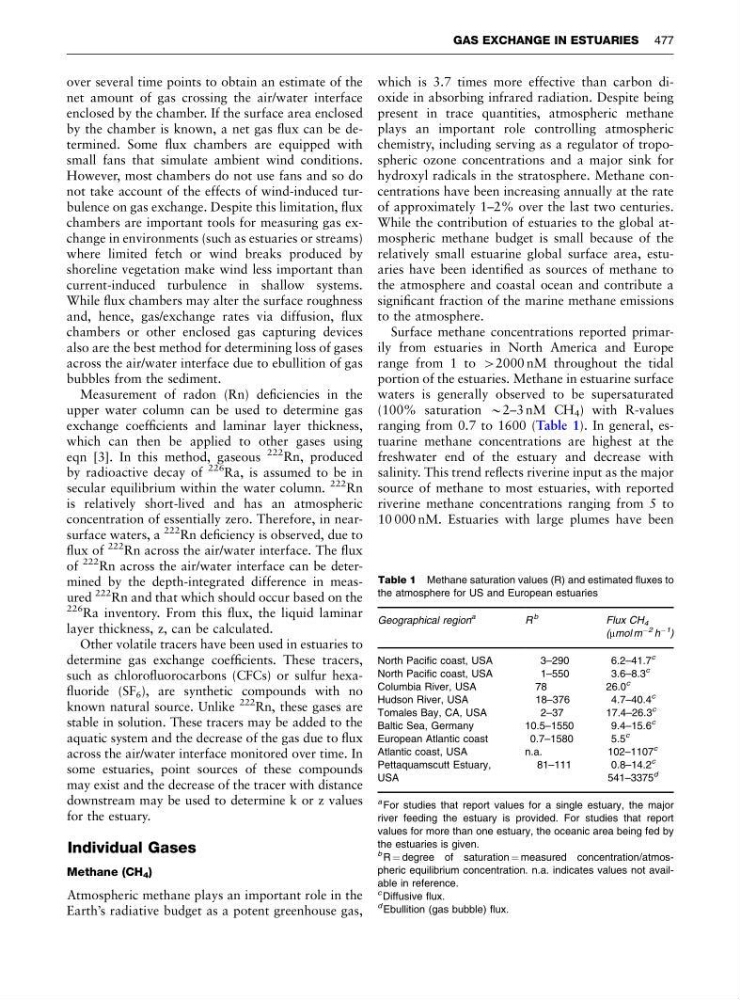
Surface methane concentrations reported primarily from estuaries in North America and Europe
range from 1 to 42000 nM throughout the tidal
portion of the estuaries. Methane in estuarine surface
waters is generally observed to be supersaturated
(100% saturation B2–3 nM CH 4 ) with R-values
ranging from 0.7 to 1600 (Table 1). In general, estuarine methane concentrations are highest at the
freshwater end of the estuary and decrease with
salinity. This trend reflects riverine input as the major
source of methane to most estuaries, with reported
riverine methane concentrations ranging from 5 to
10 000 nM. Estuaries with large plumes have been
Table 1 Methane saturation values (R) and estimated fluxes to
the atmosphere for US and European estuaries
Geographical region
a
R
b
Flux CH 4
(mmol m
À2 h
À1
)
North Pacific coast, USA
3–290
6.2–41.7
c
North Pacific coast, USA
1–550
3.6–8.3
c
Columbia River, USA
78
26.0
c
Hudson River, USA
18–376
4.7–40.4
c
Tomales Bay, CA, USA
2–37
17.4–26.3
c
Baltic Sea, Germany
10.5–1550
9.4–15.6
c
European Atlantic coast
0.7–1580
5.5
c
Atlantic coast, USA
n.a.
102–1107
c
Pettaquamscutt Estuary,
81–111
0.8–14.2
c
USA
541–3375
d
a For studies that report values for a single estuary, the major
river feeding the estuary is provided. For studies that report
values for more than one estuary, the oceanic area being fed by
the estuaries is given.
b R ¼ degree of saturation ¼ measured concentration/atmospheric equilibrium concentration. n.a. indicates values not available in reference.
c Diffusive flux.
d Ebullition (gas bubble) flux.
GAS EXCHANGE IN ESTUARIES 477
net amount of gas crossing the air/water interface
enclosed by the chamber. If the surface area enclosed
by the chamber is known, a net gas flux can be determined. Some flux chambers are equipped with
small fans that simulate ambient wind conditions.
However, most chambers do not use fans and so do
not take account of the effects of wind-induced turbulence on gas exchange. Despite this limitation, flux
chambers are important tools for measuring gas exchange in environments (such as estuaries or streams)
where limited fetch or wind breaks produced by
shoreline vegetation make wind less important than
current-induced turbulence in shallow systems.
While flux chambers may alter the surface roughness
and, hence, gas/exchange rates via diffusion, flux
chambers or other enclosed gas capturing devices
also are the best method for determining loss of gases
across the air/water interface due to ebullition of gas
bubbles from the sediment.
Measurement of radon (Rn) deficiencies in the
upper water column can be used to determine gas
exchange coefficients and laminar layer thickness,
which can then be applied to other gases using
eqn [3]. In this method, gaseous
222 Rn, produced
by radioactive decay of
226
Ra, is assumed to be in
secular equilibrium within the water column.
222 Rn
is relatively short-lived and has an atmospheric
concentration of essentially zero. Therefore, in nearsurface waters, a
222
Rn deficiency is observed, due to
flux of
222 Rn across the air/water interface. The flux
of
222
Rn across the air/water interface can be determined by the depth-integrated difference in measured
222 Rn and that which should occur based on the
226 Ra inventory. From this flux, the liquid laminar
layer thickness, z, can be calculated.
Other volatile tracers have been used in estuaries to
determine gas exchange coefficients. These tracers,
such as chlorofluorocarbons (CFCs) or sulfur hexafluoride (SF 6 ), are synthetic compounds with no
known natural source. Unlike
222
Rn, these gases are
stable in solution. These tracers may be added to the
aquatic system and the decrease of the gas due to flux
across the air/water interface monitored over time. In
some estuaries, point sources of these compounds
may exist and the decrease of the tracer with distance
downstream may be used to determine k or z values
for the estuary.
Individual Gases
Methane (CH 4 )
Atmospheric methane plays an important role in the
Earth’s radiative budget as a potent greenhouse gas,
which is 3.7 times more effective than carbon dioxide in absorbing infrared radiation. Despite being
present in trace quantities, atmospheric methane
plays an important role controlling atmospheric
chemistry, including serving as a regulator of tropospheric ozone concentrations and a major sink for
hydroxyl radicals in the stratosphere. Methane concentrations have been increasing annually at the rate
of approximately 1–2% over the last two centuries.
While the contribution of estuaries to the global atmospheric methane budget is small because of the
relatively small estuarine global surface area, estuaries have been identified as sources of methane to
the atmosphere and coastal ocean and contribute a
significant fraction of the marine methane emissions
to the atmosphere.
Surface methane concentrations reported primarily from estuaries in North America and Europe
range from 1 to 42000 nM throughout the tidal
portion of the estuaries. Methane in estuarine surface
waters is generally observed to be supersaturated
(100% saturation B2–3 nM CH 4 ) with R-values
ranging from 0.7 to 1600 (Table 1). In general, estuarine methane concentrations are highest at the
freshwater end of the estuary and decrease with
salinity. This trend reflects riverine input as the major
source of methane to most estuaries, with reported
riverine methane concentrations ranging from 5 to
10 000 nM. Estuaries with large plumes have been
Table 1 Methane saturation values (R) and estimated fluxes to
the atmosphere for US and European estuaries
Geographical region
a
R
b
Flux CH 4
(mmol m
À2 h
À1
)
North Pacific coast, USA
3–290
6.2–41.7
c
North Pacific coast, USA
1–550
3.6–8.3
c
Columbia River, USA
78
26.0
c
Hudson River, USA
18–376
4.7–40.4
c
Tomales Bay, CA, USA
2–37
17.4–26.3
c
Baltic Sea, Germany
10.5–1550
9.4–15.6
c
European Atlantic coast
0.7–1580
5.5
c
Atlantic coast, USA
n.a.
102–1107
c
Pettaquamscutt Estuary,
81–111
0.8–14.2
c
USA
541–3375
d
a For studies that report values for a single estuary, the major
river feeding the estuary is provided. For studies that report
values for more than one estuary, the oceanic area being fed by
the estuaries is given.
b R ¼ degree of saturation ¼ measured concentration/atmospheric equilibrium concentration. n.a. indicates values not available in reference.
c Diffusive flux.
d Ebullition (gas bubble) flux.
GAS EXCHANGE IN ESTUARIES 477