

long-term background flux of extraterrestrial Ir to
the earth.
Anthropogenic Release of PGEs to the
Marine Environment
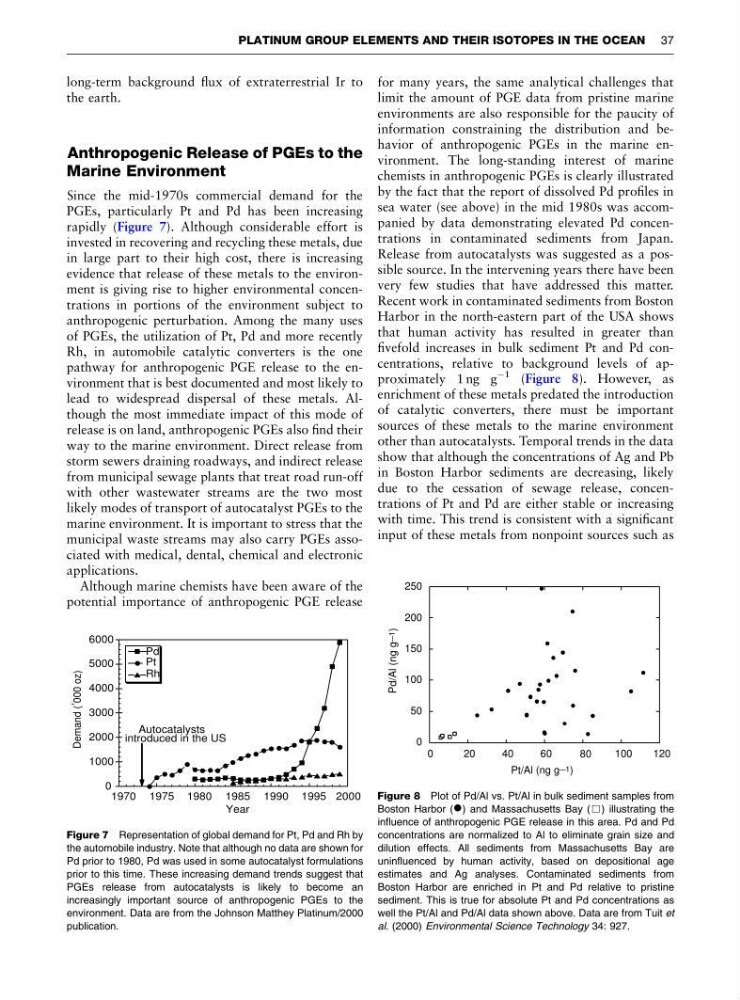
Since the mid-1970s commercial demand for the
PGEs, particularly Pt and Pd has been increasing
rapidly (Figure 7). Although considerable effort is
invested in recovering and recycling these metals, due
in large part to their high cost, there is increasing
evidence that release of these metals to the environment is giving rise to higher environmental concentrations in portions of the environment subject to
anthropogenic perturbation. Among the many uses
of PGEs, the utilization of Pt, Pd and more recently
Rh, in automobile catalytic converters is the one
pathway for anthropogenic PGE release to the environment that is best documented and most likely to
lead to widespread dispersal of these metals. Although the most immediate impact of this mode of
release is on land, anthropogenic PGEs also find their
way to the marine environment. Direct release from
storm sewers draining roadways, and indirect release
from municipal sewage plants that treat road run-off
with other wastewater streams are the two most
likely modes of transport of autocatalyst PGEs to the
marine environment. It is important to stress that the
municipal waste streams may also carry PGEs associated with medical, dental, chemical and electronic
applications.
Although marine chemists have been aware of the
potential importance of anthropogenic PGE release
for many years, the same analytical challenges that
limit the amount of PGE data from pristine marine
environments are also responsible for the paucity of
information constraining the distribution and behavior of anthropogenic PGEs in the marine environment. The long-standing interest of marine
chemists in anthropogenic PGEs is clearly illustrated
by the fact that the report of dissolved Pd profiles in
sea water (see above) in the mid 1980s was accompanied by data demonstrating elevated Pd concentrations in contaminated sediments from Japan.
Release from autocatalysts was suggested as a possible source. In the intervening years there have been
very few studies that have addressed this matter.
Recent work in contaminated sediments from Boston
Harbor in the north-eastern part of the USA shows
that human activity has resulted in greater than
fivefold increases in bulk sediment Pt and Pd concentrations, relative to background levels of approximately 1 ng g
À1 (Figure 8). However, as
enrichment of these metals predated the introduction
of catalytic converters, there must be important
sources of these metals to the marine environment
other than autocatalysts. Temporal trends in the data
show that although the concentrations of Ag and Pb
in Boston Harbor sediments are decreasing, likely
due to the cessation of sewage release, concentrations of Pt and Pd are either stable or increasing
with time. This trend is consistent with a significant
input of these metals from nonpoint sources such as
0
1000
2000
3000
4000
5000
6000
1970
Demand ( 000 oz)
1975 1980 1985 1990 1995 2000
Year
Pd
Pt
Rh
Autocatalysts
introduced in the US
′
Figure 7 Representation of global demand for Pt, Pd and Rh by
the automobile industry. Note that although no data are shown for
Pd prior to 1980, Pd was used in some autocatalyst formulations
prior to this time. These increasing demand trends suggest that
PGEs release from autocatalysts is likely to become an
increasingly important source of anthropogenic PGEs to the
environment. Data are from the Johnson Matthey Platinum/2000
publication.
0
50
100
150
200
250
Pd/Al (ng g
_
1
)
0
20
40
60
100
120
Pt/Al (ng g
_ 1 )
80
Figure 8 Plot of Pd/Al vs. Pt/Al in bulk sediment samples from
Boston Harbor () and Massachusetts Bay (&) illustrating the
influence of anthropogenic PGE release in this area. Pd and Pd
concentrations are normalized to Al to eliminate grain size and
dilution effects. All sediments from Massachusetts Bay are
uninfluenced by human activity, based on depositional age
estimates and Ag analyses. Contaminated sediments from
Boston Harbor are enriched in Pt and Pd relative to pristine
sediment. This is true for absolute Pt and Pd concentrations as
well the Pt/Al and Pd/Al data shown above. Data are from Tuit et
al. (2000) Environmental Science Technology 34: 927.
PLATINUM GROUP ELEMENTS AND THEIR ISOTOPES IN THE OCEAN 37
the earth.
Anthropogenic Release of PGEs to the
Marine Environment
Since the mid-1970s commercial demand for the
PGEs, particularly Pt and Pd has been increasing
rapidly (Figure 7). Although considerable effort is
invested in recovering and recycling these metals, due
in large part to their high cost, there is increasing
evidence that release of these metals to the environment is giving rise to higher environmental concentrations in portions of the environment subject to
anthropogenic perturbation. Among the many uses
of PGEs, the utilization of Pt, Pd and more recently
Rh, in automobile catalytic converters is the one
pathway for anthropogenic PGE release to the environment that is best documented and most likely to
lead to widespread dispersal of these metals. Although the most immediate impact of this mode of
release is on land, anthropogenic PGEs also find their
way to the marine environment. Direct release from
storm sewers draining roadways, and indirect release
from municipal sewage plants that treat road run-off
with other wastewater streams are the two most
likely modes of transport of autocatalyst PGEs to the
marine environment. It is important to stress that the
municipal waste streams may also carry PGEs associated with medical, dental, chemical and electronic
applications.
Although marine chemists have been aware of the
potential importance of anthropogenic PGE release
for many years, the same analytical challenges that
limit the amount of PGE data from pristine marine
environments are also responsible for the paucity of
information constraining the distribution and behavior of anthropogenic PGEs in the marine environment. The long-standing interest of marine
chemists in anthropogenic PGEs is clearly illustrated
by the fact that the report of dissolved Pd profiles in
sea water (see above) in the mid 1980s was accompanied by data demonstrating elevated Pd concentrations in contaminated sediments from Japan.
Release from autocatalysts was suggested as a possible source. In the intervening years there have been
very few studies that have addressed this matter.
Recent work in contaminated sediments from Boston
Harbor in the north-eastern part of the USA shows
that human activity has resulted in greater than
fivefold increases in bulk sediment Pt and Pd concentrations, relative to background levels of approximately 1 ng g
À1 (Figure 8). However, as
enrichment of these metals predated the introduction
of catalytic converters, there must be important
sources of these metals to the marine environment
other than autocatalysts. Temporal trends in the data
show that although the concentrations of Ag and Pb
in Boston Harbor sediments are decreasing, likely
due to the cessation of sewage release, concentrations of Pt and Pd are either stable or increasing
with time. This trend is consistent with a significant
input of these metals from nonpoint sources such as
0
1000
2000
3000
4000
5000
6000
1970
Demand ( 000 oz)
1975 1980 1985 1990 1995 2000
Year
Pd
Pt
Rh
Autocatalysts
introduced in the US
′
Figure 7 Representation of global demand for Pt, Pd and Rh by
the automobile industry. Note that although no data are shown for
Pd prior to 1980, Pd was used in some autocatalyst formulations
prior to this time. These increasing demand trends suggest that
PGEs release from autocatalysts is likely to become an
increasingly important source of anthropogenic PGEs to the
environment. Data are from the Johnson Matthey Platinum/2000
publication.
0
50
100
150
200
250
Pd/Al (ng g
_
1
)
0
20
40
60
100
120
Pt/Al (ng g
_ 1 )
80
Figure 8 Plot of Pd/Al vs. Pt/Al in bulk sediment samples from
Boston Harbor () and Massachusetts Bay (&) illustrating the
influence of anthropogenic PGE release in this area. Pd and Pd
concentrations are normalized to Al to eliminate grain size and
dilution effects. All sediments from Massachusetts Bay are
uninfluenced by human activity, based on depositional age
estimates and Ag analyses. Contaminated sediments from
Boston Harbor are enriched in Pt and Pd relative to pristine
sediment. This is true for absolute Pt and Pd concentrations as
well the Pt/Al and Pd/Al data shown above. Data are from Tuit et
al. (2000) Environmental Science Technology 34: 927.
PLATINUM GROUP ELEMENTS AND THEIR ISOTOPES IN THE OCEAN 37