

Cretaceous–Tertiary Boundary have demonstrated
that a wide variety of natural processing can give rise
to PGE enrichments unrelated to any extraterrestrial
input of these elements. Therefore, it is important to
emphasize that the PGEs are only one of several
possible lines of evidence used to test impact hypotheses in the geologic record.
PGEs in marine sediments are important not only
in the context of identifying specific extraterrestrial
impact events, but also in quantifying the background flux of cosmic dust to the earth’s surface.
This flux is critically important to determining what
level of Ir enrichment is likely to constitute evidence
of an extraterrestrial impact. Slowly accumulating
pelagic clays from the abyssal North Pacific are the
best available records of the average long-term flux
of extraterrestrial material to the earth’s surface. This
is because of their very slow accumulation rates, on
the order of a few millimeters per thousand years.
These slow accumulation rates reflect the fact that
this region of the ocean is far removed from terrestrial sources of particulate material. Thus a few
meters of sediment can provide a nearly continuous
record of accumulation that spans several million
years and maximizes the contribution of the background flux of extraterrestrial Ir relative to total Ir
burial flux. The best example of such a record is the
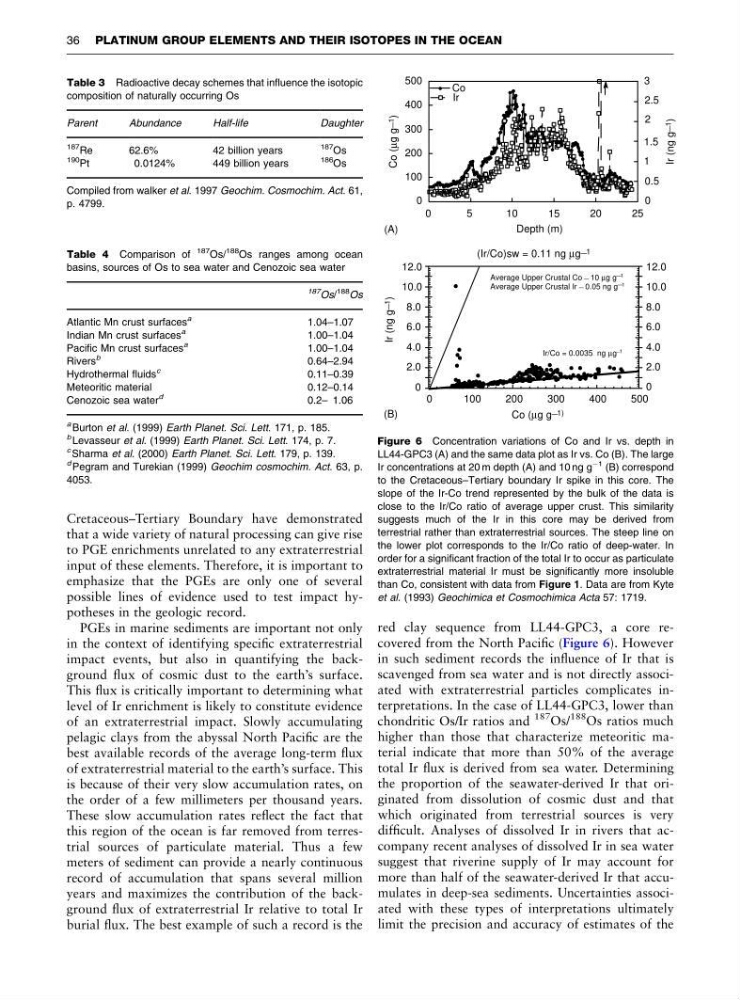
red clay sequence from LL44-GPC3, a core recovered from the North Pacific (Figure 6). However
in such sediment records the influence of Ir that is
scavenged from sea water and is not directly associated with extraterrestrial particles complicates interpretations. In the case of LL44-GPC3, lower than
chondritic Os/Ir ratios and
187 Os/
188 Os ratios much
higher than those that characterize meteoritic material indicate that more than 50% of the average
total Ir flux is derived from sea water. Determining
the proportion of the seawater-derived Ir that originated from dissolution of cosmic dust and that
which originated from terrestrial sources is very
difficult. Analyses of dissolved Ir in rivers that accompany recent analyses of dissolved Ir in sea water
suggest that riverine supply of Ir may account for
more than half of the seawater-derived Ir that accumulates in deep-sea sediments. Uncertainties associated with these types of interpretations ultimately
limit the precision and accuracy of estimates of the
Table 3 Radioactive decay schemes that influence the isotopic
composition of naturally occurring Os
Parent
Abundance
Half-life
Daughter
187
Re
62.6%
42 billion years
187
Os
190
Pt
0.0124%
449 billion years
186
Os
Compiled from walker et al. 1997 Geochim. Cosmochim. Act. 61,
p. 4799.
Table 4 Comparison of
187 Os/
188 Os ranges among ocean
basins, sources of Os to sea water and Cenozoic sea water
187 Os/
188 Os
Atlantic Mn crust surfaces
a
1.04–1.07
Indian Mn crust surfaces
a
1.00–1.04
Pacific Mn crust surfaces
a
1.00–1.04
Rivers
b
0.64–2.94
Hydrothermal fluids
c
0.11–0.39
Meteoritic material
0.12–0.14
Cenozoic sea water
d
0.2– 1.06
a Burton et al. (1999) Earth Planet. Sci. Lett. 171, p. 185.
b Levasseur et al. (1999) Earth Planet. Sci. Lett. 174, p. 7.
c Sharma et al. (2000) Earth Planet. Sci. Lett. 179, p. 139.
d Pegram and Turekian (1999) Geochim cosmochim. Act. 63, p.
4053.
0
100
200
300
400
500
Co (μg g
_
1
)
0
0.5
1
1.5
2
2.5
3
0
5
1 0
15
20
25
Depth (m)
Co
Ir
0
0
2.0
2.0
4.0
4.0
6.0
6.0
8.0
8.0
10.0
10.0
12.0
12.0
Ir (ng g
_
1
)
0
100
200
300
400
500
Co (μg g
_ 1)
Ir/Co = 0.0035 ng μg
_ 1
(Ir/Co)sw = 0.11 ng μg
_ 1
Average Upper Crustal Co _ 10 μg g
_ 1
Average Upper Crustal Ir _ 0.05 ng g
_ 1
Ir (ng g _
1
)
(A)
(B)
Figure 6 Concentration variations of Co and Ir vs. depth in
LL44-GPC3 (A) and the same data plot as Ir vs. Co (B). The large
Ir concentrations at 20 m depth (A) and 10 ng g
À1 (B) correspond
to the Cretaceous–Tertiary boundary Ir spike in this core. The
slope of the Ir-Co trend represented by the bulk of the data is
close to the Ir/Co ratio of average upper crust. This similarity
suggests much of the Ir in this core may be derived from
terrestrial rather than extraterrestrial sources. The steep line on
the lower plot corresponds to the Ir/Co ratio of deep-water. In
order for a significant fraction of the total Ir to occur as particulate
extraterrestrial material Ir must be significantly more insoluble
than Co, consistent with data from Figure 1. Data are from Kyte
et al. (1993) Geochimica et Cosmochimica Acta 57: 1719.
36 PLATINUM GROUP ELEMENTS AND THEIR ISOTOPES IN THE OCEAN
that a wide variety of natural processing can give rise
to PGE enrichments unrelated to any extraterrestrial
input of these elements. Therefore, it is important to
emphasize that the PGEs are only one of several
possible lines of evidence used to test impact hypotheses in the geologic record.
PGEs in marine sediments are important not only
in the context of identifying specific extraterrestrial
impact events, but also in quantifying the background flux of cosmic dust to the earth’s surface.
This flux is critically important to determining what
level of Ir enrichment is likely to constitute evidence
of an extraterrestrial impact. Slowly accumulating
pelagic clays from the abyssal North Pacific are the
best available records of the average long-term flux
of extraterrestrial material to the earth’s surface. This
is because of their very slow accumulation rates, on
the order of a few millimeters per thousand years.
These slow accumulation rates reflect the fact that
this region of the ocean is far removed from terrestrial sources of particulate material. Thus a few
meters of sediment can provide a nearly continuous
record of accumulation that spans several million
years and maximizes the contribution of the background flux of extraterrestrial Ir relative to total Ir
burial flux. The best example of such a record is the
red clay sequence from LL44-GPC3, a core recovered from the North Pacific (Figure 6). However
in such sediment records the influence of Ir that is
scavenged from sea water and is not directly associated with extraterrestrial particles complicates interpretations. In the case of LL44-GPC3, lower than
chondritic Os/Ir ratios and
187 Os/
188 Os ratios much
higher than those that characterize meteoritic material indicate that more than 50% of the average
total Ir flux is derived from sea water. Determining
the proportion of the seawater-derived Ir that originated from dissolution of cosmic dust and that
which originated from terrestrial sources is very
difficult. Analyses of dissolved Ir in rivers that accompany recent analyses of dissolved Ir in sea water
suggest that riverine supply of Ir may account for
more than half of the seawater-derived Ir that accumulates in deep-sea sediments. Uncertainties associated with these types of interpretations ultimately
limit the precision and accuracy of estimates of the
Table 3 Radioactive decay schemes that influence the isotopic
composition of naturally occurring Os
Parent
Abundance
Half-life
Daughter
187
Re
62.6%
42 billion years
187
Os
190
Pt
0.0124%
449 billion years
186
Os
Compiled from walker et al. 1997 Geochim. Cosmochim. Act. 61,
p. 4799.
Table 4 Comparison of
187 Os/
188 Os ranges among ocean
basins, sources of Os to sea water and Cenozoic sea water
187 Os/
188 Os
Atlantic Mn crust surfaces
a
1.04–1.07
Indian Mn crust surfaces
a
1.00–1.04
Pacific Mn crust surfaces
a
1.00–1.04
Rivers
b
0.64–2.94
Hydrothermal fluids
c
0.11–0.39
Meteoritic material
0.12–0.14
Cenozoic sea water
d
0.2– 1.06
a Burton et al. (1999) Earth Planet. Sci. Lett. 171, p. 185.
b Levasseur et al. (1999) Earth Planet. Sci. Lett. 174, p. 7.
c Sharma et al. (2000) Earth Planet. Sci. Lett. 179, p. 139.
d Pegram and Turekian (1999) Geochim cosmochim. Act. 63, p.
4053.
0
100
200
300
400
500
Co (μg g
_
1
)
0
0.5
1
1.5
2
2.5
3
0
5
1 0
15
20
25
Depth (m)
Co
Ir
0
0
2.0
2.0
4.0
4.0
6.0
6.0
8.0
8.0
10.0
10.0
12.0
12.0
Ir (ng g
_
1
)
0
100
200
300
400
500
Co (μg g
_ 1)
Ir/Co = 0.0035 ng μg
_ 1
(Ir/Co)sw = 0.11 ng μg
_ 1
Average Upper Crustal Co _ 10 μg g
_ 1
Average Upper Crustal Ir _ 0.05 ng g
_ 1
Ir (ng g _
1
)
(A)
(B)
Figure 6 Concentration variations of Co and Ir vs. depth in
LL44-GPC3 (A) and the same data plot as Ir vs. Co (B). The large
Ir concentrations at 20 m depth (A) and 10 ng g
À1 (B) correspond
to the Cretaceous–Tertiary boundary Ir spike in this core. The
slope of the Ir-Co trend represented by the bulk of the data is
close to the Ir/Co ratio of average upper crust. This similarity
suggests much of the Ir in this core may be derived from
terrestrial rather than extraterrestrial sources. The steep line on
the lower plot corresponds to the Ir/Co ratio of deep-water. In
order for a significant fraction of the total Ir to occur as particulate
extraterrestrial material Ir must be significantly more insoluble
than Co, consistent with data from Figure 1. Data are from Kyte
et al. (1993) Geochimica et Cosmochimica Acta 57: 1719.
36 PLATINUM GROUP ELEMENTS AND THEIR ISOTOPES IN THE OCEAN