

where q is the Darcy flux, or flow rate per unit surface area, and m is fluid viscosity. A more general
expression of Darcy’s law is:
q ¼ À
k
m
ðrP þ rgrzÞ
½ 4
In inland aquifers, the density of groundwater is
constant and eqn [4] is reduced to the simpler form
of Darcy’s law (eqn [3]). In coastal aquifers, however,
the presence of saline water along the coast means
that the assumption of constant density is not valid
and so the more inclusive form of Darcy’s law,
eqn [4], is required.
Groundwater Flow at the Coast
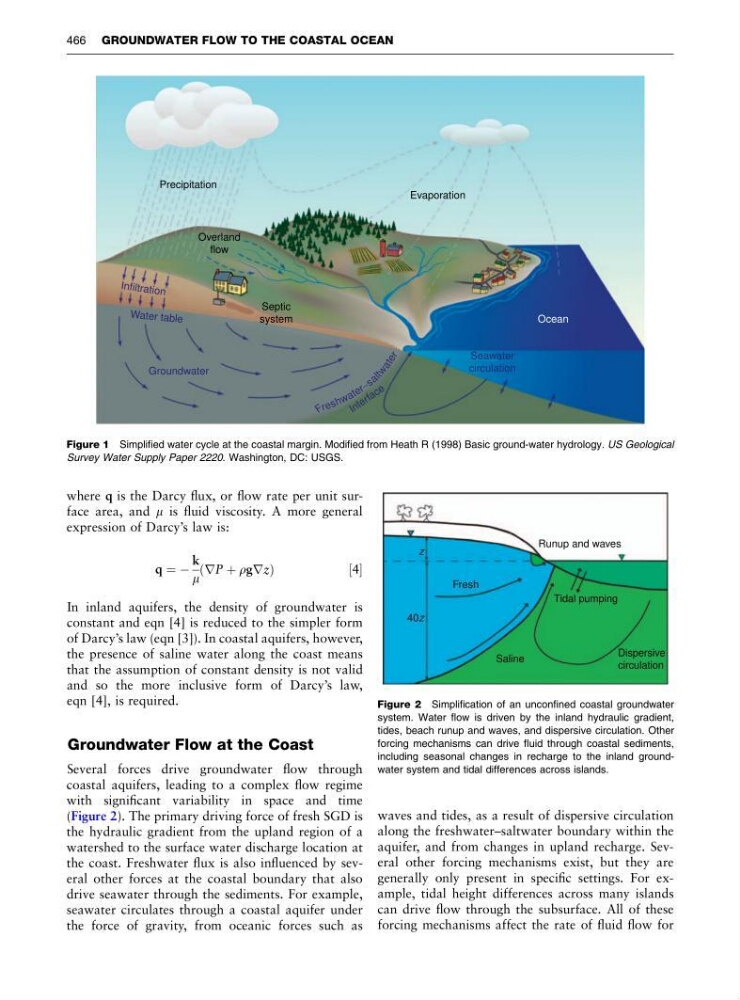
Several forces drive groundwater flow through
coastal aquifers, leading to a complex flow regime
with significant variability in space and time
(Figure 2). The primary driving force of fresh SGD is
the hydraulic gradient from the upland region of a
watershed to the surface water discharge location at
the coast. Freshwater flux is also influenced by several other forces at the coastal boundary that also
drive seawater through the sediments. For example,
seawater circulates through a coastal aquifer under
the force of gravity, from oceanic forces such as
waves and tides, as a result of dispersive circulation
along the freshwater–saltwater boundary within the
aquifer, and from changes in upland recharge. Several other forcing mechanisms exist, but they are
generally only present in specific settings. For example, tidal height differences across many islands
can drive flow through the subsurface. All of these
forcing mechanisms affect the rate of fluid flow for
Precipitation
Evaporation
Overland
flow
Septic
system
Inf iltr ati on
Wa ter tab le
Groundwater
F re s h w a t e r − s a l
t w a t e r
I n t e r f a c e
Seawater
circulation
Ocean
Figure 1 Simplified water cycle at the coastal margin. Modified from Heath R (1998) Basic ground-water hydrology. US Geological
Survey Water Supply Paper 2220. Washington, DC: USGS.
Runup and waves
Fresh
Saline
Dispersive
circulation
Tidal pumping
z
40z
Figure 2 Simplification of an unconfined coastal groundwater
system. Water flow is driven by the inland hydraulic gradient,
tides, beach runup and waves, and dispersive circulation. Other
forcing mechanisms can drive fluid through coastal sediments,
including seasonal changes in recharge to the inland groundwater system and tidal differences across islands.
466 GROUNDWATER FLOW TO THE COASTAL OCEAN
expression of Darcy’s law is:
q ¼ À
k
m
ðrP þ rgrzÞ
½ 4
In inland aquifers, the density of groundwater is
constant and eqn [4] is reduced to the simpler form
of Darcy’s law (eqn [3]). In coastal aquifers, however,
the presence of saline water along the coast means
that the assumption of constant density is not valid
and so the more inclusive form of Darcy’s law,
eqn [4], is required.
Groundwater Flow at the Coast
Several forces drive groundwater flow through
coastal aquifers, leading to a complex flow regime
with significant variability in space and time
(Figure 2). The primary driving force of fresh SGD is
the hydraulic gradient from the upland region of a
watershed to the surface water discharge location at
the coast. Freshwater flux is also influenced by several other forces at the coastal boundary that also
drive seawater through the sediments. For example,
seawater circulates through a coastal aquifer under
the force of gravity, from oceanic forces such as
waves and tides, as a result of dispersive circulation
along the freshwater–saltwater boundary within the
aquifer, and from changes in upland recharge. Several other forcing mechanisms exist, but they are
generally only present in specific settings. For example, tidal height differences across many islands
can drive flow through the subsurface. All of these
forcing mechanisms affect the rate of fluid flow for
Precipitation
Evaporation
Overland
flow
Septic
system
Inf iltr ati on
Wa ter tab le
Groundwater
F re s h w a t e r − s a l
t w a t e r
I n t e r f a c e
Seawater
circulation
Ocean
Figure 1 Simplified water cycle at the coastal margin. Modified from Heath R (1998) Basic ground-water hydrology. US Geological
Survey Water Supply Paper 2220. Washington, DC: USGS.
Runup and waves
Fresh
Saline
Dispersive
circulation
Tidal pumping
z
40z
Figure 2 Simplification of an unconfined coastal groundwater
system. Water flow is driven by the inland hydraulic gradient,
tides, beach runup and waves, and dispersive circulation. Other
forcing mechanisms can drive fluid through coastal sediments,
including seasonal changes in recharge to the inland groundwater system and tidal differences across islands.
466 GROUNDWATER FLOW TO THE COASTAL OCEAN