

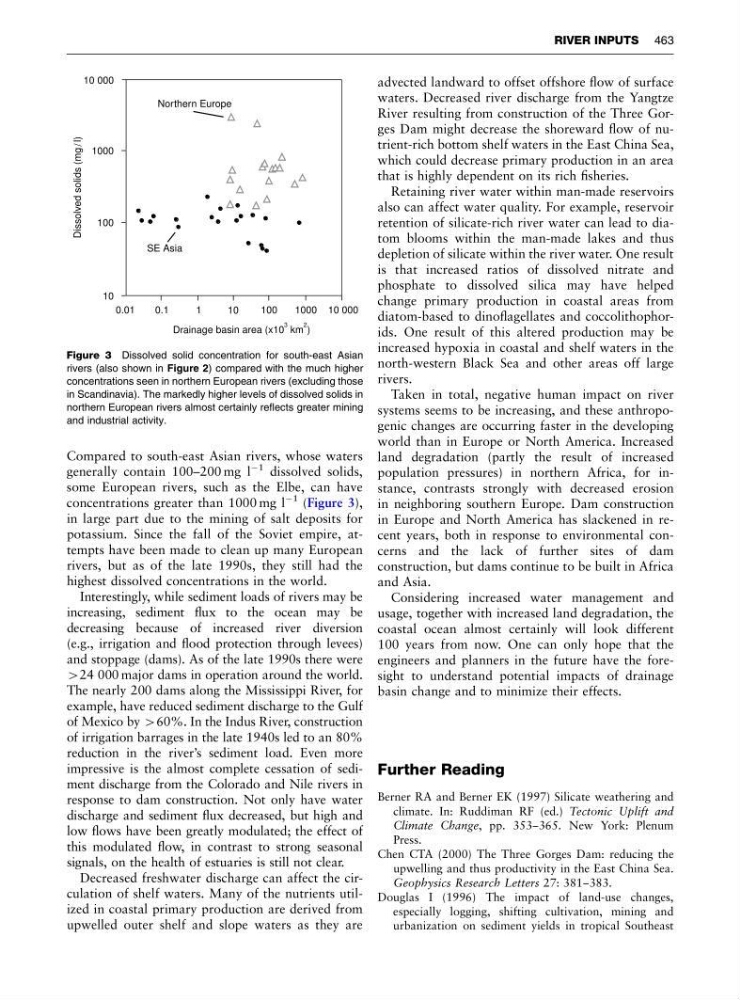
Compared to south-east Asian rivers, whose waters
generally contain 100–200 mg l
À1 dissolved solids,
some European rivers, such as the Elbe, can have
concentrations greater than 1000 mg l
À1 (Figure 3),
in large part due to the mining of salt deposits for
potassium. Since the fall of the Soviet empire, attempts have been made to clean up many European
rivers, but as of the late 1990s, they still had the
highest dissolved concentrations in the world.
Interestingly, while sediment loads of rivers may be
increasing, sediment flux to the ocean may be
decreasing because of increased river diversion
(e.g., irrigation and flood protection through levees)
and stoppage (dams). As of the late 1990s there were
424 000 major dams in operation around the world.
The nearly 200 dams along the Mississippi River, for
example, have reduced sediment discharge to the Gulf
of Mexico by 460%. In the Indus River, construction
of irrigation barrages in the late 1940s led to an 80%
reduction in the river’s sediment load. Even more
impressive is the almost complete cessation of sediment discharge from the Colorado and Nile rivers in
response to dam construction. Not only have water
discharge and sediment flux decreased, but high and
low flows have been greatly modulated; the effect of
this modulated flow, in contrast to strong seasonal
signals, on the health of estuaries is still not clear.
Decreased freshwater discharge can affect the circulation of shelf waters. Many of the nutrients utilized in coastal primary production are derived from
upwelled outer shelf and slope waters as they are
advected landward to offset offshore flow of surface
waters. Decreased river discharge from the Yangtze
River resulting from construction of the Three Gorges Dam might decrease the shoreward flow of nutrient-rich bottom shelf waters in the East China Sea,
which could decrease primary production in an area
that is highly dependent on its rich fisheries.
Retaining river water within man-made reservoirs
also can affect water quality. For example, reservoir
retention of silicate-rich river water can lead to diatom blooms within the man-made lakes and thus
depletion of silicate within the river water. One result
is that increased ratios of dissolved nitrate and
phosphate to dissolved silica may have helped
change primary production in coastal areas from
diatom-based to dinoflagellates and coccolithophorids. One result of this altered production may be
increased hypoxia in coastal and shelf waters in the
north-western Black Sea and other areas off large
rivers.
Taken in total, negative human impact on river
systems seems to be increasing, and these anthropogenic changes are occurring faster in the developing
world than in Europe or North America. Increased
land degradation (partly the result of increased
population pressures) in northern Africa, for instance, contrasts strongly with decreased erosion
in neighboring southern Europe. Dam construction
in Europe and North America has slackened in recent years, both in response to environmental concerns and the lack of further sites of dam
construction, but dams continue to be built in Africa
and Asia.
Considering increased water management and
usage, together with increased land degradation, the
coastal ocean almost certainly will look different
100 years from now. One can only hope that the
engineers and planners in the future have the foresight to understand potential impacts of drainage
basin change and to minimize their effects.
Further Reading
Berner RA and Berner EK (1997) Silicate weathering and
climate. In: Ruddiman RF (ed.) Tectonic Uplift and
Climate Change, pp. 353--365. New York: Plenum
Press.
Chen CTA (2000) The Three Gorges Dam: reducing the
upwelling and thus productivity in the East China Sea.
Geophysics Research Letters 27: 381--383.
Douglas I (1996) The impact of land-use changes,
especially logging, shifting cultivation, mining and
urbanization on sediment yields in tropical Southeast
10
100
1000
10 000
0.01
0.1
1
10
100
1000 10 000
Drainage basin area (x10 km )
3
2
Northern Europe
SE Asia
Dissolved solids (mg /
l)
Figure 3 Dissolved solid concentration for south-east Asian
rivers (also shown in Figure 2) compared with the much higher
concentrations seen in northern European rivers (excluding those
in Scandinavia). The markedly higher levels of dissolved solids in
northern European rivers almost certainly reflects greater mining
and industrial activity.
RIVER INPUTS 463
generally contain 100–200 mg l
À1 dissolved solids,
some European rivers, such as the Elbe, can have
concentrations greater than 1000 mg l
À1 (Figure 3),
in large part due to the mining of salt deposits for
potassium. Since the fall of the Soviet empire, attempts have been made to clean up many European
rivers, but as of the late 1990s, they still had the
highest dissolved concentrations in the world.
Interestingly, while sediment loads of rivers may be
increasing, sediment flux to the ocean may be
decreasing because of increased river diversion
(e.g., irrigation and flood protection through levees)
and stoppage (dams). As of the late 1990s there were
424 000 major dams in operation around the world.
The nearly 200 dams along the Mississippi River, for
example, have reduced sediment discharge to the Gulf
of Mexico by 460%. In the Indus River, construction
of irrigation barrages in the late 1940s led to an 80%
reduction in the river’s sediment load. Even more
impressive is the almost complete cessation of sediment discharge from the Colorado and Nile rivers in
response to dam construction. Not only have water
discharge and sediment flux decreased, but high and
low flows have been greatly modulated; the effect of
this modulated flow, in contrast to strong seasonal
signals, on the health of estuaries is still not clear.
Decreased freshwater discharge can affect the circulation of shelf waters. Many of the nutrients utilized in coastal primary production are derived from
upwelled outer shelf and slope waters as they are
advected landward to offset offshore flow of surface
waters. Decreased river discharge from the Yangtze
River resulting from construction of the Three Gorges Dam might decrease the shoreward flow of nutrient-rich bottom shelf waters in the East China Sea,
which could decrease primary production in an area
that is highly dependent on its rich fisheries.
Retaining river water within man-made reservoirs
also can affect water quality. For example, reservoir
retention of silicate-rich river water can lead to diatom blooms within the man-made lakes and thus
depletion of silicate within the river water. One result
is that increased ratios of dissolved nitrate and
phosphate to dissolved silica may have helped
change primary production in coastal areas from
diatom-based to dinoflagellates and coccolithophorids. One result of this altered production may be
increased hypoxia in coastal and shelf waters in the
north-western Black Sea and other areas off large
rivers.
Taken in total, negative human impact on river
systems seems to be increasing, and these anthropogenic changes are occurring faster in the developing
world than in Europe or North America. Increased
land degradation (partly the result of increased
population pressures) in northern Africa, for instance, contrasts strongly with decreased erosion
in neighboring southern Europe. Dam construction
in Europe and North America has slackened in recent years, both in response to environmental concerns and the lack of further sites of dam
construction, but dams continue to be built in Africa
and Asia.
Considering increased water management and
usage, together with increased land degradation, the
coastal ocean almost certainly will look different
100 years from now. One can only hope that the
engineers and planners in the future have the foresight to understand potential impacts of drainage
basin change and to minimize their effects.
Further Reading
Berner RA and Berner EK (1997) Silicate weathering and
climate. In: Ruddiman RF (ed.) Tectonic Uplift and
Climate Change, pp. 353--365. New York: Plenum
Press.
Chen CTA (2000) The Three Gorges Dam: reducing the
upwelling and thus productivity in the East China Sea.
Geophysics Research Letters 27: 381--383.
Douglas I (1996) The impact of land-use changes,
especially logging, shifting cultivation, mining and
urbanization on sediment yields in tropical Southeast
10
100
1000
10 000
0.01
0.1
1
10
100
1000 10 000
Drainage basin area (x10 km )
3
2
Northern Europe
SE Asia
Dissolved solids (mg /
l)
Figure 3 Dissolved solid concentration for south-east Asian
rivers (also shown in Figure 2) compared with the much higher
concentrations seen in northern European rivers (excluding those
in Scandinavia). The markedly higher levels of dissolved solids in
northern European rivers almost certainly reflects greater mining
and industrial activity.
RIVER INPUTS 463