

Thamdrup and Dalsgaard illustrated the occurrence
of this N 2 formation mechanism. The result of these
processes is that 15–75% of the flux of N to the
surface of coastal and estuarine sediments may be
removed to N 2 .
Contaminant Cycling: Anthropogenic
Metals
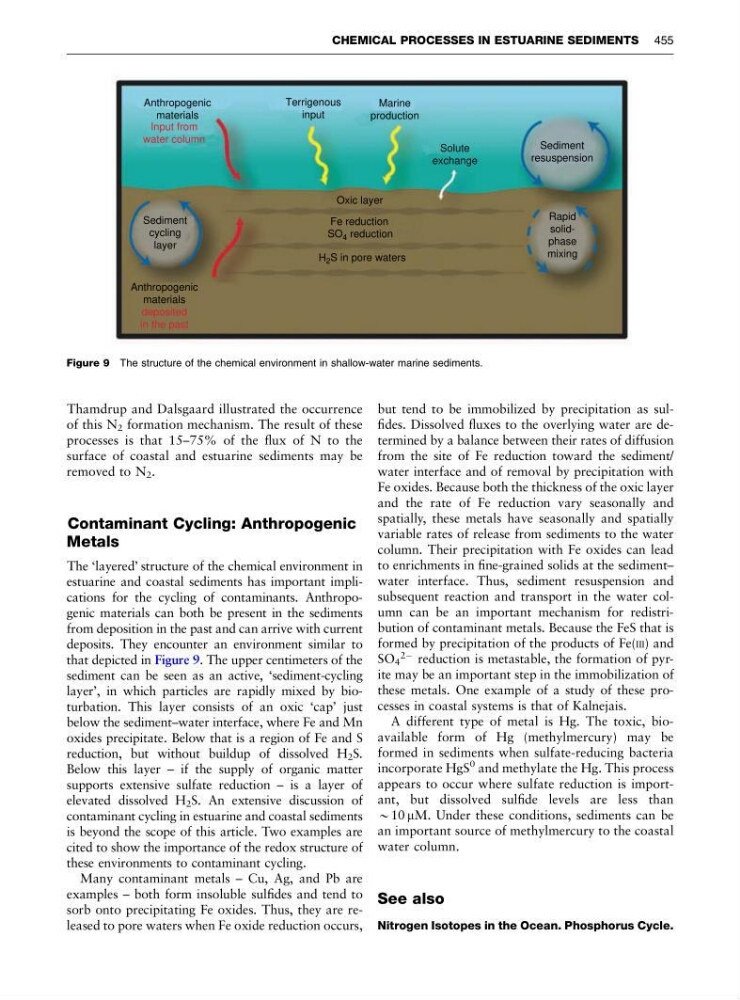
The ‘layered’ structure of the chemical environment in
estuarine and coastal sediments has important implications for the cycling of contaminants. Anthropogenic materials can both be present in the sediments
from deposition in the past and can arrive with current
deposits. They encounter an environment similar to
that depicted in Figure 9. The upper centimeters of the
sediment can be seen as an active, ‘sediment-cycling
layer’, in which particles are rapidly mixed by bioturbation. This layer consists of an oxic ‘cap’ just
below the sediment–water interface, where Fe and Mn
oxides precipitate. Below that is a region of Fe and S
reduction, but without buildup of dissolved H 2 S.
Below this layer – if the supply of organic matter
supports extensive sulfate reduction – is a layer of
elevated dissolved H 2 S. An extensive discussion of
contaminant cycling in estuarine and coastal sediments
is beyond the scope of this article. Two examples are
cited to show the importance of the redox structure of
these environments to contaminant cycling.
Many contaminant metals – Cu, Ag, and Pb are
examples – both form insoluble sulfides and tend to
sorb onto precipitating Fe oxides. Thus, they are released to pore waters when Fe oxide reduction occurs,
but tend to be immobilized by precipitation as sulfides. Dissolved fluxes to the overlying water are determined by a balance between their rates of diffusion
from the site of Fe reduction toward the sediment/
water interface and of removal by precipitation with
Fe oxides. Because both the thickness of the oxic layer
and the rate of Fe reduction vary seasonally and
spatially, these metals have seasonally and spatially
variable rates of release from sediments to the water
column. Their precipitation with Fe oxides can lead
to enrichments in fine-grained solids at the sediment–
water interface. Thus, sediment resuspension and
subsequent reaction and transport in the water column can be an important mechanism for redistribution of contaminant metals. Because the FeS that is
formed by precipitation of the products of Fe(III) and
SO 4
2À reduction is metastable, the formation of pyrite may be an important step in the immobilization of
these metals. One example of a study of these processes in coastal systems is that of Kalnejais.
A different type of metal is Hg. The toxic, bioavailable form of Hg (methylmercury) may be
formed in sediments when sulfate-reducing bacteria
incorporate HgS
0 and methylate the Hg. This process
appears to occur where sulfate reduction is important, but dissolved sulfide levels are less than
B10 mM. Under these conditions, sediments can be
an important source of methylmercury to the coastal
water column.
See also
Nitrogen Isotopes in the Ocean. Phosphorus Cycle.
Anthropogenic
materials
Marine
production
Solute
exchange
Input from
water column
Sediment
resuspension
Rapid
solidphase
mixing
Oxic layer
Fe reduction
SO 4 reduction
Sediment
cycling
layer
Anthropogenic
materials
deposited
in the past
Terrigenous
input
H 2 S in pore waters
Figure 9 The structure of the chemical environment in shallow-water marine sediments.
CHEMICAL PROCESSES IN ESTUARINE SEDIMENTS 455
of this N 2 formation mechanism. The result of these
processes is that 15–75% of the flux of N to the
surface of coastal and estuarine sediments may be
removed to N 2 .
Contaminant Cycling: Anthropogenic
Metals
The ‘layered’ structure of the chemical environment in
estuarine and coastal sediments has important implications for the cycling of contaminants. Anthropogenic materials can both be present in the sediments
from deposition in the past and can arrive with current
deposits. They encounter an environment similar to
that depicted in Figure 9. The upper centimeters of the
sediment can be seen as an active, ‘sediment-cycling
layer’, in which particles are rapidly mixed by bioturbation. This layer consists of an oxic ‘cap’ just
below the sediment–water interface, where Fe and Mn
oxides precipitate. Below that is a region of Fe and S
reduction, but without buildup of dissolved H 2 S.
Below this layer – if the supply of organic matter
supports extensive sulfate reduction – is a layer of
elevated dissolved H 2 S. An extensive discussion of
contaminant cycling in estuarine and coastal sediments
is beyond the scope of this article. Two examples are
cited to show the importance of the redox structure of
these environments to contaminant cycling.
Many contaminant metals – Cu, Ag, and Pb are
examples – both form insoluble sulfides and tend to
sorb onto precipitating Fe oxides. Thus, they are released to pore waters when Fe oxide reduction occurs,
but tend to be immobilized by precipitation as sulfides. Dissolved fluxes to the overlying water are determined by a balance between their rates of diffusion
from the site of Fe reduction toward the sediment/
water interface and of removal by precipitation with
Fe oxides. Because both the thickness of the oxic layer
and the rate of Fe reduction vary seasonally and
spatially, these metals have seasonally and spatially
variable rates of release from sediments to the water
column. Their precipitation with Fe oxides can lead
to enrichments in fine-grained solids at the sediment–
water interface. Thus, sediment resuspension and
subsequent reaction and transport in the water column can be an important mechanism for redistribution of contaminant metals. Because the FeS that is
formed by precipitation of the products of Fe(III) and
SO 4
2À reduction is metastable, the formation of pyrite may be an important step in the immobilization of
these metals. One example of a study of these processes in coastal systems is that of Kalnejais.
A different type of metal is Hg. The toxic, bioavailable form of Hg (methylmercury) may be
formed in sediments when sulfate-reducing bacteria
incorporate HgS
0 and methylate the Hg. This process
appears to occur where sulfate reduction is important, but dissolved sulfide levels are less than
B10 mM. Under these conditions, sediments can be
an important source of methylmercury to the coastal
water column.
See also
Nitrogen Isotopes in the Ocean. Phosphorus Cycle.
Anthropogenic
materials
Marine
production
Solute
exchange
Input from
water column
Sediment
resuspension
Rapid
solidphase
mixing
Oxic layer
Fe reduction
SO 4 reduction
Sediment
cycling
layer
Anthropogenic
materials
deposited
in the past
Terrigenous
input
H 2 S in pore waters
Figure 9 The structure of the chemical environment in shallow-water marine sediments.
CHEMICAL PROCESSES IN ESTUARINE SEDIMENTS 455