

temperate waters, as well as the first blooms in nutrient-rich, recently upwelled waters) and some to
oligotrophic conditions. Most species are best
adapted to living near to the surface, but some others
to the darker conditions prevailing in the thermocline. Most species today live in warm, nutrient-poor,
open ocean conditions; the highest diversity occurs in
subtropical oceanic gyres, whereas lower diversity
occurs in coastal and temperate waters.
Much of our knowledge of coccolithophore physiology and ecology comes from studies of E. huxleyi,
which has attracted more scientific interest than the
other coccolithophore species because of its ease of
culturing and the visibility of its blooms from space.
The ability to map bloom distributions from space
provides unique information on the ecology of this
species. Blooms of the species E. huxleyi occur
preferentially in strongly stratified waters experiencing high light levels. Coccolithophore success
may be indirectly promoted by exhaustion of silicate,
due to exclusion of the more competitive diatoms.
By analogy with diatoms, whose success is contingent on silicate availability for their shell building, coccolithophores might be expected to be
more successful at high CaCO 3 saturation state
O ð¼ ½CO 3
2À ½Ca
2þ =K sp Þ, because the value of O
controls inorganic calcification and dissolution. Such
a dependency would render coccolithophores vulnerable to ocean acidification, as discussed further
below. It was formerly thought that E. huxleyi was
particularly successful in phosphate-deficient waters,
but a reassessment has suggested that this is not a
critical factor. Many coccolithophores are restricted
to the warmer parts of the oceans, although this may
be coincidental rather than due to a direct temperature effect. Emiliania huxleyi is found to grow well
at low iron concentrations, in culture experiments.
Biogeochemical Impacts
Coccolithophores assimilate carbon during photosynthesis, leading to similar biogeochemical impacts to
other phytoplankton that do not possess mineral shells.
They also, however, assimilate carbon into biomass.
Following death, some of the coccolith CaCO 3
dissolves in the surface waters inhabited by coccolithophores, with the rest of the coccolith CaCO 3
sinking out of the surface waters within zooplankton
fecal pellets or marine snow aggregates. The exact
means by which some coccoliths are dissolved in
near-surface waters are unclear (dissolution within
zooplankton guts may be important), but regardless
of mechanisms several lines of evidence suggest that
near-surface dissolution does occur. The size of
coccoliths precludes the likelihood of single coccoliths sinking at all rapidly under gravity, because of
the considerable viscosity of water with respect to
such small particles (Stokes’ law). Stokes’ law can be
overcome if coccoliths become part of larger aggregates, either marine snow or zooplankton fecal pellets. Another possible fate for coccoliths is to become
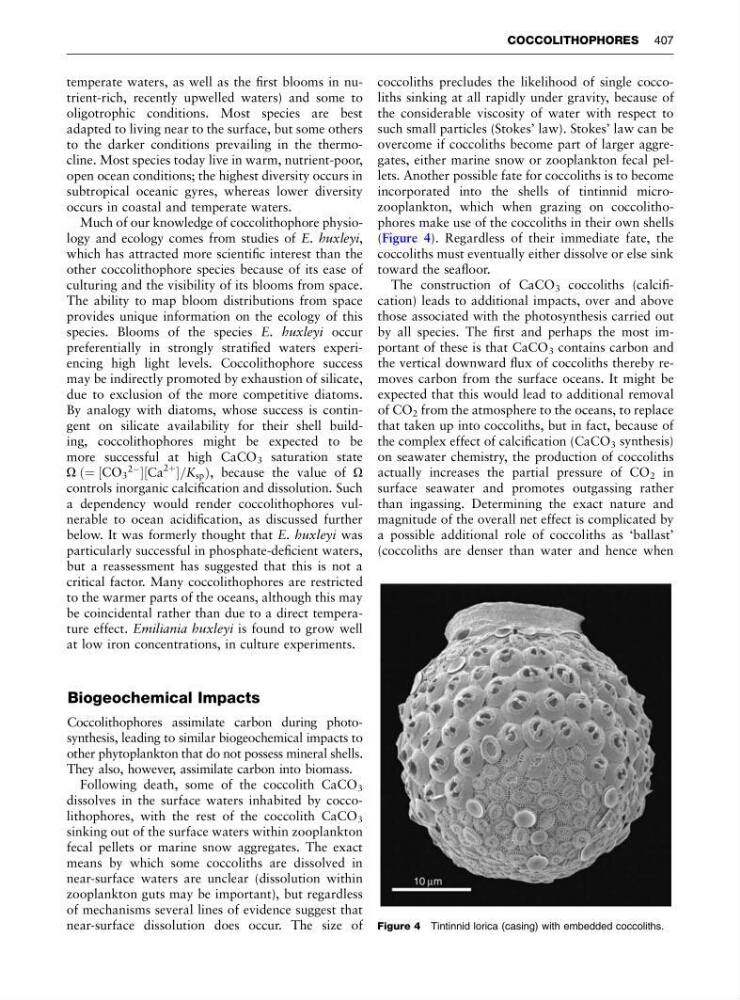
incorporated into the shells of tintinnid microzooplankton, which when grazing on coccolithophores make use of the coccoliths in their own shells
(Figure 4). Regardless of their immediate fate, the
coccoliths must eventually either dissolve or else sink
toward the seafloor.
The construction of CaCO 3 coccoliths (calcification) leads to additional impacts, over and above
those associated with the photosynthesis carried out
by all species. The first and perhaps the most important of these is that CaCO 3 contains carbon and
the vertical downward flux of coccoliths thereby removes carbon from the surface oceans. It might be
expected that this would lead to additional removal
of CO 2 from the atmosphere to the oceans, to replace
that taken up into coccoliths, but in fact, because of
the complex effect of calcification (CaCO 3 synthesis)
on seawater chemistry, the production of coccoliths
actually increases the partial pressure of CO 2 in
surface seawater and promotes outgassing rather
than ingassing. Determining the exact nature and
magnitude of the overall net effect is complicated by
a possible additional role of coccoliths as ‘ballast’
(coccoliths are denser than water and hence when
Figure 4 Tintinnid lorica (casing) with embedded coccoliths.
COCCOLITHOPHORES 407
oligotrophic conditions. Most species are best
adapted to living near to the surface, but some others
to the darker conditions prevailing in the thermocline. Most species today live in warm, nutrient-poor,
open ocean conditions; the highest diversity occurs in
subtropical oceanic gyres, whereas lower diversity
occurs in coastal and temperate waters.
Much of our knowledge of coccolithophore physiology and ecology comes from studies of E. huxleyi,
which has attracted more scientific interest than the
other coccolithophore species because of its ease of
culturing and the visibility of its blooms from space.
The ability to map bloom distributions from space
provides unique information on the ecology of this
species. Blooms of the species E. huxleyi occur
preferentially in strongly stratified waters experiencing high light levels. Coccolithophore success
may be indirectly promoted by exhaustion of silicate,
due to exclusion of the more competitive diatoms.
By analogy with diatoms, whose success is contingent on silicate availability for their shell building, coccolithophores might be expected to be
more successful at high CaCO 3 saturation state
O ð¼ ½CO 3
2À ½Ca
2þ =K sp Þ, because the value of O
controls inorganic calcification and dissolution. Such
a dependency would render coccolithophores vulnerable to ocean acidification, as discussed further
below. It was formerly thought that E. huxleyi was
particularly successful in phosphate-deficient waters,
but a reassessment has suggested that this is not a
critical factor. Many coccolithophores are restricted
to the warmer parts of the oceans, although this may
be coincidental rather than due to a direct temperature effect. Emiliania huxleyi is found to grow well
at low iron concentrations, in culture experiments.
Biogeochemical Impacts
Coccolithophores assimilate carbon during photosynthesis, leading to similar biogeochemical impacts to
other phytoplankton that do not possess mineral shells.
They also, however, assimilate carbon into biomass.
Following death, some of the coccolith CaCO 3
dissolves in the surface waters inhabited by coccolithophores, with the rest of the coccolith CaCO 3
sinking out of the surface waters within zooplankton
fecal pellets or marine snow aggregates. The exact
means by which some coccoliths are dissolved in
near-surface waters are unclear (dissolution within
zooplankton guts may be important), but regardless
of mechanisms several lines of evidence suggest that
near-surface dissolution does occur. The size of
coccoliths precludes the likelihood of single coccoliths sinking at all rapidly under gravity, because of
the considerable viscosity of water with respect to
such small particles (Stokes’ law). Stokes’ law can be
overcome if coccoliths become part of larger aggregates, either marine snow or zooplankton fecal pellets. Another possible fate for coccoliths is to become
incorporated into the shells of tintinnid microzooplankton, which when grazing on coccolithophores make use of the coccoliths in their own shells
(Figure 4). Regardless of their immediate fate, the
coccoliths must eventually either dissolve or else sink
toward the seafloor.
The construction of CaCO 3 coccoliths (calcification) leads to additional impacts, over and above
those associated with the photosynthesis carried out
by all species. The first and perhaps the most important of these is that CaCO 3 contains carbon and
the vertical downward flux of coccoliths thereby removes carbon from the surface oceans. It might be
expected that this would lead to additional removal
of CO 2 from the atmosphere to the oceans, to replace
that taken up into coccoliths, but in fact, because of
the complex effect of calcification (CaCO 3 synthesis)
on seawater chemistry, the production of coccoliths
actually increases the partial pressure of CO 2 in
surface seawater and promotes outgassing rather
than ingassing. Determining the exact nature and
magnitude of the overall net effect is complicated by
a possible additional role of coccoliths as ‘ballast’
(coccoliths are denser than water and hence when
Figure 4 Tintinnid lorica (casing) with embedded coccoliths.
COCCOLITHOPHORES 407