

(just one genetic variant of the organism). Coccolithophore gametes (haploid stages) are radically
different from those of larger (multicellular) organisms in the sense of being equipped for an independent existence: they can move about, acquire
energy (photosynthesize), and divide asexually by
binary fission. Naked diploid phases can be induced
in cultures, but these may be mutations which are
not viable in the wild. There are no confirmed
identifications of resting spore or cyst stages in
coccolithophores.
Coccolithophores, in common with other phytoplankton, experience only an ephemeral existence.
Typical life spans of phytoplankton in nature are
measured in days. Comparison of the rate at which
CaCO 3 is being produced in open ocean waters (as
measured by the rate of uptake of isotopically labeled carbon), to the amounts present (the ‘standingstock’), has led to the calculation that the average
turnover (replacement) time for CaCO 3 averages
about 3 days, ranging between a minimum of o1
and a maximum of 7 days at different locations in
the Atlantic Ocean. This implies that if a surfacedwelling coccolithophore synthesizes coccoliths on a
Monday, the coccoliths are fairly unlikely to still be
there on the Friday, either because they have redissolved or else because they have sunk down to
deeper waters.
The genome of one species, E. huxleyi, has recently been sequenced, but at the time of writing its
analysis is at an early stage.
Calcification
Calcification is the synthesis of solid calcium
carbonate from dissolved substances, whether passively by spontaneous formation of crystals in
a supersaturated solution (inorganic calcification)
or actively through the intervention of organisms
(biocalcification). The building of coccoliths by
coccolithophores is a major fraction of the total
biocalcification taking place in seawater. Inorganic
calcification is not commonplace or quantitatively
significant in the global budget, with the exception of
‘whitings’ that occur in just a few unusual locations
in the world’s oceans, such as the Persian Gulf and
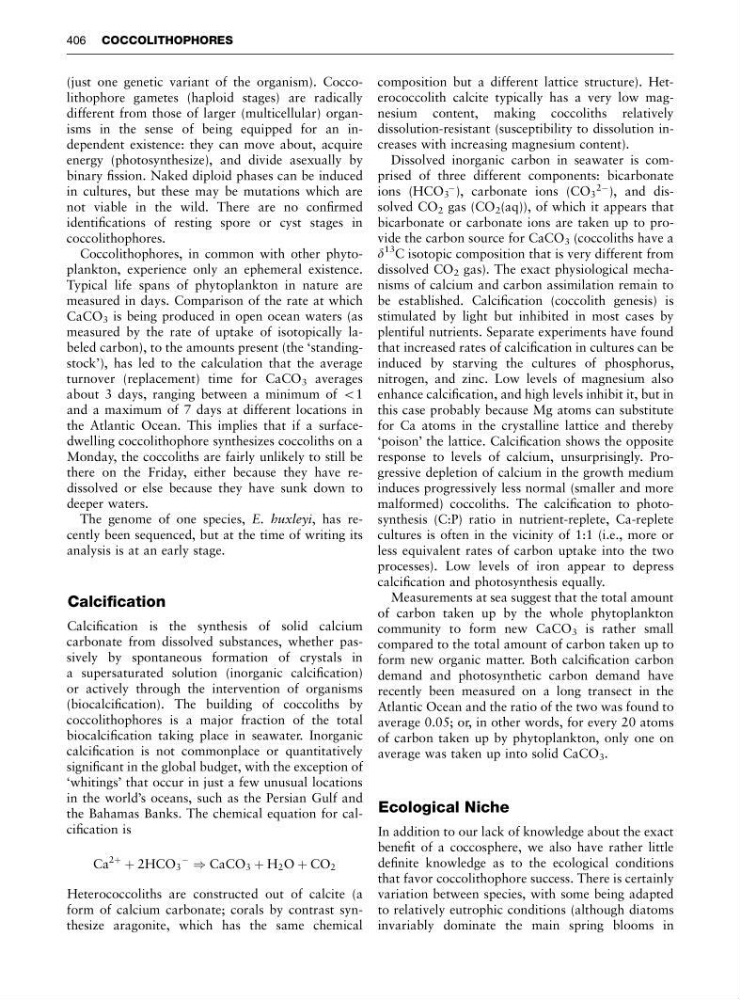
the Bahamas Banks. The chemical equation for calcification is
Ca
2þ þ 2HCO 3
À ) CaCO 3 þ H 2 O þ CO 2
Heterococcoliths are constructed out of calcite (a
form of calcium carbonate; corals by contrast synthesize aragonite, which has the same chemical
composition but a different lattice structure). Heterococcolith calcite typically has a very low magnesium content, making coccoliths relatively
dissolution-resistant (susceptibility to dissolution increases with increasing magnesium content).
Dissolved inorganic carbon in seawater is comprised of three different components: bicarbonate
ions (HCO 3
À ), carbonate ions (CO 3
2À ), and dissolved CO 2 gas (CO 2 (aq)), of which it appears that
bicarbonate or carbonate ions are taken up to provide the carbon source for CaCO 3 (coccoliths have a
d
13 C isotopic composition that is very different from
dissolved CO 2 gas). The exact physiological mechanisms of calcium and carbon assimilation remain to
be established. Calcification (coccolith genesis) is
stimulated by light but inhibited in most cases by
plentiful nutrients. Separate experiments have found
that increased rates of calcification in cultures can be
induced by starving the cultures of phosphorus,
nitrogen, and zinc. Low levels of magnesium also
enhance calcification, and high levels inhibit it, but in
this case probably because Mg atoms can substitute
for Ca atoms in the crystalline lattice and thereby
‘poison’ the lattice. Calcification shows the opposite
response to levels of calcium, unsurprisingly. Progressive depletion of calcium in the growth medium
induces progressively less normal (smaller and more
malformed) coccoliths. The calcification to photosynthesis (C:P) ratio in nutrient-replete, Ca-replete
cultures is often in the vicinity of 1:1 (i.e., more or
less equivalent rates of carbon uptake into the two
processes). Low levels of iron appear to depress
calcification and photosynthesis equally.
Measurements at sea suggest that the total amount
of carbon taken up by the whole phytoplankton
community to form new CaCO 3 is rather small
compared to the total amount of carbon taken up to
form new organic matter. Both calcification carbon
demand and photosynthetic carbon demand have
recently been measured on a long transect in the
Atlantic Ocean and the ratio of the two was found to
average 0.05; or, in other words, for every 20 atoms
of carbon taken up by phytoplankton, only one on
average was taken up into solid CaCO 3 .
Ecological Niche
In addition to our lack of knowledge about the exact
benefit of a coccosphere, we also have rather little
definite knowledge as to the ecological conditions
that favor coccolithophore success. There is certainly
variation between species, with some being adapted
to relatively eutrophic conditions (although diatoms
invariably dominate the main spring blooms in
406 COCCOLITHOPHORES
different from those of larger (multicellular) organisms in the sense of being equipped for an independent existence: they can move about, acquire
energy (photosynthesize), and divide asexually by
binary fission. Naked diploid phases can be induced
in cultures, but these may be mutations which are
not viable in the wild. There are no confirmed
identifications of resting spore or cyst stages in
coccolithophores.
Coccolithophores, in common with other phytoplankton, experience only an ephemeral existence.
Typical life spans of phytoplankton in nature are
measured in days. Comparison of the rate at which
CaCO 3 is being produced in open ocean waters (as
measured by the rate of uptake of isotopically labeled carbon), to the amounts present (the ‘standingstock’), has led to the calculation that the average
turnover (replacement) time for CaCO 3 averages
about 3 days, ranging between a minimum of o1
and a maximum of 7 days at different locations in
the Atlantic Ocean. This implies that if a surfacedwelling coccolithophore synthesizes coccoliths on a
Monday, the coccoliths are fairly unlikely to still be
there on the Friday, either because they have redissolved or else because they have sunk down to
deeper waters.
The genome of one species, E. huxleyi, has recently been sequenced, but at the time of writing its
analysis is at an early stage.
Calcification
Calcification is the synthesis of solid calcium
carbonate from dissolved substances, whether passively by spontaneous formation of crystals in
a supersaturated solution (inorganic calcification)
or actively through the intervention of organisms
(biocalcification). The building of coccoliths by
coccolithophores is a major fraction of the total
biocalcification taking place in seawater. Inorganic
calcification is not commonplace or quantitatively
significant in the global budget, with the exception of
‘whitings’ that occur in just a few unusual locations
in the world’s oceans, such as the Persian Gulf and
the Bahamas Banks. The chemical equation for calcification is
Ca
2þ þ 2HCO 3
À ) CaCO 3 þ H 2 O þ CO 2
Heterococcoliths are constructed out of calcite (a
form of calcium carbonate; corals by contrast synthesize aragonite, which has the same chemical
composition but a different lattice structure). Heterococcolith calcite typically has a very low magnesium content, making coccoliths relatively
dissolution-resistant (susceptibility to dissolution increases with increasing magnesium content).
Dissolved inorganic carbon in seawater is comprised of three different components: bicarbonate
ions (HCO 3
À ), carbonate ions (CO 3
2À ), and dissolved CO 2 gas (CO 2 (aq)), of which it appears that
bicarbonate or carbonate ions are taken up to provide the carbon source for CaCO 3 (coccoliths have a
d
13 C isotopic composition that is very different from
dissolved CO 2 gas). The exact physiological mechanisms of calcium and carbon assimilation remain to
be established. Calcification (coccolith genesis) is
stimulated by light but inhibited in most cases by
plentiful nutrients. Separate experiments have found
that increased rates of calcification in cultures can be
induced by starving the cultures of phosphorus,
nitrogen, and zinc. Low levels of magnesium also
enhance calcification, and high levels inhibit it, but in
this case probably because Mg atoms can substitute
for Ca atoms in the crystalline lattice and thereby
‘poison’ the lattice. Calcification shows the opposite
response to levels of calcium, unsurprisingly. Progressive depletion of calcium in the growth medium
induces progressively less normal (smaller and more
malformed) coccoliths. The calcification to photosynthesis (C:P) ratio in nutrient-replete, Ca-replete
cultures is often in the vicinity of 1:1 (i.e., more or
less equivalent rates of carbon uptake into the two
processes). Low levels of iron appear to depress
calcification and photosynthesis equally.
Measurements at sea suggest that the total amount
of carbon taken up by the whole phytoplankton
community to form new CaCO 3 is rather small
compared to the total amount of carbon taken up to
form new organic matter. Both calcification carbon
demand and photosynthetic carbon demand have
recently been measured on a long transect in the
Atlantic Ocean and the ratio of the two was found to
average 0.05; or, in other words, for every 20 atoms
of carbon taken up by phytoplankton, only one on
average was taken up into solid CaCO 3 .
Ecological Niche
In addition to our lack of knowledge about the exact
benefit of a coccosphere, we also have rather little
definite knowledge as to the ecological conditions
that favor coccolithophore success. There is certainly
variation between species, with some being adapted
to relatively eutrophic conditions (although diatoms
invariably dominate the main spring blooms in
406 COCCOLITHOPHORES