

Species and Distribution
Approximately 200 species of coccolithophore have
been formally described, separated into 65 genera.
However, the true number of authentic modern
coccolithophore species is rather unclear, for a couple of reasons. First, it is now realized that pairs of
species, previously thought to be distinct and rather
unrelated, are actually different life-cycle stages of
the same species; coccolithophores typically have life
cycles in which the haploid (single set of chromosomes, as in sex cells) and diploid (double set of
chromosomes) phases can form different coccolith
types: ‘heterococcoliths’ during the diploid life stage,
and ‘holococcoliths’ during the haploid life stage.
This type of life cycle has long been known from
classic studies of laboratory cultures. It has only recently been appreciated that it is a very widespread
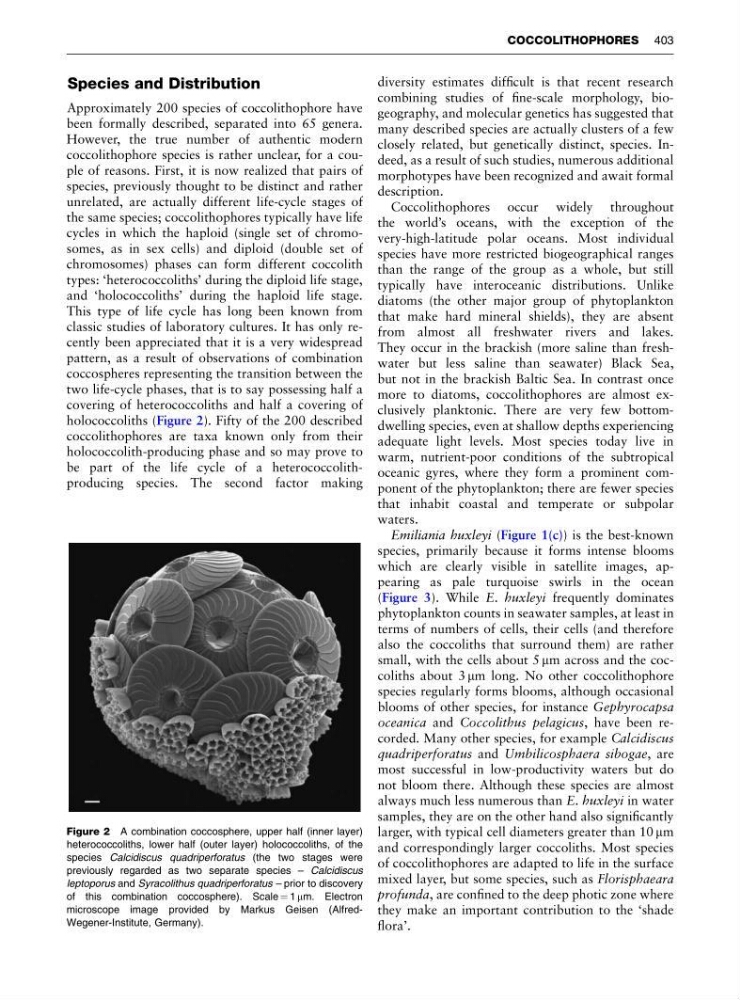
pattern, as a result of observations of combination
coccospheres representing the transition between the
two life-cycle phases, that is to say possessing half a
covering of heterococcoliths and half a covering of
holococcoliths (Figure 2). Fifty of the 200 described
coccolithophores are taxa known only from their
holococcolith-producing phase and so may prove to
be part of the life cycle of a heterococcolithproducing species. The second factor making
diversity estimates difficult is that recent research
combining studies of fine-scale morphology, biogeography, and molecular genetics has suggested that
many described species are actually clusters of a few
closely related, but genetically distinct, species. Indeed, as a result of such studies, numerous additional
morphotypes have been recognized and await formal
description.
Coccolithophores occur widely throughout
the world’s oceans, with the exception of the
very-high-latitude polar oceans. Most individual
species have more restricted biogeographical ranges
than the range of the group as a whole, but still
typically have interoceanic distributions. Unlike
diatoms (the other major group of phytoplankton
that make hard mineral shields), they are absent
from almost all freshwater rivers and lakes.
They occur in the brackish (more saline than freshwater but less saline than seawater) Black Sea,
but not in the brackish Baltic Sea. In contrast once
more to diatoms, coccolithophores are almost exclusively planktonic. There are very few bottomdwelling species, even at shallow depths experiencing
adequate light levels. Most species today live in
warm, nutrient-poor conditions of the subtropical
oceanic gyres, where they form a prominent component of the phytoplankton; there are fewer species
that inhabit coastal and temperate or subpolar
waters.
Emiliania huxleyi (Figure 1(c)) is the best-known
species, primarily because it forms intense blooms
which are clearly visible in satellite images, appearing as pale turquoise swirls in the ocean
(Figure 3). While E. huxleyi frequently dominates
phytoplankton counts in seawater samples, at least in
terms of numbers of cells, their cells (and therefore
also the coccoliths that surround them) are rather
small, with the cells about 5 mm across and the coccoliths about 3 mm long. No other coccolithophore
species regularly forms blooms, although occasional
blooms of other species, for instance Gephyrocapsa
oceanica and Coccolithus pelagicus, have been recorded. Many other species, for example Calcidiscus
quadriperforatus and Umbilicosphaera sibogae, are
most successful in low-productivity waters but do
not bloom there. Although these species are almost
always much less numerous than E. huxleyi in water
samples, they are on the other hand also significantly
larger, with typical cell diameters greater than 10 mm
and correspondingly larger coccoliths. Most species
of coccolithophores are adapted to life in the surface
mixed layer, but some species, such as Florisphaeara
profunda, are confined to the deep photic zone where
they make an important contribution to the ‘shade
flora’.
Figure 2 A combination coccosphere, upper half (inner layer)
heterococcoliths, lower half (outer layer) holococcoliths, of the
species Calcidiscus quadriperforatus (the two stages were
previously regarded as two separate species – Calcidiscus
leptoporus and Syracolithus quadriperforatus – prior to discovery
of this combination coccosphere). Scale ¼ 1 mm. Electron
microscope image provided by Markus Geisen (AlfredWegener-Institute, Germany).
COCCOLITHOPHORES 403
Approximately 200 species of coccolithophore have
been formally described, separated into 65 genera.
However, the true number of authentic modern
coccolithophore species is rather unclear, for a couple of reasons. First, it is now realized that pairs of
species, previously thought to be distinct and rather
unrelated, are actually different life-cycle stages of
the same species; coccolithophores typically have life
cycles in which the haploid (single set of chromosomes, as in sex cells) and diploid (double set of
chromosomes) phases can form different coccolith
types: ‘heterococcoliths’ during the diploid life stage,
and ‘holococcoliths’ during the haploid life stage.
This type of life cycle has long been known from
classic studies of laboratory cultures. It has only recently been appreciated that it is a very widespread
pattern, as a result of observations of combination
coccospheres representing the transition between the
two life-cycle phases, that is to say possessing half a
covering of heterococcoliths and half a covering of
holococcoliths (Figure 2). Fifty of the 200 described
coccolithophores are taxa known only from their
holococcolith-producing phase and so may prove to
be part of the life cycle of a heterococcolithproducing species. The second factor making
diversity estimates difficult is that recent research
combining studies of fine-scale morphology, biogeography, and molecular genetics has suggested that
many described species are actually clusters of a few
closely related, but genetically distinct, species. Indeed, as a result of such studies, numerous additional
morphotypes have been recognized and await formal
description.
Coccolithophores occur widely throughout
the world’s oceans, with the exception of the
very-high-latitude polar oceans. Most individual
species have more restricted biogeographical ranges
than the range of the group as a whole, but still
typically have interoceanic distributions. Unlike
diatoms (the other major group of phytoplankton
that make hard mineral shields), they are absent
from almost all freshwater rivers and lakes.
They occur in the brackish (more saline than freshwater but less saline than seawater) Black Sea,
but not in the brackish Baltic Sea. In contrast once
more to diatoms, coccolithophores are almost exclusively planktonic. There are very few bottomdwelling species, even at shallow depths experiencing
adequate light levels. Most species today live in
warm, nutrient-poor conditions of the subtropical
oceanic gyres, where they form a prominent component of the phytoplankton; there are fewer species
that inhabit coastal and temperate or subpolar
waters.
Emiliania huxleyi (Figure 1(c)) is the best-known
species, primarily because it forms intense blooms
which are clearly visible in satellite images, appearing as pale turquoise swirls in the ocean
(Figure 3). While E. huxleyi frequently dominates
phytoplankton counts in seawater samples, at least in
terms of numbers of cells, their cells (and therefore
also the coccoliths that surround them) are rather
small, with the cells about 5 mm across and the coccoliths about 3 mm long. No other coccolithophore
species regularly forms blooms, although occasional
blooms of other species, for instance Gephyrocapsa
oceanica and Coccolithus pelagicus, have been recorded. Many other species, for example Calcidiscus
quadriperforatus and Umbilicosphaera sibogae, are
most successful in low-productivity waters but do
not bloom there. Although these species are almost
always much less numerous than E. huxleyi in water
samples, they are on the other hand also significantly
larger, with typical cell diameters greater than 10 mm
and correspondingly larger coccoliths. Most species
of coccolithophores are adapted to life in the surface
mixed layer, but some species, such as Florisphaeara
profunda, are confined to the deep photic zone where
they make an important contribution to the ‘shade
flora’.
Figure 2 A combination coccosphere, upper half (inner layer)
heterococcoliths, lower half (outer layer) holococcoliths, of the
species Calcidiscus quadriperforatus (the two stages were
previously regarded as two separate species – Calcidiscus
leptoporus and Syracolithus quadriperforatus – prior to discovery
of this combination coccosphere). Scale ¼ 1 mm. Electron
microscope image provided by Markus Geisen (AlfredWegener-Institute, Germany).
COCCOLITHOPHORES 403