

COCCOLITHOPHORES
T. Tyrrell, National Oceanography Centre,
Southampton, UK
J. R. Young, The Natural History Museum, London,
UK
& 2009 Elsevier Ltd. All rights reserved.
Introduction
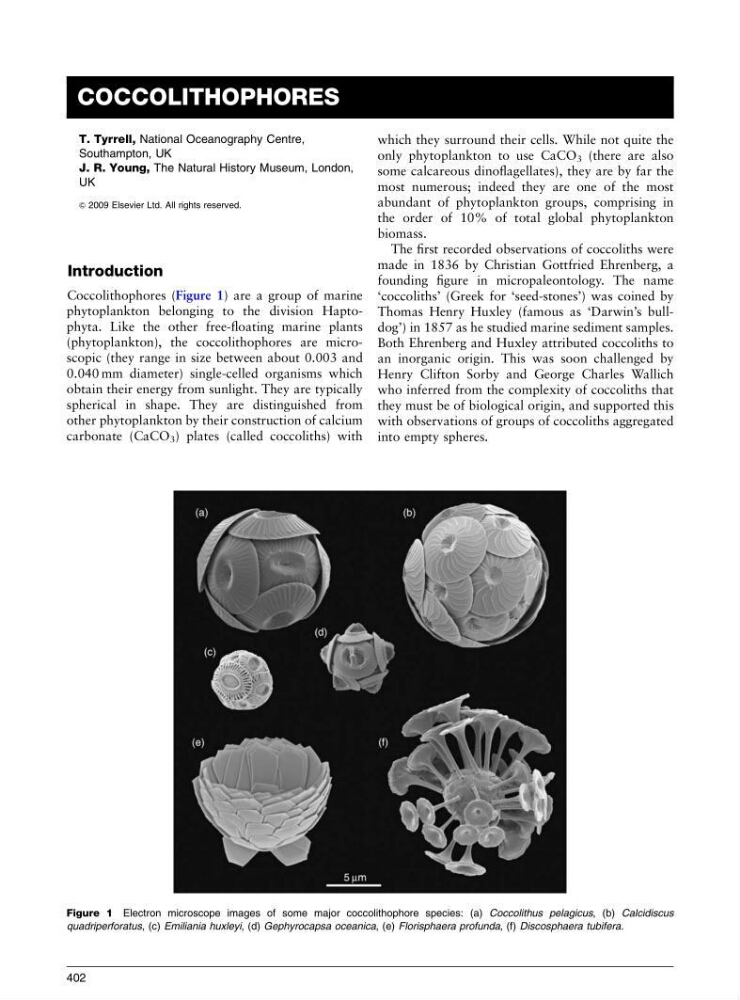
Coccolithophores (Figure 1) are a group of marine
phytoplankton belonging to the division Haptophyta. Like the other free-floating marine plants
(phytoplankton), the coccolithophores are microscopic (they range in size between about 0.003 and
0.040 mm diameter) single-celled organisms which
obtain their energy from sunlight. They are typically
spherical in shape. They are distinguished from
other phytoplankton by their construction of calcium
carbonate (CaCO 3 ) plates (called coccoliths) with
which they surround their cells. While not quite the
only phytoplankton to use CaCO 3 (there are also
some calcareous dinoflagellates), they are by far the
most numerous; indeed they are one of the most
abundant of phytoplankton groups, comprising in
the order of 10% of total global phytoplankton
biomass.
The first recorded observations of coccoliths were
made in 1836 by Christian Gottfried Ehrenberg, a
founding figure in micropaleontology. The name
‘coccoliths’ (Greek for ‘seed-stones’) was coined by
Thomas Henry Huxley (famous as ‘Darwin’s bulldog’) in 1857 as he studied marine sediment samples.
Both Ehrenberg and Huxley attributed coccoliths to
an inorganic origin. This was soon challenged by
Henry Clifton Sorby and George Charles Wallich
who inferred from the complexity of coccoliths that
they must be of biological origin, and supported this
with observations of groups of coccoliths aggregated
into empty spheres.
Figure 1 Electron microscope images of some major coccolithophore species: (a) Coccolithus pelagicus, (b) Calcidiscus
quadriperforatus, (c) Emiliania huxleyi, (d) Gephyrocapsa oceanica, (e) Florisphaera profunda, (f) Discosphaera tubifera.
402
T. Tyrrell, National Oceanography Centre,
Southampton, UK
J. R. Young, The Natural History Museum, London,
UK
& 2009 Elsevier Ltd. All rights reserved.
Introduction
Coccolithophores (Figure 1) are a group of marine
phytoplankton belonging to the division Haptophyta. Like the other free-floating marine plants
(phytoplankton), the coccolithophores are microscopic (they range in size between about 0.003 and
0.040 mm diameter) single-celled organisms which
obtain their energy from sunlight. They are typically
spherical in shape. They are distinguished from
other phytoplankton by their construction of calcium
carbonate (CaCO 3 ) plates (called coccoliths) with
which they surround their cells. While not quite the
only phytoplankton to use CaCO 3 (there are also
some calcareous dinoflagellates), they are by far the
most numerous; indeed they are one of the most
abundant of phytoplankton groups, comprising in
the order of 10% of total global phytoplankton
biomass.
The first recorded observations of coccoliths were
made in 1836 by Christian Gottfried Ehrenberg, a
founding figure in micropaleontology. The name
‘coccoliths’ (Greek for ‘seed-stones’) was coined by
Thomas Henry Huxley (famous as ‘Darwin’s bulldog’) in 1857 as he studied marine sediment samples.
Both Ehrenberg and Huxley attributed coccoliths to
an inorganic origin. This was soon challenged by
Henry Clifton Sorby and George Charles Wallich
who inferred from the complexity of coccoliths that
they must be of biological origin, and supported this
with observations of groups of coccoliths aggregated
into empty spheres.
Figure 1 Electron microscope images of some major coccolithophore species: (a) Coccolithus pelagicus, (b) Calcidiscus
quadriperforatus, (c) Emiliania huxleyi, (d) Gephyrocapsa oceanica, (e) Florisphaera profunda, (f) Discosphaera tubifera.
402