

mineral deposits precipitated on the seafloor on
magmatically active segments are often buried beneath frequent eruptions of new lava flows. The
greatest number of deposits, therefore, are observed
on inflated ridge segments that are surfaced by
somewhat older flows, i.e., along segments where:
(1) much heat is available to power hydrothermal
vents; and (2) mineral deposits have had time to
develop but have not yet been buried by renewed
eruptions.
Intermediate- and Slow-spreading Ridges
Most hydrothermal deposits that have been found
on intermediate- and slow-spreading ridge crests are
focused along faults, fissures, and volcanic structures within large rift valleys that are several kilometers wide. The fault scarps along the margins of
rift valleys are common sites for hydrothermal
venting and mineral deposition. Fault intersections
are thought to be particularly favorable sites for
hydrothermal mineral deposition because they are
zones of high permeability that can focus fluid flow.
Mineral deposition on rift valley floors is observed
along fissures above dike intrusions, along eruptive
fissures and volcanic collapse troughs, and on top of
volcanic mounds, cones and other constructions. In
general at slower-spreading ridges, faults appear to
play a greater role in controlling the distribution of
hydrothermal vents and mineral deposits than they
do at fast-spreading ridges, where magmatic fissures
are clearly a dominant geologic control on where
vents and deposits are forming.
Structures, Morphologies, and Sizes
of Deposits
A typical hydrothermal mineral deposit on an unsedimented mid-ocean ridge accumulates directly on top
of the volcanic flows covering the ridge crest. On
sedimented ridges, minerals are deposited within and
on top of the sediments. Beneath seafloor mineral deposits are networks of feeder cracks through which
fluids travel to the seafloor. Precipitation of hydrothermal minerals in these cracks and in the surrounding rocks or sediments creates a subseafloor zone
of mineralization called a ‘stockwork’. In hydrothermal systems where fluid flow is weak, unfocused,
or where the fluids mix extensively with sea water
beneath the seafloor, most of the minerals will precipitate in the stockwork rather than on the seafloor.
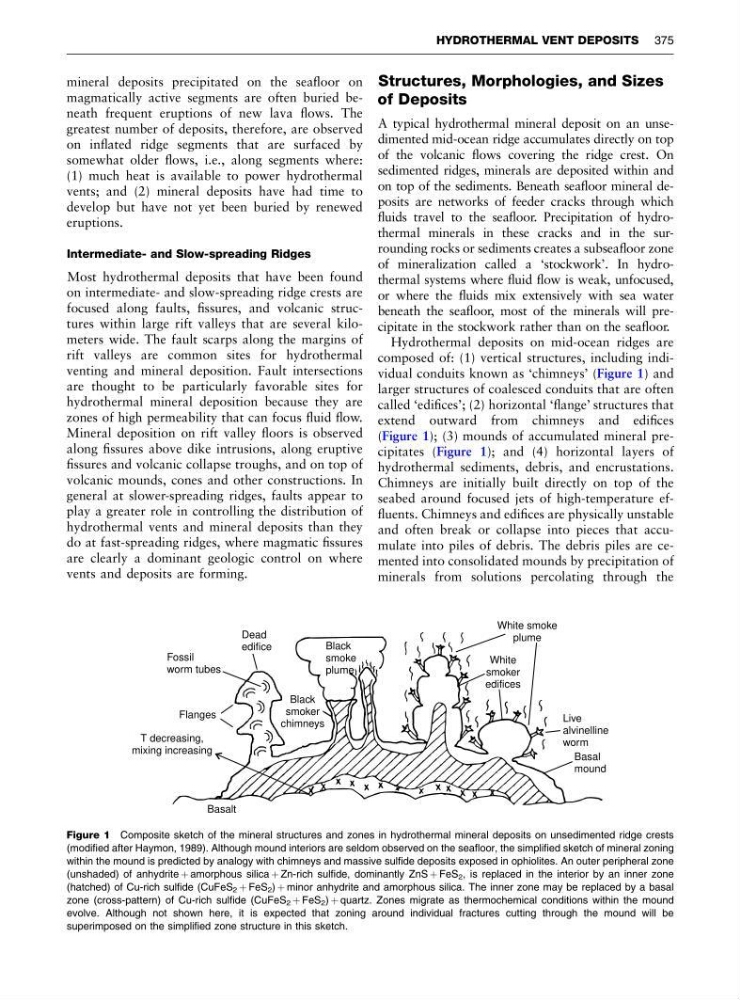
Hydrothermal deposits on mid-ocean ridges are
composed of: (1) vertical structures, including individual conduits known as ‘chimneys’ (Figure 1) and
larger structures of coalesced conduits that are often
called ‘edifices’; (2) horizontal ‘flange’ structures that
extend outward from chimneys and edifices
(Figure 1); (3) mounds of accumulated mineral precipitates (Figure 1); and (4) horizontal layers of
hydrothermal sediments, debris, and encrustations.
Chimneys are initially built directly on top of the
seabed around focused jets of high-temperature effluents. Chimneys and edifices are physically unstable
and often break or collapse into pieces that accumulate into piles of debris. The debris piles are cemented into consolidated mounds by precipitation of
minerals from solutions percolating through the
Dead
edifice
White smoke
plume
Fossil
worm tubes
Flanges
T decreasing,
mixing increasing
Black
smoker
chimneys
White
smoker
edifices
Live
alvinelline
worm
Basal
mound
Black
smoke
plume
Basalt
Figure 1 Composite sketch of the mineral structures and zones in hydrothermal mineral deposits on unsedimented ridge crests
(modified after Haymon, 1989). Although mound interiors are seldom observed on the seafloor, the simplified sketch of mineral zoning
within the mound is predicted by analogy with chimneys and massive sulfide deposits exposed in ophiolites. An outer peripheral zone
(unshaded) of anhydrite þ amorphous silica þ Zn-rich sulfide, dominantly ZnS þ FeS 2 , is replaced in the interior by an inner zone
(hatched) of Cu-rich sulfide (CuFeS 2 þ FeS 2 ) þ minor anhydrite and amorphous silica. The inner zone may be replaced by a basal
zone (cross-pattern) of Cu-rich sulfide (CuFeS 2 þ FeS 2 ) þ quartz. Zones migrate as thermochemical conditions within the mound
evolve. Although not shown here, it is expected that zoning around individual fractures cutting through the mound will be
superimposed on the simplified zone structure in this sketch.
HYDROTHERMAL VENT DEPOSITS 375
magmatically active segments are often buried beneath frequent eruptions of new lava flows. The
greatest number of deposits, therefore, are observed
on inflated ridge segments that are surfaced by
somewhat older flows, i.e., along segments where:
(1) much heat is available to power hydrothermal
vents; and (2) mineral deposits have had time to
develop but have not yet been buried by renewed
eruptions.
Intermediate- and Slow-spreading Ridges
Most hydrothermal deposits that have been found
on intermediate- and slow-spreading ridge crests are
focused along faults, fissures, and volcanic structures within large rift valleys that are several kilometers wide. The fault scarps along the margins of
rift valleys are common sites for hydrothermal
venting and mineral deposition. Fault intersections
are thought to be particularly favorable sites for
hydrothermal mineral deposition because they are
zones of high permeability that can focus fluid flow.
Mineral deposition on rift valley floors is observed
along fissures above dike intrusions, along eruptive
fissures and volcanic collapse troughs, and on top of
volcanic mounds, cones and other constructions. In
general at slower-spreading ridges, faults appear to
play a greater role in controlling the distribution of
hydrothermal vents and mineral deposits than they
do at fast-spreading ridges, where magmatic fissures
are clearly a dominant geologic control on where
vents and deposits are forming.
Structures, Morphologies, and Sizes
of Deposits
A typical hydrothermal mineral deposit on an unsedimented mid-ocean ridge accumulates directly on top
of the volcanic flows covering the ridge crest. On
sedimented ridges, minerals are deposited within and
on top of the sediments. Beneath seafloor mineral deposits are networks of feeder cracks through which
fluids travel to the seafloor. Precipitation of hydrothermal minerals in these cracks and in the surrounding rocks or sediments creates a subseafloor zone
of mineralization called a ‘stockwork’. In hydrothermal systems where fluid flow is weak, unfocused,
or where the fluids mix extensively with sea water
beneath the seafloor, most of the minerals will precipitate in the stockwork rather than on the seafloor.
Hydrothermal deposits on mid-ocean ridges are
composed of: (1) vertical structures, including individual conduits known as ‘chimneys’ (Figure 1) and
larger structures of coalesced conduits that are often
called ‘edifices’; (2) horizontal ‘flange’ structures that
extend outward from chimneys and edifices
(Figure 1); (3) mounds of accumulated mineral precipitates (Figure 1); and (4) horizontal layers of
hydrothermal sediments, debris, and encrustations.
Chimneys are initially built directly on top of the
seabed around focused jets of high-temperature effluents. Chimneys and edifices are physically unstable
and often break or collapse into pieces that accumulate into piles of debris. The debris piles are cemented into consolidated mounds by precipitation of
minerals from solutions percolating through the
Dead
edifice
White smoke
plume
Fossil
worm tubes
Flanges
T decreasing,
mixing increasing
Black
smoker
chimneys
White
smoker
edifices
Live
alvinelline
worm
Basal
mound
Black
smoke
plume
Basalt
Figure 1 Composite sketch of the mineral structures and zones in hydrothermal mineral deposits on unsedimented ridge crests
(modified after Haymon, 1989). Although mound interiors are seldom observed on the seafloor, the simplified sketch of mineral zoning
within the mound is predicted by analogy with chimneys and massive sulfide deposits exposed in ophiolites. An outer peripheral zone
(unshaded) of anhydrite þ amorphous silica þ Zn-rich sulfide, dominantly ZnS þ FeS 2 , is replaced in the interior by an inner zone
(hatched) of Cu-rich sulfide (CuFeS 2 þ FeS 2 ) þ minor anhydrite and amorphous silica. The inner zone may be replaced by a basal
zone (cross-pattern) of Cu-rich sulfide (CuFeS 2 þ FeS 2 ) þ quartz. Zones migrate as thermochemical conditions within the mound
evolve. Although not shown here, it is expected that zoning around individual fractures cutting through the mound will be
superimposed on the simplified zone structure in this sketch.
HYDROTHERMAL VENT DEPOSITS 375