

geomorphological changes and their aptitude for
long distance transportation, clay minerals are able
to express slight and progressive epeirogenic changes
as well as very remote tectonic events.
See also
Cenozoic Climate – Oxygen Isotope Evidence.
Hydrothermal Vent Deposits. Rare Earth Elements
and their Isotopes in the Ocean. River Inputs.
Further Reading
Bout-Roumazeilles V, Debrabant P, Labeyrie L, Chamley
H, and Cortijo E (1997) Latitudinal control of
astronomical forcing parameters on the high-resolution
clay mineral distribution in the 451–601 N range in the
North Atlantic Ocean during the past 300,000 years.
Paleoceanography 12: 671--686.
Buatier MD and Karpoff AM (1995) Authigene ´se et
e ´volution
d’argiles
hydrothermales
oce ´aniques:
exemples des monts des Galapagos et des se ´diments de
la ride de Juan de Fuca. Bulletin de la Socie ´te ´
Ge ´ologique de France 166: 123--136.
Chamley H (1989) Clay Sedimentology. Berlin: SpringerVerlag.
Hoffert M (1980) Les ‘argiles rouges des grands fonds’
dans le Pacifique centre-est. Sciences ge ´ologique.
Strasbourg, Mem 61: 257.
Millot G (1970) Geology of Clays. Berlin: Springer-Verlag.
Odin GS (ed.) (1988) Green Marine Clays. Developments
in Sedimentology, 45, Amsterdam: Elsevier.
Robert C and Chamley H (1992) Late Eocene-early
Oligocene evolution of climate and marine circulation:
deep-sea clay mineral evidence. American Geophysical
Union. Antarctic Research Series 56: 97--117.
Vanderaveroet P, Averbuch O, Deconinck JF, and Chamley
H (1999) A record of glacial/interglacial alternations in
Pleistocene sediments off New Jersey expressed by clay
mineral, grain-size and magnetic susceptibility data.
Marine Geology 159: 79--92.
Weaver CE (1999) Clays, Muds, and Shales. Developments
in Sedimentology, 44. Amsterdam: Elsevier.
Windom HL (1976) Lithogenous material in marine
sediments. Chemical Oceanography vol. 5, pp. 103--135.
New York: Academic Press.
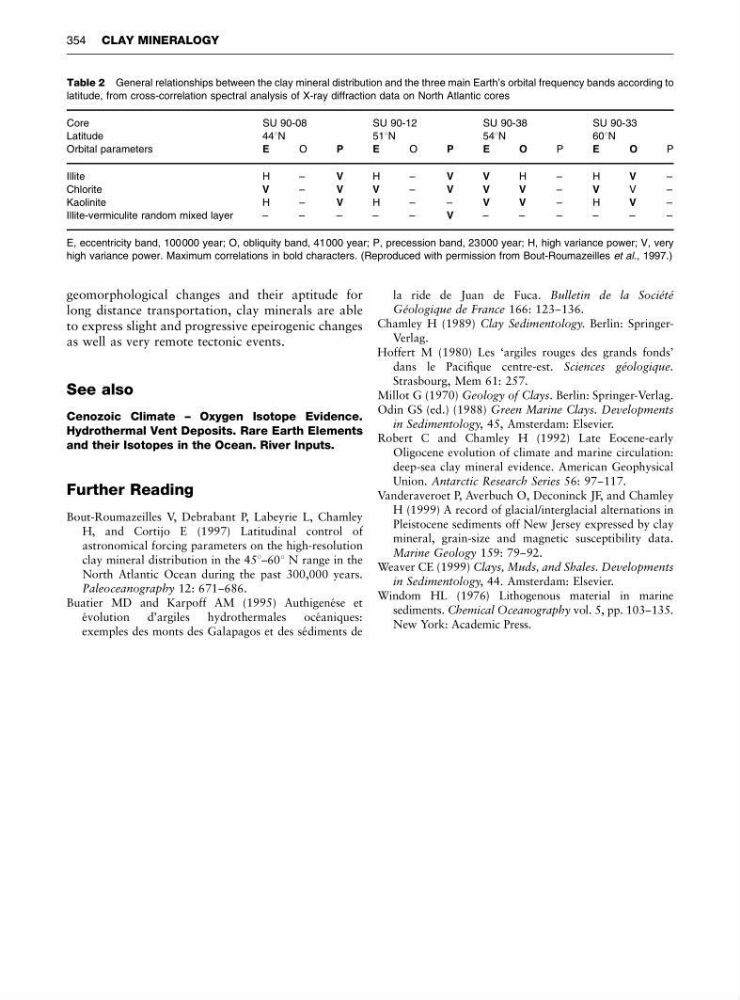
Table 2 General relationships between the clay mineral distribution and the three main Earth’s orbital frequency bands according to
latitude, from cross-correlation spectral analysis of X-ray diffraction data on North Atlantic cores
Core
SU 90-08
SU 90-12
SU 90-38
SU 90-33
Latitude
441N
5 1 1N
5 4 1N
6 0 1N
Orbital parameters
E
O
P
E
O
P
E
O
P
E
O
P
Illite
H
–
V
H
–
V
V
H
–
H
V
–
Chlorite
V
–
V
V
–
V
V
V
–
V
V
–
Kaolinite
H
–
V
H
–
–
V
V
–
H
V
–
Illite-vermiculite random mixed layer
–
–
–
–
–
V
–
–
–
–
–
–
E, eccentricity band, 100000 year; O, obliquity band, 41000 year; P, precession band, 23000 year; H, high variance power; V, very
high variance power. Maximum correlations in bold characters. (Reproduced with permission from Bout-Roumazeilles et al., 1997.)
354 CLAY MINERALOGY
long distance transportation, clay minerals are able
to express slight and progressive epeirogenic changes
as well as very remote tectonic events.
See also
Cenozoic Climate – Oxygen Isotope Evidence.
Hydrothermal Vent Deposits. Rare Earth Elements
and their Isotopes in the Ocean. River Inputs.
Further Reading
Bout-Roumazeilles V, Debrabant P, Labeyrie L, Chamley
H, and Cortijo E (1997) Latitudinal control of
astronomical forcing parameters on the high-resolution
clay mineral distribution in the 451–601 N range in the
North Atlantic Ocean during the past 300,000 years.
Paleoceanography 12: 671--686.
Buatier MD and Karpoff AM (1995) Authigene ´se et
e ´volution
d’argiles
hydrothermales
oce ´aniques:
exemples des monts des Galapagos et des se ´diments de
la ride de Juan de Fuca. Bulletin de la Socie ´te ´
Ge ´ologique de France 166: 123--136.
Chamley H (1989) Clay Sedimentology. Berlin: SpringerVerlag.
Hoffert M (1980) Les ‘argiles rouges des grands fonds’
dans le Pacifique centre-est. Sciences ge ´ologique.
Strasbourg, Mem 61: 257.
Millot G (1970) Geology of Clays. Berlin: Springer-Verlag.
Odin GS (ed.) (1988) Green Marine Clays. Developments
in Sedimentology, 45, Amsterdam: Elsevier.
Robert C and Chamley H (1992) Late Eocene-early
Oligocene evolution of climate and marine circulation:
deep-sea clay mineral evidence. American Geophysical
Union. Antarctic Research Series 56: 97--117.
Vanderaveroet P, Averbuch O, Deconinck JF, and Chamley
H (1999) A record of glacial/interglacial alternations in
Pleistocene sediments off New Jersey expressed by clay
mineral, grain-size and magnetic susceptibility data.
Marine Geology 159: 79--92.
Weaver CE (1999) Clays, Muds, and Shales. Developments
in Sedimentology, 44. Amsterdam: Elsevier.
Windom HL (1976) Lithogenous material in marine
sediments. Chemical Oceanography vol. 5, pp. 103--135.
New York: Academic Press.
Table 2 General relationships between the clay mineral distribution and the three main Earth’s orbital frequency bands according to
latitude, from cross-correlation spectral analysis of X-ray diffraction data on North Atlantic cores
Core
SU 90-08
SU 90-12
SU 90-38
SU 90-33
Latitude
441N
5 1 1N
5 4 1N
6 0 1N
Orbital parameters
E
O
P
E
O
P
E
O
P
E
O
P
Illite
H
–
V
H
–
V
V
H
–
H
V
–
Chlorite
V
–
V
V
–
V
V
V
–
V
V
–
Kaolinite
H
–
V
H
–
–
V
V
–
H
V
–
Illite-vermiculite random mixed layer
–
–
–
–
–
V
–
–
–
–
–
–
E, eccentricity band, 100000 year; O, obliquity band, 41000 year; P, precession band, 23000 year; H, high variance power; V, very
high variance power. Maximum correlations in bold characters. (Reproduced with permission from Bout-Roumazeilles et al., 1997.)
354 CLAY MINERALOGY