

vertical heat transfers. The direct paleoclimatic reconstructions from clay mineral data are all the more
reliable since the marine basins investigated are
preserved from important erosion of paleosoils,
changes in detrital sources, differential settling processes, longitudinal oceanic currents, and major
geomorphological changes.
Marine Currents
The different marine water masses may carry the
small and light clay mineral particles over long
distances, and therefore leave an imprint within
the sediments at the depth range they are moving.
This has been demonstrated for late Quaternary
sediments of the southwestern Atlantic, where the
southward-flowing North Atlantic deep water is
enriched in kaolinite supplied from rivers draining
the intertropical South American continent, and
the northward flowing Antarctic Atlantic bottom
water supplies chlorite and smectite issuing from
southernmost Argentina and Antarctica. Paleocurrent reconstructions from clay data exist mainly
about Atlantic and Southern Oceans, which are
marked by numerous and distinct terrigenous
sources, vertical mixing and longitudinal heat
transfers, and Tertiary to Quaternary changing
conditions of the superimposed water masses volume and celerity.
Tectonic Activity
The tectonic instability determines some changes in
the composition of clay mineral assemblages which
are usually much more important than those due to
climate or circulation. First, the subpermanent rejuvenation by neotectonics of continental relief increases the erosion potential and therefore impedes
the development of pedogenic blankets where clay
minerals tend to be in equilibrium with current climatic conditions. Such a chronic tectonic activity
explains the abundance of rock-derived illite and
chlorite in equatorial Indian Ocean basins depending
on Himalayan output. Second, a continental tectonic
uplift determines changes in the nature of clay minerals eroded from rocky substrates, while submarine
uplift may determine morphological barriers to the
clay transfer. This was the case for the Hellenic
Trench in the eastern Mediterranean during late
Pliocene to early Pleistocene periods, when the
combined uplift of Peloponnese and of Mediterranean ridge both increased the terrigenous input of
European illite and chlorite and blocked the supply
of African palygorskite. Due to their sensitivity to
500
450
400
350
300
250
200
150
100
Stage 11
Stage 12
Stage 9
Stage 8
Stage 10
Stage 7
Stage 5
Stage 6
Age before present (ky)
2
0
_ 2
Cold
Temperate
Oxygen isotope curve
O
δ
18
2.5
2.5
5.0
5.0
7.5
7.5
10.0
10.0
12.5
12.5
Kaolinite %
0.5
1.0
1.5
Kaolinite / chlorite
ratio
Increasing weathering
130
120
110
100
90
80
70
60
50
40
30
20
10
0
Chlorite %
Depth (mbsf)
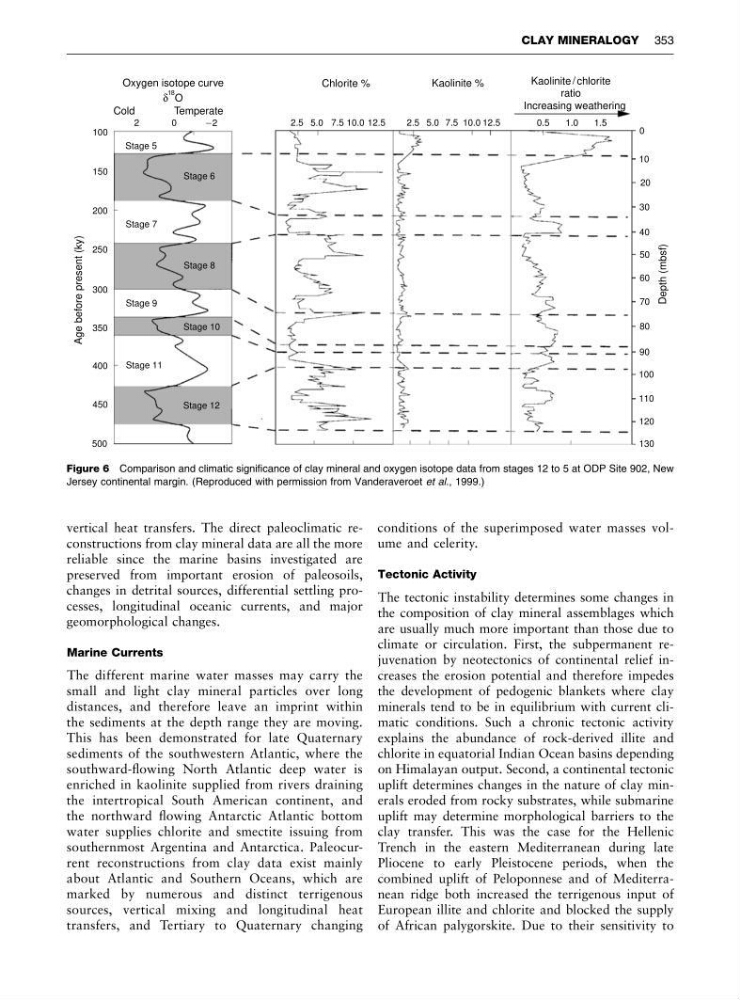
Figure 6 Comparison and climatic significance of clay mineral and oxygen isotope data from stages 12 to 5 at ODP Site 902, New
Jersey continental margin. (Reproduced with permission from Vanderaveroet et al., 1999.)
CLAY MINERALOGY 353
reliable since the marine basins investigated are
preserved from important erosion of paleosoils,
changes in detrital sources, differential settling processes, longitudinal oceanic currents, and major
geomorphological changes.
Marine Currents
The different marine water masses may carry the
small and light clay mineral particles over long
distances, and therefore leave an imprint within
the sediments at the depth range they are moving.
This has been demonstrated for late Quaternary
sediments of the southwestern Atlantic, where the
southward-flowing North Atlantic deep water is
enriched in kaolinite supplied from rivers draining
the intertropical South American continent, and
the northward flowing Antarctic Atlantic bottom
water supplies chlorite and smectite issuing from
southernmost Argentina and Antarctica. Paleocurrent reconstructions from clay data exist mainly
about Atlantic and Southern Oceans, which are
marked by numerous and distinct terrigenous
sources, vertical mixing and longitudinal heat
transfers, and Tertiary to Quaternary changing
conditions of the superimposed water masses volume and celerity.
Tectonic Activity
The tectonic instability determines some changes in
the composition of clay mineral assemblages which
are usually much more important than those due to
climate or circulation. First, the subpermanent rejuvenation by neotectonics of continental relief increases the erosion potential and therefore impedes
the development of pedogenic blankets where clay
minerals tend to be in equilibrium with current climatic conditions. Such a chronic tectonic activity
explains the abundance of rock-derived illite and
chlorite in equatorial Indian Ocean basins depending
on Himalayan output. Second, a continental tectonic
uplift determines changes in the nature of clay minerals eroded from rocky substrates, while submarine
uplift may determine morphological barriers to the
clay transfer. This was the case for the Hellenic
Trench in the eastern Mediterranean during late
Pliocene to early Pleistocene periods, when the
combined uplift of Peloponnese and of Mediterranean ridge both increased the terrigenous input of
European illite and chlorite and blocked the supply
of African palygorskite. Due to their sensitivity to
500
450
400
350
300
250
200
150
100
Stage 11
Stage 12
Stage 9
Stage 8
Stage 10
Stage 7
Stage 5
Stage 6
Age before present (ky)
2
0
_ 2
Cold
Temperate
Oxygen isotope curve
O
δ
18
2.5
2.5
5.0
5.0
7.5
7.5
10.0
10.0
12.5
12.5
Kaolinite %
0.5
1.0
1.5
Kaolinite / chlorite
ratio
Increasing weathering
130
120
110
100
90
80
70
60
50
40
30
20
10
0
Chlorite %
Depth (mbsf)
Figure 6 Comparison and climatic significance of clay mineral and oxygen isotope data from stages 12 to 5 at ODP Site 902, New
Jersey continental margin. (Reproduced with permission from Vanderaveroet et al., 1999.)
CLAY MINERALOGY 353