

effects, as the marine clay associations are roughly
the same as the terrestrial associations.
The chemical impact on clay mineral stability of
the organic matter incorporated in deep marine
sediments is variable. Most sedimentary series containing significant amounts of dispersed organic
matter (i.e., 1–3%) do not display any specific clay
mineral composition. For example, this is the case
for black shales deposited during the Cretaceous
period in the Atlantic, where clay mineral
associations may comprise vulnerable species such as
smectite and palygorskite, the abundance and crystalline status of which vary independently of the
content and distribution of the organic matter. In
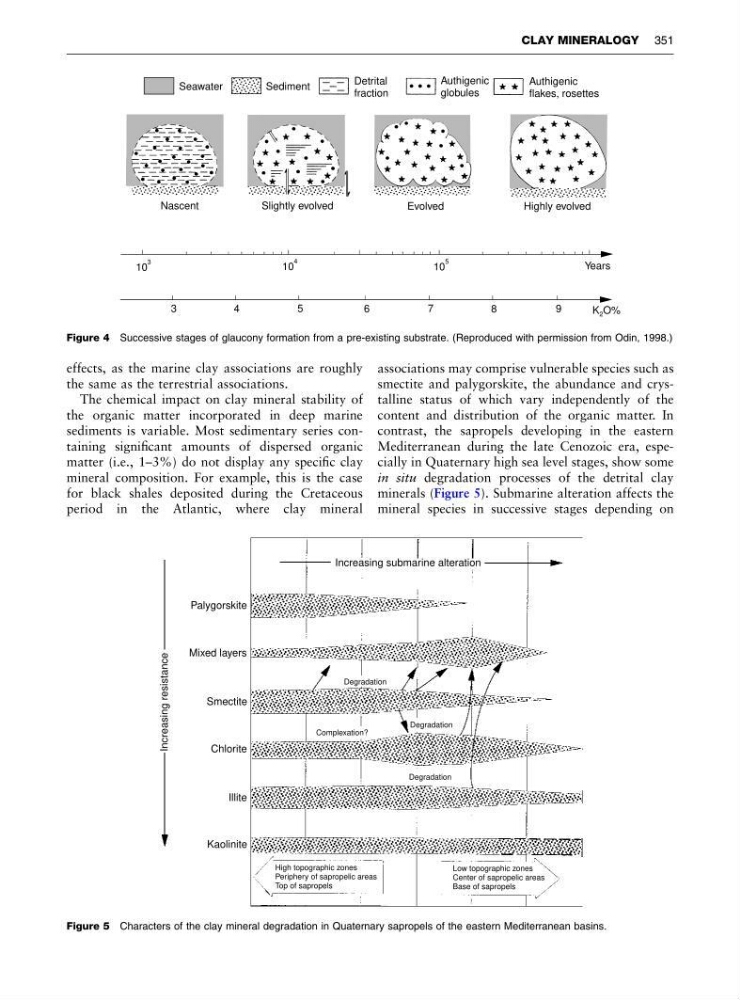
contrast, the sapropels developing in the eastern
Mediterranean during the late Cenozoic era, especially in Quaternary high sea level stages, show some
in situ degradation processes of the detrital clay
minerals (Figure 5). Submarine alteration affects the
mineral species in successive stages depending on
Seawater
Sediment
Detrital
fraction
Authigenic
globules
Authigenic
flakes, rosettes
3
4
5
6
7
8
9
K O%
2
10
3
10
4
10
5
Years
Nascent
Slightly evolved
Highly evolved
Evolved
Figure 4 Successive stages of glaucony formation from a pre-existing substrate. (Reproduced with permission from Odin, 1998.)
High topographic zones
Periphery of sapropelic areas
Top of sapropels
Low topographic zones
Center of sapropelic areas
Base of sapropels
Kaolinite
Illite
Chlorite
Smectite
Mixed layers
Palygorskite
Degradation
Degradation
Degradation
Complexation?
Increasing submarine alteration
Increasing resistance
Figure 5 Characters of the clay mineral degradation in Quaternary sapropels of the eastern Mediterranean basins.
CLAY MINERALOGY 351
the same as the terrestrial associations.
The chemical impact on clay mineral stability of
the organic matter incorporated in deep marine
sediments is variable. Most sedimentary series containing significant amounts of dispersed organic
matter (i.e., 1–3%) do not display any specific clay
mineral composition. For example, this is the case
for black shales deposited during the Cretaceous
period in the Atlantic, where clay mineral
associations may comprise vulnerable species such as
smectite and palygorskite, the abundance and crystalline status of which vary independently of the
content and distribution of the organic matter. In
contrast, the sapropels developing in the eastern
Mediterranean during the late Cenozoic era, especially in Quaternary high sea level stages, show some
in situ degradation processes of the detrital clay
minerals (Figure 5). Submarine alteration affects the
mineral species in successive stages depending on
Seawater
Sediment
Detrital
fraction
Authigenic
globules
Authigenic
flakes, rosettes
3
4
5
6
7
8
9
K O%
2
10
3
10
4
10
5
Years
Nascent
Slightly evolved
Highly evolved
Evolved
Figure 4 Successive stages of glaucony formation from a pre-existing substrate. (Reproduced with permission from Odin, 1998.)
High topographic zones
Periphery of sapropelic areas
Top of sapropels
Low topographic zones
Center of sapropelic areas
Base of sapropels
Kaolinite
Illite
Chlorite
Smectite
Mixed layers
Palygorskite
Degradation
Degradation
Degradation
Complexation?
Increasing submarine alteration
Increasing resistance
Figure 5 Characters of the clay mineral degradation in Quaternary sapropels of the eastern Mediterranean basins.
CLAY MINERALOGY 351