

sediments. Concurrent encroachment of the OMZ
onto the continental shelf-slope during marine transgressions increases the extent of organic matter preservation. When combined, these effects are thought to
promote initial phosphorite formation. Subsequent
marine regressions may enhance the initial enrichment
by winnowing detritus from older phosphatic sediments, producing deposits of economic value.
Insular phosphorites are relatively easily understood
deposits from guano in the nesting areas of ancient sea
birds that created the ore deposit by transporting and
further biologically concentrating scarce dissolved
phosphate in surface sea waters within the flight radius
of the island. The island of Nauru in the central
Equatorial Pacific is a prime example. Although some
are presently submerged, these deposits have all formed
subaerially and are no older than Tertiary.
Comparatively less is known about the formation
of seamount phosphorites. Substrate samples show
cryptocrystalline CFA matrix replacement of preexisting limestones that often contain altered basalt
breccia and other evidence of high-energy deposition
upon the summits and upper slopes of Cretaceous
seamounts in the Pacific (Figure 5). Within ferromanganese crusts, these deposits show the effects of
lowered redox conditions (e.g., platinum remobilization) with impregnation and replacement of older
ferromanganese oxides. Strontium and oxygen isotope-derived ages of CFA formation appear to center
on the Eocene–Oligocene (36 Ma) and Oligocene–
Miocene (24 Ma) boundaries, with some evidence
for a minor Middle Miocene event at about 15 Ma.
Paleotracking of the Pacific Cretaceous seamounts
shows that many were close to the equatorial high
productivity belt during the late Cretaceous and
Paleocene–Eocene periods, where their then-shallower summits and slopes could have intersected the
OMZ in a region of equatorial upwelling. Later depositional episodes would require a greatly expanded
and more intense OMZ than the present one.
Marine Barite and Authigenic
Silicates
Marine Barite
Barite (BaSO 4 ) is a widespread mineral in deep-sea
sediments, varying between 1 and 10 wt% on a carbonate-free basis. It is the predominant barium phase
in the ocean. BaSO 4 is known to compose a solid solution series with SrSO 4 as celestobarite in the skeletal
portions of some marine organisms (i.e., the Xenophyophoria) and is often found in association with
marine organic matter, such as in suspended particles
and fecal pellets. Barite is also a well-known gangue
mineral in hydrothermal deposits on land and has more
recently been found as a principal component of
moderate-temperature hydrothermal chimneys on midocean ridges and volcanically active seamounts. Early
work on the distribution of marine barite in deep-sea
sediments had difficulty distinguishing the relative importance of hydrothermal sources from continental
weathering as cycled through the marine biosphere.
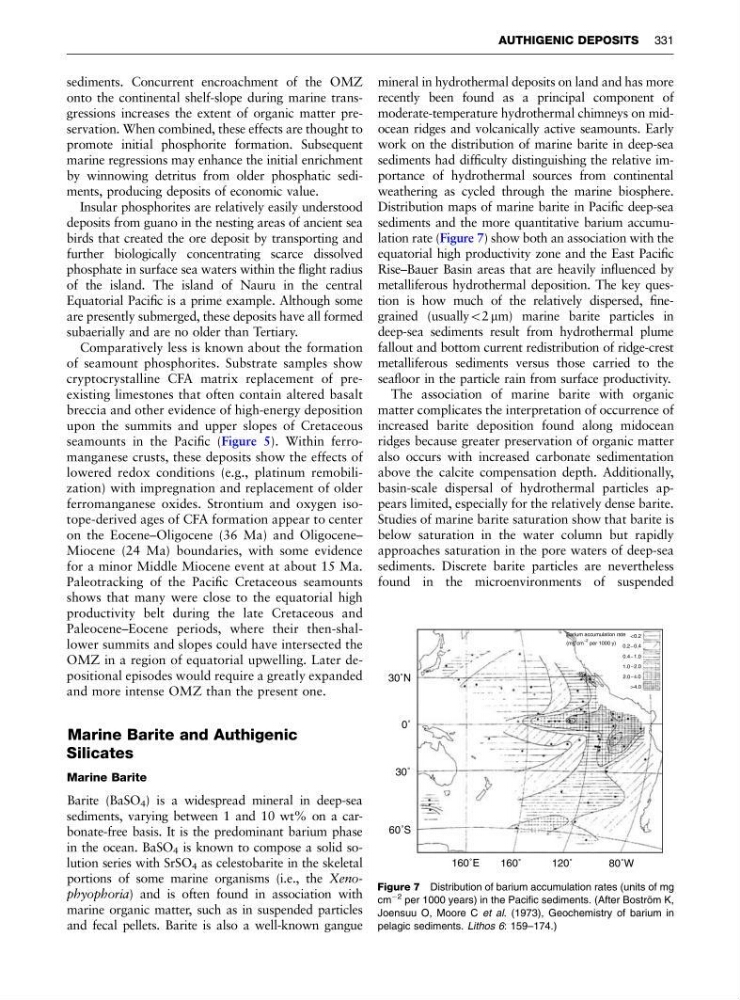
Distribution maps of marine barite in Pacific deep-sea
sediments and the more quantitative barium accumulation rate (Figure 7) show both an association with the
equatorial high productivity zone and the East Pacific
Rise–Bauer Basin areas that are heavily influenced by
metalliferous hydrothermal deposition. The key question is how much of the relatively dispersed, finegrained (usuallyo2 mm) marine barite particles in
deep-sea sediments result from hydrothermal plume
fallout and bottom current redistribution of ridge-crest
metalliferous sediments versus those carried to the
seafloor in the particle rain from surface productivity.
The association of marine barite with organic
matter complicates the interpretation of occurrence of
increased barite deposition found along midocean
ridges because greater preservation of organic matter
also occurs with increased carbonate sedimentation
above the calcite compensation depth. Additionally,
basin-scale dispersal of hydrothermal particles appears limited, especially for the relatively dense barite.
Studies of marine barite saturation show that barite is
below saturation in the water column but rapidly
approaches saturation in the pore waters of deep-sea
sediments. Discrete barite particles are nevertheless
found in the microenvironments of suspended
Figure 7 Distribution of barium accumulation rates (units of mg
cm
À2 per 1000 years) in the Pacific sediments. (After Bostro ¨ m K,
Joensuu O, Moore C et al. (1973), Geochemistry of barium in
pelagic sediments. Lithos 6: 159–174.)
AUTHIGENIC DEPOSITS 331
onto the continental shelf-slope during marine transgressions increases the extent of organic matter preservation. When combined, these effects are thought to
promote initial phosphorite formation. Subsequent
marine regressions may enhance the initial enrichment
by winnowing detritus from older phosphatic sediments, producing deposits of economic value.
Insular phosphorites are relatively easily understood
deposits from guano in the nesting areas of ancient sea
birds that created the ore deposit by transporting and
further biologically concentrating scarce dissolved
phosphate in surface sea waters within the flight radius
of the island. The island of Nauru in the central
Equatorial Pacific is a prime example. Although some
are presently submerged, these deposits have all formed
subaerially and are no older than Tertiary.
Comparatively less is known about the formation
of seamount phosphorites. Substrate samples show
cryptocrystalline CFA matrix replacement of preexisting limestones that often contain altered basalt
breccia and other evidence of high-energy deposition
upon the summits and upper slopes of Cretaceous
seamounts in the Pacific (Figure 5). Within ferromanganese crusts, these deposits show the effects of
lowered redox conditions (e.g., platinum remobilization) with impregnation and replacement of older
ferromanganese oxides. Strontium and oxygen isotope-derived ages of CFA formation appear to center
on the Eocene–Oligocene (36 Ma) and Oligocene–
Miocene (24 Ma) boundaries, with some evidence
for a minor Middle Miocene event at about 15 Ma.
Paleotracking of the Pacific Cretaceous seamounts
shows that many were close to the equatorial high
productivity belt during the late Cretaceous and
Paleocene–Eocene periods, where their then-shallower summits and slopes could have intersected the
OMZ in a region of equatorial upwelling. Later depositional episodes would require a greatly expanded
and more intense OMZ than the present one.
Marine Barite and Authigenic
Silicates
Marine Barite
Barite (BaSO 4 ) is a widespread mineral in deep-sea
sediments, varying between 1 and 10 wt% on a carbonate-free basis. It is the predominant barium phase
in the ocean. BaSO 4 is known to compose a solid solution series with SrSO 4 as celestobarite in the skeletal
portions of some marine organisms (i.e., the Xenophyophoria) and is often found in association with
marine organic matter, such as in suspended particles
and fecal pellets. Barite is also a well-known gangue
mineral in hydrothermal deposits on land and has more
recently been found as a principal component of
moderate-temperature hydrothermal chimneys on midocean ridges and volcanically active seamounts. Early
work on the distribution of marine barite in deep-sea
sediments had difficulty distinguishing the relative importance of hydrothermal sources from continental
weathering as cycled through the marine biosphere.
Distribution maps of marine barite in Pacific deep-sea
sediments and the more quantitative barium accumulation rate (Figure 7) show both an association with the
equatorial high productivity zone and the East Pacific
Rise–Bauer Basin areas that are heavily influenced by
metalliferous hydrothermal deposition. The key question is how much of the relatively dispersed, finegrained (usuallyo2 mm) marine barite particles in
deep-sea sediments result from hydrothermal plume
fallout and bottom current redistribution of ridge-crest
metalliferous sediments versus those carried to the
seafloor in the particle rain from surface productivity.
The association of marine barite with organic
matter complicates the interpretation of occurrence of
increased barite deposition found along midocean
ridges because greater preservation of organic matter
also occurs with increased carbonate sedimentation
above the calcite compensation depth. Additionally,
basin-scale dispersal of hydrothermal particles appears limited, especially for the relatively dense barite.
Studies of marine barite saturation show that barite is
below saturation in the water column but rapidly
approaches saturation in the pore waters of deep-sea
sediments. Discrete barite particles are nevertheless
found in the microenvironments of suspended
Figure 7 Distribution of barium accumulation rates (units of mg
cm
À2 per 1000 years) in the Pacific sediments. (After Bostro ¨ m K,
Joensuu O, Moore C et al. (1973), Geochemistry of barium in
pelagic sediments. Lithos 6: 159–174.)
AUTHIGENIC DEPOSITS 331