

Phosphorites
Submarine phosphorites are principally composed of
CFA or francolite with usually large admixtures of
detrital impurities from the sediments in which they
form or replace during authigenesis. Concentrations
of P 2 O 5 commonly range from 5 to 28 wt%, reaching
values of 35 wt%, with minor element enrichments of
strontium, yttrium, and the REE. There are three
principal types of phosphorite deposits in the world’s
oceans: offshore or continental shelf-slope nodules
and concretions; massive insular deposits originating
from sea bird guano; and ‘seamount’ phosphorites
that often associate with ferromanganese crusts as
layers, veins, impregnations, and substrate material
(Figure 5). Submarine phosphorites were originally
thought to be fossil deposits no younger than Miocene
age, like those marine phosphorites mined on land,
but were subsequently found to be actively forming in
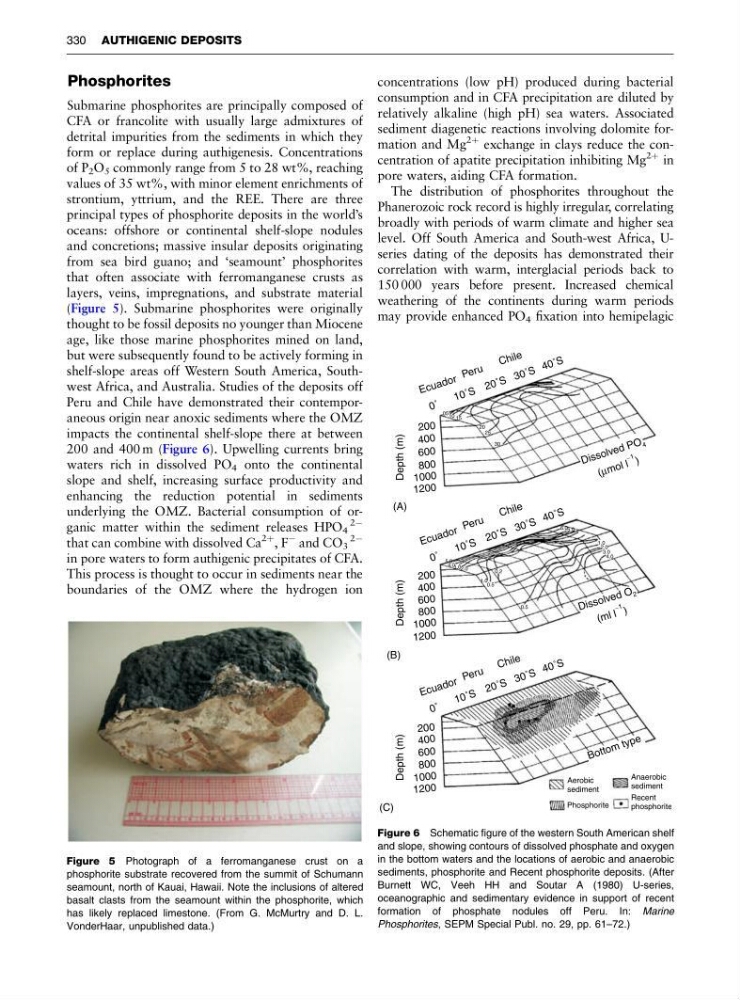
shelf-slope areas off Western South America, Southwest Africa, and Australia. Studies of the deposits off
Peru and Chile have demonstrated their contemporaneous origin near anoxic sediments where the OMZ
impacts the continental shelf-slope there at between
200 and 400 m (Figure 6). Upwelling currents bring
waters rich in dissolved PO 4 onto the continental
slope and shelf, increasing surface productivity and
enhancing the reduction potential in sediments
underlying the OMZ. Bacterial consumption of organic matter within the sediment releases HPO 4
2À
that can combine with dissolved Ca
2þ , F
À and CO 3
2À
in pore waters to form authigenic precipitates of CFA.
This process is thought to occur in sediments near the
boundaries of the OMZ where the hydrogen ion
concentrations (low pH) produced during bacterial
consumption and in CFA precipitation are diluted by
relatively alkaline (high pH) sea waters. Associated
sediment diagenetic reactions involving dolomite formation and Mg
2þ exchange in clays reduce the concentration of apatite precipitation inhibiting Mg
2þ in
pore waters, aiding CFA formation.
The distribution of phosphorites throughout the
Phanerozoic rock record is highly irregular, correlating
broadly with periods of warm climate and higher sea
level. Off South America and South-west Africa, Useries dating of the deposits has demonstrated their
correlation with warm, interglacial periods back to
150 000 years before present. Increased chemical
weathering of the continents during warm periods
may provide enhanced PO 4 fixation into hemipelagic
Figure 5 Photograph of a ferromanganese crust on a
phosphorite substrate recovered from the summit of Schumann
seamount, north of Kauai, Hawaii. Note the inclusions of altered
basalt clasts from the seamount within the phosphorite, which
has likely replaced limestone. (From G. McMurtry and D. L.
VonderHaar, unpublished data.)
Figure 6 Schematic figure of the western South American shelf
and slope, showing contours of dissolved phosphate and oxygen
in the bottom waters and the locations of aerobic and anaerobic
sediments, phosphorite and Recent phosphorite deposits. (After
Burnett WC, Veeh HH and Soutar A (1980) U-series,
oceanographic and sedimentary evidence in support of recent
formation of phosphate nodules off Peru. In: Marine
Phosphorites, SEPM Special Publ. no. 29, pp. 61–72.)
330 AUTHIGENIC DEPOSITS
Submarine phosphorites are principally composed of
CFA or francolite with usually large admixtures of
detrital impurities from the sediments in which they
form or replace during authigenesis. Concentrations
of P 2 O 5 commonly range from 5 to 28 wt%, reaching
values of 35 wt%, with minor element enrichments of
strontium, yttrium, and the REE. There are three
principal types of phosphorite deposits in the world’s
oceans: offshore or continental shelf-slope nodules
and concretions; massive insular deposits originating
from sea bird guano; and ‘seamount’ phosphorites
that often associate with ferromanganese crusts as
layers, veins, impregnations, and substrate material
(Figure 5). Submarine phosphorites were originally
thought to be fossil deposits no younger than Miocene
age, like those marine phosphorites mined on land,
but were subsequently found to be actively forming in
shelf-slope areas off Western South America, Southwest Africa, and Australia. Studies of the deposits off
Peru and Chile have demonstrated their contemporaneous origin near anoxic sediments where the OMZ
impacts the continental shelf-slope there at between
200 and 400 m (Figure 6). Upwelling currents bring
waters rich in dissolved PO 4 onto the continental
slope and shelf, increasing surface productivity and
enhancing the reduction potential in sediments
underlying the OMZ. Bacterial consumption of organic matter within the sediment releases HPO 4
2À
that can combine with dissolved Ca
2þ , F
À and CO 3
2À
in pore waters to form authigenic precipitates of CFA.
This process is thought to occur in sediments near the
boundaries of the OMZ where the hydrogen ion
concentrations (low pH) produced during bacterial
consumption and in CFA precipitation are diluted by
relatively alkaline (high pH) sea waters. Associated
sediment diagenetic reactions involving dolomite formation and Mg
2þ exchange in clays reduce the concentration of apatite precipitation inhibiting Mg
2þ in
pore waters, aiding CFA formation.
The distribution of phosphorites throughout the
Phanerozoic rock record is highly irregular, correlating
broadly with periods of warm climate and higher sea
level. Off South America and South-west Africa, Useries dating of the deposits has demonstrated their
correlation with warm, interglacial periods back to
150 000 years before present. Increased chemical
weathering of the continents during warm periods
may provide enhanced PO 4 fixation into hemipelagic
Figure 5 Photograph of a ferromanganese crust on a
phosphorite substrate recovered from the summit of Schumann
seamount, north of Kauai, Hawaii. Note the inclusions of altered
basalt clasts from the seamount within the phosphorite, which
has likely replaced limestone. (From G. McMurtry and D. L.
VonderHaar, unpublished data.)
Figure 6 Schematic figure of the western South American shelf
and slope, showing contours of dissolved phosphate and oxygen
in the bottom waters and the locations of aerobic and anaerobic
sediments, phosphorite and Recent phosphorite deposits. (After
Burnett WC, Veeh HH and Soutar A (1980) U-series,
oceanographic and sedimentary evidence in support of recent
formation of phosphate nodules off Peru. In: Marine
Phosphorites, SEPM Special Publ. no. 29, pp. 61–72.)
330 AUTHIGENIC DEPOSITS