

bound as ferric oxides and organic chelates and
prokaryotic and eukaryotic plankton cells have
evolved different strategies to access these bound
forms of iron. Prokaryotic cells (cyanobacteria and
heterotrophic bacteria) have evolved high-affinity
uptake systems that are induced under iron deficiency. These systems involve the biosynthesis and
extracellular release of a variety of high-affinity iron
chelators (siderophores) that strongly bind iron(III) in
the surrounding seawater. The siderophore chelates
are then actively taken up into the cells by transport
proteins on the outer cell membrane. The siderophore chelates have different chemical structures,
and different outer membrane siderophore transport
proteins are needed to take up structurally distinct
siderophores or groups of siderophores with similar
chemical structures. Bacteria often take up not only
their own siderophores, but those produced by other
bacteria, resulting in complex ecological interactions
among bacteria.
Eukaryotic phytoplankton do not appear to produce siderophores and there is little evidence for direct
cellular uptake of ferric siderophore chelates. Instead
there is mounting evidence for the utilization of a
high-affinity transport system that accesses ferric
complexes via their reduction at the cell surface and
subsequent dissociation of the resulting ferrous-ligand
complexes. The released ferrous ions bind to iron(II)
receptors on iron transport proteins located on the
outer cell membrane, which transport the iron into
the cell. This intracellular transport involves the
reoxidation of bound iron(II) to iron(III) by a copper
protein, and thus copper is required for cellular iron
uptake. The availability of iron to this transport
0.001
0.01
0.1
1
10
100
−13.0
−12.0
−11.0
−10.0
−9.0
log [Zn′]
Cellular metal uptake rate (μmol (mol C)
−1
d
−1
)
Zinc
Cobalt
Cadmium
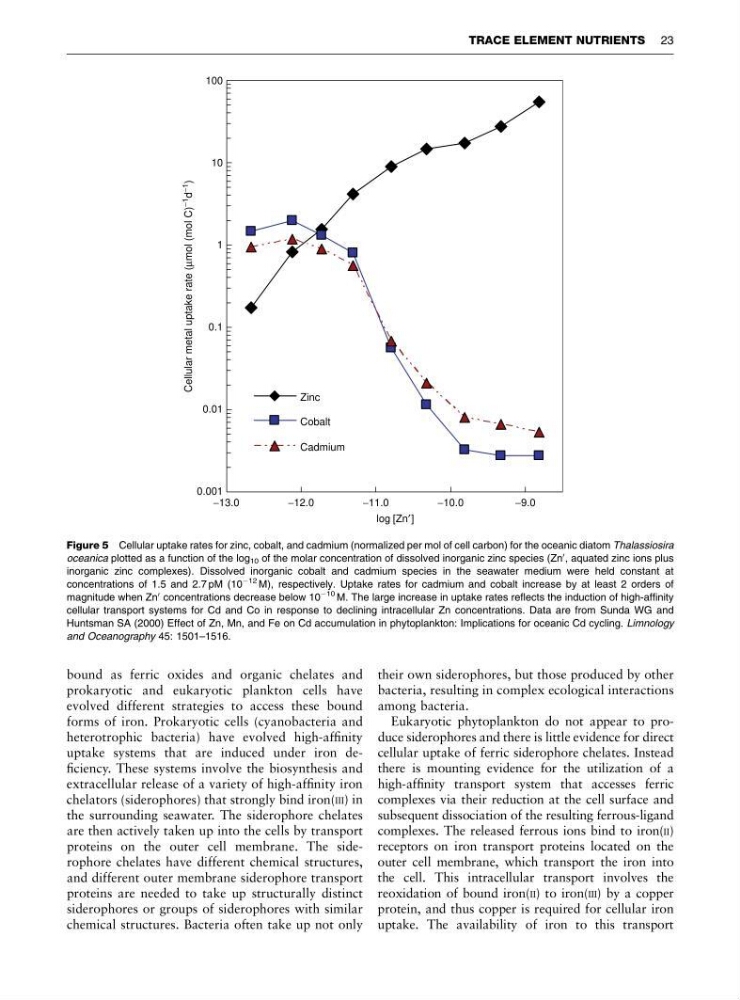
Figure 5 Cellular uptake rates for zinc, cobalt, and cadmium (normalized per mol of cell carbon) for the oceanic diatom Thalassiosira
oceanica plotted as a function of the log 10 of the molar concentration of dissolved inorganic zinc species (Zn
0 , aquated zinc ions plus
inorganic zinc complexes). Dissolved inorganic cobalt and cadmium species in the seawater medium were held constant at
concentrations of 1.5 and 2.7 pM (10
À12 M), respectively. Uptake rates for cadmium and cobalt increase by at least 2 orders of
magnitude when Zn
0 concentrations decrease below 10
À10 M. The large increase in uptake rates reflects the induction of high-affinity
cellular transport systems for Cd and Co in response to declining intracellular Zn concentrations. Data are from Sunda WG and
Huntsman SA (2000) Effect of Zn, Mn, and Fe on Cd accumulation in phytoplankton: Implications for oceanic Cd cycling. Limnology
and Oceanography 45: 1501–1516.
TRACE ELEMENT NUTRIENTS 23
prokaryotic and eukaryotic plankton cells have
evolved different strategies to access these bound
forms of iron. Prokaryotic cells (cyanobacteria and
heterotrophic bacteria) have evolved high-affinity
uptake systems that are induced under iron deficiency. These systems involve the biosynthesis and
extracellular release of a variety of high-affinity iron
chelators (siderophores) that strongly bind iron(III) in
the surrounding seawater. The siderophore chelates
are then actively taken up into the cells by transport
proteins on the outer cell membrane. The siderophore chelates have different chemical structures,
and different outer membrane siderophore transport
proteins are needed to take up structurally distinct
siderophores or groups of siderophores with similar
chemical structures. Bacteria often take up not only
their own siderophores, but those produced by other
bacteria, resulting in complex ecological interactions
among bacteria.
Eukaryotic phytoplankton do not appear to produce siderophores and there is little evidence for direct
cellular uptake of ferric siderophore chelates. Instead
there is mounting evidence for the utilization of a
high-affinity transport system that accesses ferric
complexes via their reduction at the cell surface and
subsequent dissociation of the resulting ferrous-ligand
complexes. The released ferrous ions bind to iron(II)
receptors on iron transport proteins located on the
outer cell membrane, which transport the iron into
the cell. This intracellular transport involves the
reoxidation of bound iron(II) to iron(III) by a copper
protein, and thus copper is required for cellular iron
uptake. The availability of iron to this transport
0.001
0.01
0.1
1
10
100
−13.0
−12.0
−11.0
−10.0
−9.0
log [Zn′]
Cellular metal uptake rate (μmol (mol C)
−1
d
−1
)
Zinc
Cobalt
Cadmium
Figure 5 Cellular uptake rates for zinc, cobalt, and cadmium (normalized per mol of cell carbon) for the oceanic diatom Thalassiosira
oceanica plotted as a function of the log 10 of the molar concentration of dissolved inorganic zinc species (Zn
0 , aquated zinc ions plus
inorganic zinc complexes). Dissolved inorganic cobalt and cadmium species in the seawater medium were held constant at
concentrations of 1.5 and 2.7 pM (10
À12 M), respectively. Uptake rates for cadmium and cobalt increase by at least 2 orders of
magnitude when Zn
0 concentrations decrease below 10
À10 M. The large increase in uptake rates reflects the induction of high-affinity
cellular transport systems for Cd and Co in response to declining intracellular Zn concentrations. Data are from Sunda WG and
Huntsman SA (2000) Effect of Zn, Mn, and Fe on Cd accumulation in phytoplankton: Implications for oceanic Cd cycling. Limnology
and Oceanography 45: 1501–1516.
TRACE ELEMENT NUTRIENTS 23