

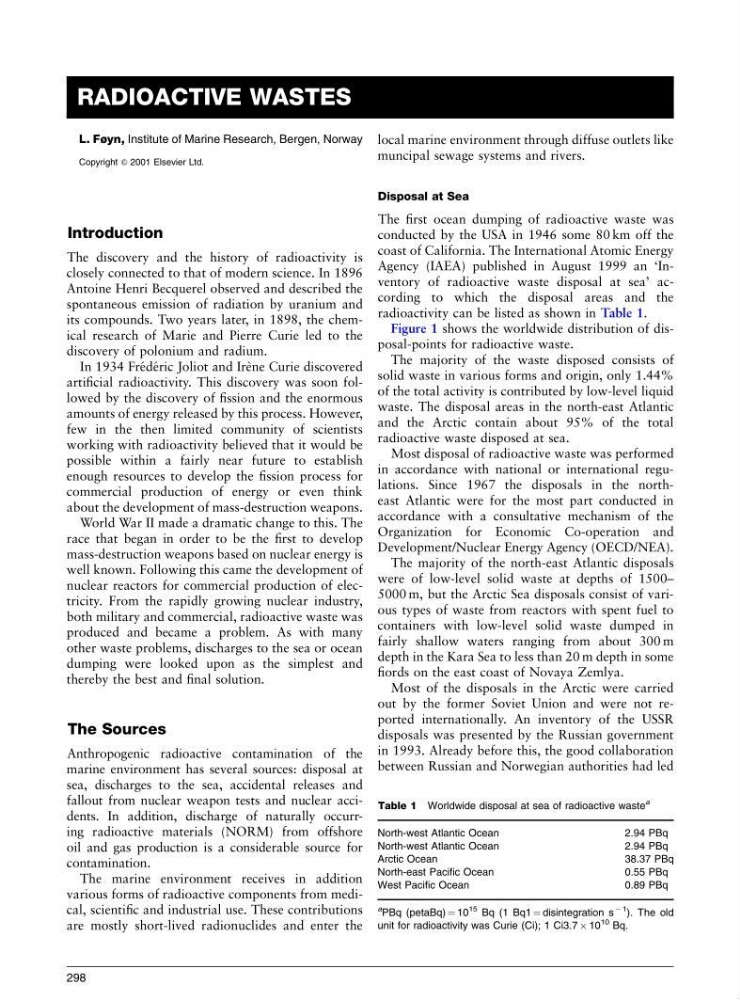
RADIOACTIVE WASTES
L. Føyn, Institute of Marine Research, Bergen, Norway
Copyright & 2001 Elsevier Ltd.
Introduction
The discovery and the history of radioactivity is
closely connected to that of modern science. In 1896
Antoine Henri Becquerel observed and described the
spontaneous emission of radiation by uranium and
its compounds. Two years later, in 1898, the chemical research of Marie and Pierre Curie led to the
discovery of polonium and radium.
In 1934 Fre ´de ´ric Joliot and Ire `ne Curie discovered
artificial radioactivity. This discovery was soon followed by the discovery of fission and the enormous
amounts of energy released by this process. However,
few in the then limited community of scientists
working with radioactivity believed that it would be
possible within a fairly near future to establish
enough resources to develop the fission process for
commercial production of energy or even think
about the development of mass-destruction weapons.
World War II made a dramatic change to this. The
race that began in order to be the first to develop
mass-destruction weapons based on nuclear energy is
well known. Following this came the development of
nuclear reactors for commercial production of electricity. From the rapidly growing nuclear industry,
both military and commercial, radioactive waste was
produced and became a problem. As with many
other waste problems, discharges to the sea or ocean
dumping were looked upon as the simplest and
thereby the best and final solution.
The Sources
Anthropogenic radioactive contamination of the
marine environment has several sources: disposal at
sea, discharges to the sea, accidental releases and
fallout from nuclear weapon tests and nuclear accidents. In addition, discharge of naturally occurring radioactive materials (NORM) from offshore
oil and gas production is a considerable source for
contamination.
The marine environment receives in addition
various forms of radioactive components from medical, scientific and industrial use. These contributions
are mostly short-lived radionuclides and enter the
local marine environment through diffuse outlets like
muncipal sewage systems and rivers.
Disposal at Sea
The first ocean dumping of radioactive waste was
conducted by the USA in 1946 some 80 km off the
coast of California. The International Atomic Energy
Agency (IAEA) published in August 1999 an ‘Inventory of radioactive waste disposal at sea’ according to which the disposal areas and the
radioactivity can be listed as shown in Table 1.
Figure 1 shows the worldwide distribution of disposal-points for radioactive waste.
The majority of the waste disposed consists of
solid waste in various forms and origin, only 1.44%
of the total activity is contributed by low-level liquid
waste. The disposal areas in the north-east Atlantic
and the Arctic contain about 95% of the total
radioactive waste disposed at sea.
Most disposal of radioactive waste was performed
in accordance with national or international regulations. Since 1967 the disposals in the northeast Atlantic were for the most part conducted in
accordance with a consultative mechanism of the
Organization for Economic Co-operation and
Development/Nuclear Energy Agency (OECD/NEA).
The majority of the north-east Atlantic disposals
were of low-level solid waste at depths of 1500–
5000 m, but the Arctic Sea disposals consist of various types of waste from reactors with spent fuel to
containers with low-level solid waste dumped in
fairly shallow waters ranging from about 300 m
depth in the Kara Sea to less than 20 m depth in some
fiords on the east coast of Novaya Zemlya.
Most of the disposals in the Arctic were carried
out by the former Soviet Union and were not reported internationally. An inventory of the USSR
disposals was presented by the Russian government
in 1993. Already before this, the good collaboration
between Russian and Norwegian authorities had led
Table 1 Worldwide disposal at sea of radioactive waste
a
North-west Atlantic Ocean
2.94 PBq
North-west Atlantic Ocean
2.94 PBq
Arctic Ocean
38.37 PBq
North-east Pacific Ocean
0.55 PBq
West Pacific Ocean
0.89 PBq
a PBq (petaBq) ¼ 10
15 Bq (1 Bq1 ¼ disintegration s
À 1
). The old
unit for radioactivity was Curie (Ci); 1 Ci3.7 Â 10
10 Bq.
298
L. Føyn, Institute of Marine Research, Bergen, Norway
Copyright & 2001 Elsevier Ltd.
Introduction
The discovery and the history of radioactivity is
closely connected to that of modern science. In 1896
Antoine Henri Becquerel observed and described the
spontaneous emission of radiation by uranium and
its compounds. Two years later, in 1898, the chemical research of Marie and Pierre Curie led to the
discovery of polonium and radium.
In 1934 Fre ´de ´ric Joliot and Ire `ne Curie discovered
artificial radioactivity. This discovery was soon followed by the discovery of fission and the enormous
amounts of energy released by this process. However,
few in the then limited community of scientists
working with radioactivity believed that it would be
possible within a fairly near future to establish
enough resources to develop the fission process for
commercial production of energy or even think
about the development of mass-destruction weapons.
World War II made a dramatic change to this. The
race that began in order to be the first to develop
mass-destruction weapons based on nuclear energy is
well known. Following this came the development of
nuclear reactors for commercial production of electricity. From the rapidly growing nuclear industry,
both military and commercial, radioactive waste was
produced and became a problem. As with many
other waste problems, discharges to the sea or ocean
dumping were looked upon as the simplest and
thereby the best and final solution.
The Sources
Anthropogenic radioactive contamination of the
marine environment has several sources: disposal at
sea, discharges to the sea, accidental releases and
fallout from nuclear weapon tests and nuclear accidents. In addition, discharge of naturally occurring radioactive materials (NORM) from offshore
oil and gas production is a considerable source for
contamination.
The marine environment receives in addition
various forms of radioactive components from medical, scientific and industrial use. These contributions
are mostly short-lived radionuclides and enter the
local marine environment through diffuse outlets like
muncipal sewage systems and rivers.
Disposal at Sea
The first ocean dumping of radioactive waste was
conducted by the USA in 1946 some 80 km off the
coast of California. The International Atomic Energy
Agency (IAEA) published in August 1999 an ‘Inventory of radioactive waste disposal at sea’ according to which the disposal areas and the
radioactivity can be listed as shown in Table 1.
Figure 1 shows the worldwide distribution of disposal-points for radioactive waste.
The majority of the waste disposed consists of
solid waste in various forms and origin, only 1.44%
of the total activity is contributed by low-level liquid
waste. The disposal areas in the north-east Atlantic
and the Arctic contain about 95% of the total
radioactive waste disposed at sea.
Most disposal of radioactive waste was performed
in accordance with national or international regulations. Since 1967 the disposals in the northeast Atlantic were for the most part conducted in
accordance with a consultative mechanism of the
Organization for Economic Co-operation and
Development/Nuclear Energy Agency (OECD/NEA).
The majority of the north-east Atlantic disposals
were of low-level solid waste at depths of 1500–
5000 m, but the Arctic Sea disposals consist of various types of waste from reactors with spent fuel to
containers with low-level solid waste dumped in
fairly shallow waters ranging from about 300 m
depth in the Kara Sea to less than 20 m depth in some
fiords on the east coast of Novaya Zemlya.
Most of the disposals in the Arctic were carried
out by the former Soviet Union and were not reported internationally. An inventory of the USSR
disposals was presented by the Russian government
in 1993. Already before this, the good collaboration
between Russian and Norwegian authorities had led
Table 1 Worldwide disposal at sea of radioactive waste
a
North-west Atlantic Ocean
2.94 PBq
North-west Atlantic Ocean
2.94 PBq
Arctic Ocean
38.37 PBq
North-east Pacific Ocean
0.55 PBq
West Pacific Ocean
0.89 PBq
a PBq (petaBq) ¼ 10
15 Bq (1 Bq1 ¼ disintegration s
À 1
). The old
unit for radioactivity was Curie (Ci); 1 Ci3.7 Â 10
10 Bq.
298