

leaded gasoline was o1.15. Eventually anthropogenic Pb will be removed from the water column and
reside in marine sediments, and there is already evidence from surficial sediments of the North Atlantic
Ocean for significant quantities of anthropogenic Pb.
Anthropogenic Mercury in the Ocean
Volatile mercury (Hg) and organomercury compounds are emitted from the land into the atmosphere naturally from wildfires, volcanoes, and
microbial activity. Mercury is emitted into the atmosphere by humans as a result of high temperature processes (e.g. smelting, coal combustion,
incineration) combined with commercial uses of
elemental mercury (e.g. thermometers, batteries), as
well as disposal of mercury-laden wastes (e.g. from
gold mining operations) that are then converted
into volatile forms in the environment. Estimates
indicate that the anthropogenic mercury emissions
from the land into the atmosphere exceeded natural
sources by approximately a factor of three during
the past century, not nearly so large as the Pb
emission enhancement, but nonetheless substantial.
A large fraction of this Hg is carried over great
distances by the atmosphere and deposited into the
ocean.
As for Pb, contamination is a major problem in
Hg sampling and analysis (perhaps even more so),
because Hg
0 is volatile and broken mercury
thermometer residues exist in most chemical
laboratories.
Evidence for anthropogenic perturbation of the
oceanic Hg reservoir is less straightforward than it is
for Pb. Observations in the modern Atlantic marine
atmosphere show that the Northern Hemisphere has
two- to three-fold higher Hg concentrations than the
Southern Hemisphere, as might be expected for an
anthropogenic source. However, land area is also
higher in the Northern Hemisphere, and it is likely
that even natural emissions are higher in the
Northern Hemisphere, so observation of an interhemisphere difference does not by itself prove anthropogenic perturbation. Measurements of Hg in
sea water have attempted to determine elemental
(Hg
0 ), organometallic (e.g. CH 3 Hg, (CH 3 ) 2 Hg), and
‘reactive’ forms (ionic and inorganically complexed
Hg, organically complexed Hg, and labile organic
and particulate Hg). Reported Hg concentrations
range from 10
À11 to 10
À9 moles kg
À1
. There are no
direct seawater measurements or indirect seawater
1980
1985
1990
1995
Year (year marked at Jan. 1)
2000
0
50
100
150
Pb (pmol kg
_
1
)
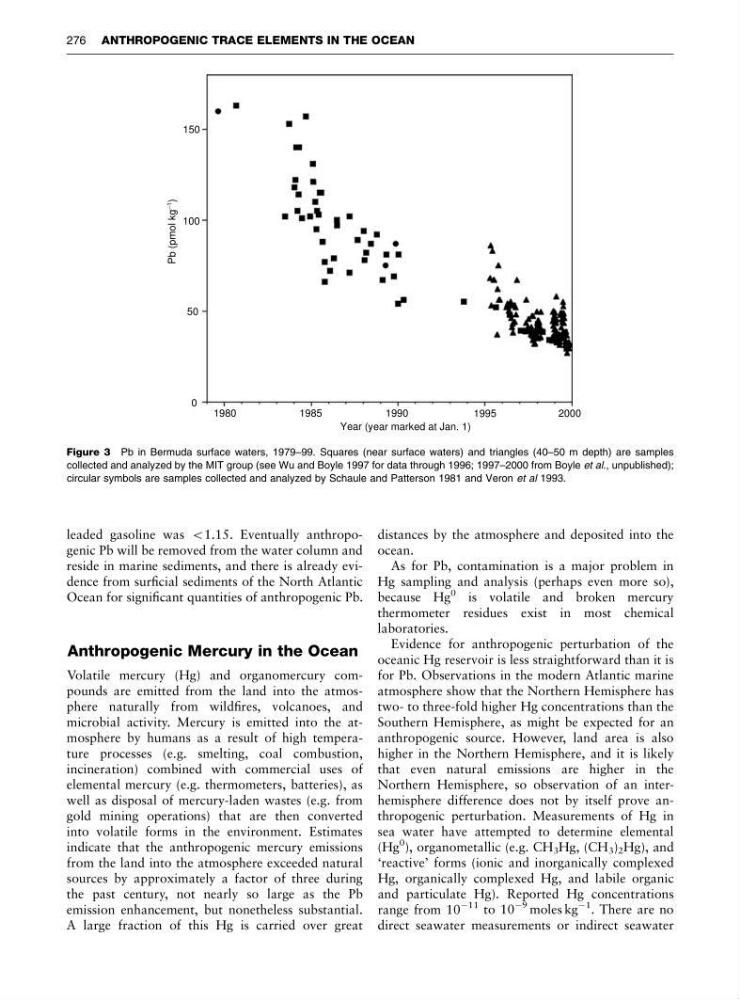
Figure 3 Pb in Bermuda surface waters, 1979–99. Squares (near surface waters) and triangles (40–50 m depth) are samples
collected and analyzed by the MIT group (see Wu and Boyle 1997 for data through 1996; 1997–2000 from Boyle et al., unpublished);
circular symbols are samples collected and analyzed by Schaule and Patterson 1981 and Veron et al 1993.
276 ANTHROPOGENIC TRACE ELEMENTS IN THE OCEAN
reside in marine sediments, and there is already evidence from surficial sediments of the North Atlantic
Ocean for significant quantities of anthropogenic Pb.
Anthropogenic Mercury in the Ocean
Volatile mercury (Hg) and organomercury compounds are emitted from the land into the atmosphere naturally from wildfires, volcanoes, and
microbial activity. Mercury is emitted into the atmosphere by humans as a result of high temperature processes (e.g. smelting, coal combustion,
incineration) combined with commercial uses of
elemental mercury (e.g. thermometers, batteries), as
well as disposal of mercury-laden wastes (e.g. from
gold mining operations) that are then converted
into volatile forms in the environment. Estimates
indicate that the anthropogenic mercury emissions
from the land into the atmosphere exceeded natural
sources by approximately a factor of three during
the past century, not nearly so large as the Pb
emission enhancement, but nonetheless substantial.
A large fraction of this Hg is carried over great
distances by the atmosphere and deposited into the
ocean.
As for Pb, contamination is a major problem in
Hg sampling and analysis (perhaps even more so),
because Hg
0 is volatile and broken mercury
thermometer residues exist in most chemical
laboratories.
Evidence for anthropogenic perturbation of the
oceanic Hg reservoir is less straightforward than it is
for Pb. Observations in the modern Atlantic marine
atmosphere show that the Northern Hemisphere has
two- to three-fold higher Hg concentrations than the
Southern Hemisphere, as might be expected for an
anthropogenic source. However, land area is also
higher in the Northern Hemisphere, and it is likely
that even natural emissions are higher in the
Northern Hemisphere, so observation of an interhemisphere difference does not by itself prove anthropogenic perturbation. Measurements of Hg in
sea water have attempted to determine elemental
(Hg
0 ), organometallic (e.g. CH 3 Hg, (CH 3 ) 2 Hg), and
‘reactive’ forms (ionic and inorganically complexed
Hg, organically complexed Hg, and labile organic
and particulate Hg). Reported Hg concentrations
range from 10
À11 to 10
À9 moles kg
À1
. There are no
direct seawater measurements or indirect seawater
1980
1985
1990
1995
Year (year marked at Jan. 1)
2000
0
50
100
150
Pb (pmol kg
_
1
)
Figure 3 Pb in Bermuda surface waters, 1979–99. Squares (near surface waters) and triangles (40–50 m depth) are samples
collected and analyzed by the MIT group (see Wu and Boyle 1997 for data through 1996; 1997–2000 from Boyle et al., unpublished);
circular symbols are samples collected and analyzed by Schaule and Patterson 1981 and Veron et al 1993.
276 ANTHROPOGENIC TRACE ELEMENTS IN THE OCEAN