

Changing leaded gasoline utilization patterns
offer an opportunity to establish that Pb decreases
in the ocean in response to the decreasing Pb
emissions from leaded gasoline. Pb gas utilization
increased from its introduction in the 1920s until
the 1970s, then decreased rapidly – resulting in
nearly complete elimination from the USA by 1990
and from western Europe by the turn of the century
(Figure 2).
Surface waters of the ocean should respond within
a few years to changes in fluxes from the atmosphere,
and the upper layers of the ocean should respond on
decadal timescales. These expectations are based
upon the penetration of the nuclear bomb tritium
into the ocean and natural radioisotope
210
Pb (halflife 22.3 years). Studies of tritium penetration show
that surface waters ventilate the upper thermocline
of the ocean on a timescale of several years to several
decades.
210 Pb is supplied to the ocean from windblown aerosols which have acquired
210 Pb from the
decay of the radioactive noble gas
222 Rn.
222
Rn is
released into the atmosphere as a decay product of
naturally occurring crystal
238 U which decays in
several stages to the immediate parent of
222 Rn,
226 Ra. The flux of
210 Pb out of the atmosphere has
been measured at numerous sites, therefore the flux
of
210 Pb into the ocean can be estimated reasonably
well. In the surface ocean,
210 Pb is rapidly scavenged
from sea water by newly formed biological material
whose residues eventually sink out of the surface
waters carrying
210
Pb. The steady-state concentration of
210 Pb in the mixed layer of the ocean is
thus determined by a balance between
210 Pb supply
from the atmosphere and
210 Pb removal by sinking
particles. The time constant for this process is estimated by dividing the measured surface water
210 Pb
reservoir by the flux of
210
Pb from the atmosphere.
The rate of removal varies with the rate of biological
activity, but in typical open-ocean ‘deserts’ such as
the Sargasso Sea,
210 Pb is removed from surface
waters every 2 years. Thus as the flux of anthropogenic lead from the atmosphere decreases, the concentration of lead in surface waters should follow
this decrease with a 2 year lag.
0
50
100
150
200
0
1000
2000
3000
5000
4000
Depth (m)
Pb (10 moles kg )
_ 12
_ 1
South
Pacific
North
Pacific
North
Atlantic
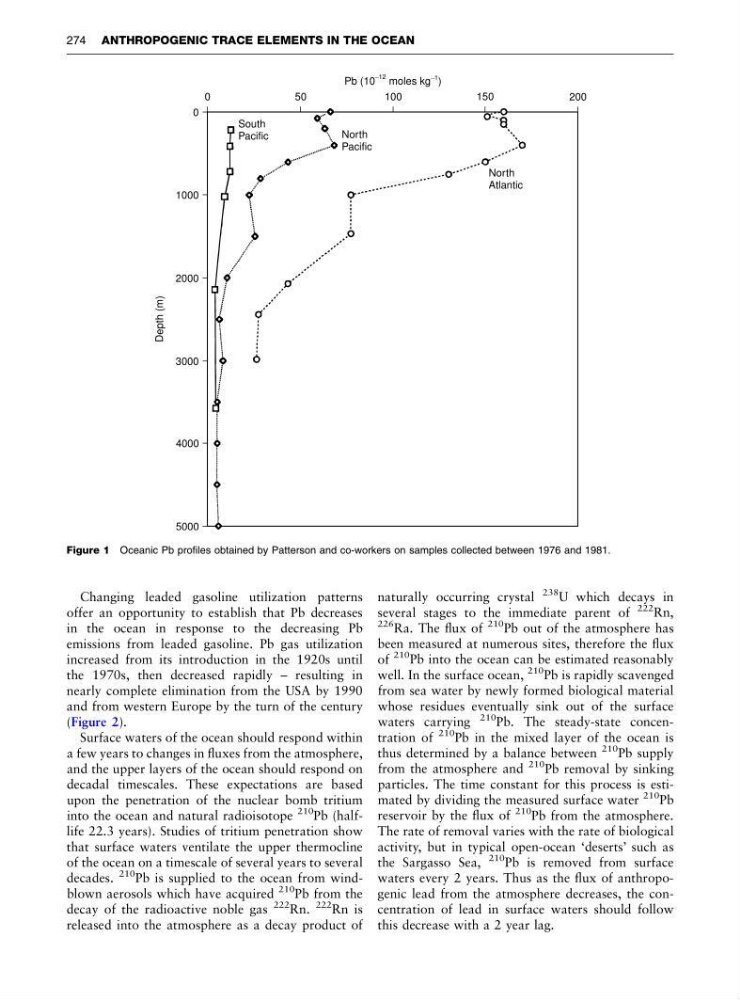
Figure 1 Oceanic Pb profiles obtained by Patterson and co-workers on samples collected between 1976 and 1981.
274 ANTHROPOGENIC TRACE ELEMENTS IN THE OCEAN
offer an opportunity to establish that Pb decreases
in the ocean in response to the decreasing Pb
emissions from leaded gasoline. Pb gas utilization
increased from its introduction in the 1920s until
the 1970s, then decreased rapidly – resulting in
nearly complete elimination from the USA by 1990
and from western Europe by the turn of the century
(Figure 2).
Surface waters of the ocean should respond within
a few years to changes in fluxes from the atmosphere,
and the upper layers of the ocean should respond on
decadal timescales. These expectations are based
upon the penetration of the nuclear bomb tritium
into the ocean and natural radioisotope
210
Pb (halflife 22.3 years). Studies of tritium penetration show
that surface waters ventilate the upper thermocline
of the ocean on a timescale of several years to several
decades.
210 Pb is supplied to the ocean from windblown aerosols which have acquired
210 Pb from the
decay of the radioactive noble gas
222 Rn.
222
Rn is
released into the atmosphere as a decay product of
naturally occurring crystal
238 U which decays in
several stages to the immediate parent of
222 Rn,
226 Ra. The flux of
210 Pb out of the atmosphere has
been measured at numerous sites, therefore the flux
of
210 Pb into the ocean can be estimated reasonably
well. In the surface ocean,
210 Pb is rapidly scavenged
from sea water by newly formed biological material
whose residues eventually sink out of the surface
waters carrying
210
Pb. The steady-state concentration of
210 Pb in the mixed layer of the ocean is
thus determined by a balance between
210 Pb supply
from the atmosphere and
210 Pb removal by sinking
particles. The time constant for this process is estimated by dividing the measured surface water
210 Pb
reservoir by the flux of
210
Pb from the atmosphere.
The rate of removal varies with the rate of biological
activity, but in typical open-ocean ‘deserts’ such as
the Sargasso Sea,
210 Pb is removed from surface
waters every 2 years. Thus as the flux of anthropogenic lead from the atmosphere decreases, the concentration of lead in surface waters should follow
this decrease with a 2 year lag.
0
50
100
150
200
0
1000
2000
3000
5000
4000
Depth (m)
Pb (10 moles kg )
_ 12
_ 1
South
Pacific
North
Pacific
North
Atlantic
Figure 1 Oceanic Pb profiles obtained by Patterson and co-workers on samples collected between 1976 and 1981.
274 ANTHROPOGENIC TRACE ELEMENTS IN THE OCEAN