

marine organisms. Thus, depending on their physicochemical state or bioavailability, metals will impact upon different parts of the marine food web and
in some cases bioaccumulation and/or biomagnification occurs, which may, ultimately, expose humans
to a potential health hazard.
When attempting to assess the biogeochemical
pathways and health impact of metals it is crucial to
determine the total concentration accurately and
where possible to identify and quantify the physical
and chemical forms, or species. The analytical determination of metals in sea water has had a difficult
history and many measurements reported in the literature prior to about 1985 should be treated with
caution. Major strides have been made in the minimization of contamination during sample collection,
storage, and preparation and in the application of
sensitive analytical techniques, sometimes coupled
with methods for the separation of metal species.
The concentrations of dissolved metals have been
revised downwards in recent years as a consequence
of the introduction of these advances, together
with improvements in analytical quality assurance,
including appropriate use of certified reference
materials.
The sources and pathways of metals through the
coastal environment are complex (see Figure 1).
Interfacial processes play a key role in their passage
from the land to the sea. In estuaries the composition
of river water may be modified by physicochemical
processes at the fresh water–brackish water interface
(FBI), where strong gradients of salinity, temperature, concentration and type of suspended particulate
matter (SPM), pH and dissolved oxygen exist. Metal
exchanges, between the dissolved and particulate
phases, take place under the influence of these gradients and this process is quantified by the partition
coefficient (K D , 1 kg
À1
) (eqn [1]).
K D ¼
M p
 Ã
M d
½
½1
Here [M p ] is the metal concentration of SPM in nmol
kg
À1 (or mg kg
À1
), and [M d ] is the dissolved metal
concentration in nmol l
À1 (or mg l
À1
). Coastal sediments can contain elevated concentrations of dissolved metals in their interstitial waters which may
be exchanged across the sediment–water interface
via molecular diffusion or by resuspension and in
soft sediments by enhanced diffusion due to bioturbation from burrowing organisms (Figure 1). The
mercury cycle is complicated by the fact that
microbial activity, in sediments and the water
column, can produce DMHg and Hg
0
, both of which
are volatile and can exchange across the air–sea
interface.
Anthropogenic and Natural Inputs
Dissolved and particulate metals in rivers and estuaries are derived from natural weathering process in
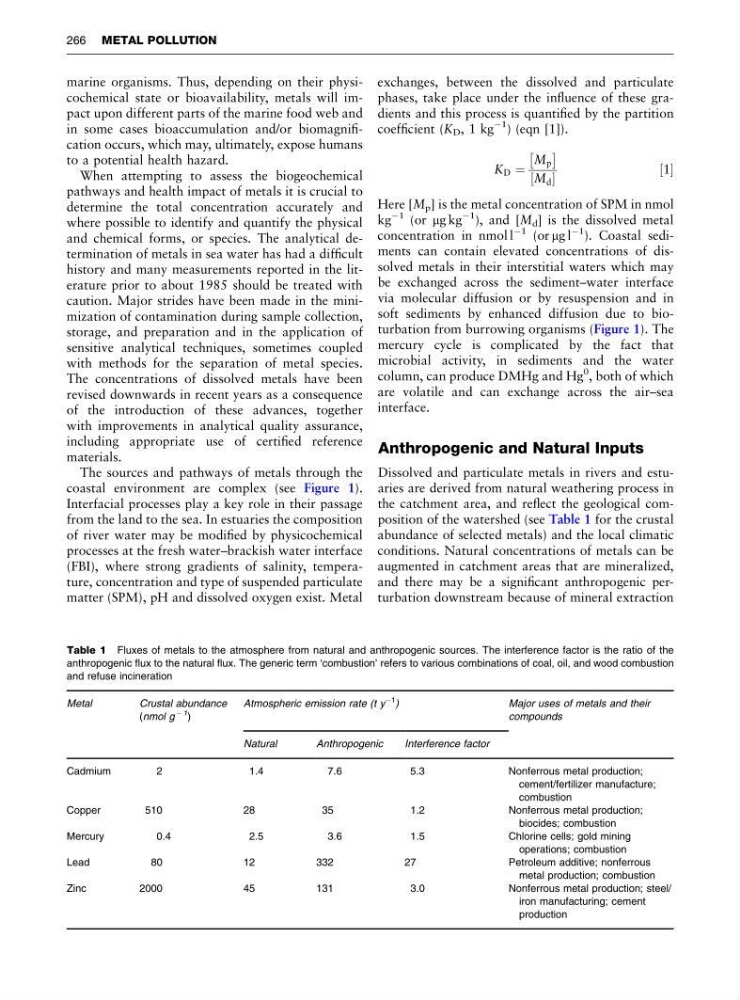
the catchment area, and reflect the geological composition of the watershed (see Table 1 for the crustal
abundance of selected metals) and the local climatic
conditions. Natural concentrations of metals can be
augmented in catchment areas that are mineralized,
and there may be a significant anthropogenic perturbation downstream because of mineral extraction
Table 1 Fluxes of metals to the atmosphere from natural and anthropogenic sources. The interference factor is the ratio of the
anthropogenic flux to the natural flux. The generic term ‘combustion’ refers to various combinations of coal, oil, and wood combustion
and refuse incineration
Metal
Crustal abundance
(nmol g
À 1 )
Atmospheric emission rate (t y
À1 )
Major uses of metals and their
compounds
Natural
Anthropogenic
Interference factor
Cadmium
2
1.4
7.6
5.3
Nonferrous metal production;
cement/fertilizer manufacture;
combustion
Copper
510
28
35
1.2
Nonferrous metal production;
biocides; combustion
Mercury
0.4
2.5
3.6
1.5
Chlorine cells; gold mining
operations; combustion
Lead
80
12
332
27
Petroleum additive; nonferrous
metal production; combustion
Zinc
2000
45
131
3.0
Nonferrous metal production; steel/
iron manufacturing; cement
production
266 METAL POLLUTION
in some cases bioaccumulation and/or biomagnification occurs, which may, ultimately, expose humans
to a potential health hazard.
When attempting to assess the biogeochemical
pathways and health impact of metals it is crucial to
determine the total concentration accurately and
where possible to identify and quantify the physical
and chemical forms, or species. The analytical determination of metals in sea water has had a difficult
history and many measurements reported in the literature prior to about 1985 should be treated with
caution. Major strides have been made in the minimization of contamination during sample collection,
storage, and preparation and in the application of
sensitive analytical techniques, sometimes coupled
with methods for the separation of metal species.
The concentrations of dissolved metals have been
revised downwards in recent years as a consequence
of the introduction of these advances, together
with improvements in analytical quality assurance,
including appropriate use of certified reference
materials.
The sources and pathways of metals through the
coastal environment are complex (see Figure 1).
Interfacial processes play a key role in their passage
from the land to the sea. In estuaries the composition
of river water may be modified by physicochemical
processes at the fresh water–brackish water interface
(FBI), where strong gradients of salinity, temperature, concentration and type of suspended particulate
matter (SPM), pH and dissolved oxygen exist. Metal
exchanges, between the dissolved and particulate
phases, take place under the influence of these gradients and this process is quantified by the partition
coefficient (K D , 1 kg
À1
) (eqn [1]).
K D ¼
M p
 Ã
M d
½
½1
Here [M p ] is the metal concentration of SPM in nmol
kg
À1 (or mg kg
À1
), and [M d ] is the dissolved metal
concentration in nmol l
À1 (or mg l
À1
). Coastal sediments can contain elevated concentrations of dissolved metals in their interstitial waters which may
be exchanged across the sediment–water interface
via molecular diffusion or by resuspension and in
soft sediments by enhanced diffusion due to bioturbation from burrowing organisms (Figure 1). The
mercury cycle is complicated by the fact that
microbial activity, in sediments and the water
column, can produce DMHg and Hg
0
, both of which
are volatile and can exchange across the air–sea
interface.
Anthropogenic and Natural Inputs
Dissolved and particulate metals in rivers and estuaries are derived from natural weathering process in
the catchment area, and reflect the geological composition of the watershed (see Table 1 for the crustal
abundance of selected metals) and the local climatic
conditions. Natural concentrations of metals can be
augmented in catchment areas that are mineralized,
and there may be a significant anthropogenic perturbation downstream because of mineral extraction
Table 1 Fluxes of metals to the atmosphere from natural and anthropogenic sources. The interference factor is the ratio of the
anthropogenic flux to the natural flux. The generic term ‘combustion’ refers to various combinations of coal, oil, and wood combustion
and refuse incineration
Metal
Crustal abundance
(nmol g
À 1 )
Atmospheric emission rate (t y
À1 )
Major uses of metals and their
compounds
Natural
Anthropogenic
Interference factor
Cadmium
2
1.4
7.6
5.3
Nonferrous metal production;
cement/fertilizer manufacture;
combustion
Copper
510
28
35
1.2
Nonferrous metal production;
biocides; combustion
Mercury
0.4
2.5
3.6
1.5
Chlorine cells; gold mining
operations; combustion
Lead
80
12
332
27
Petroleum additive; nonferrous
metal production; combustion
Zinc
2000
45
131
3.0
Nonferrous metal production; steel/
iron manufacturing; cement
production
266 METAL POLLUTION