

METAL POLLUTION
G. E. Millward and A. Turner,
University of Plymouth, Plymouth, UK
Copyright & 2001 Elsevier Ltd.
Introduction
Marine pollution has been defined as ‘the introduction by man, directly or indirectly, of substances
or energy to the marine environment resulting in
deleterious effects such as hazards to human health;
hindrance of marine activities, including fishing;
impairment of the quality for the use of sea water;
and reduction in amenities’ (GESAMP, 1990).
Approximately 45% of people on Earth live within
150 km of the coast and marine pollution occurs as a
consequence of increases in population density and
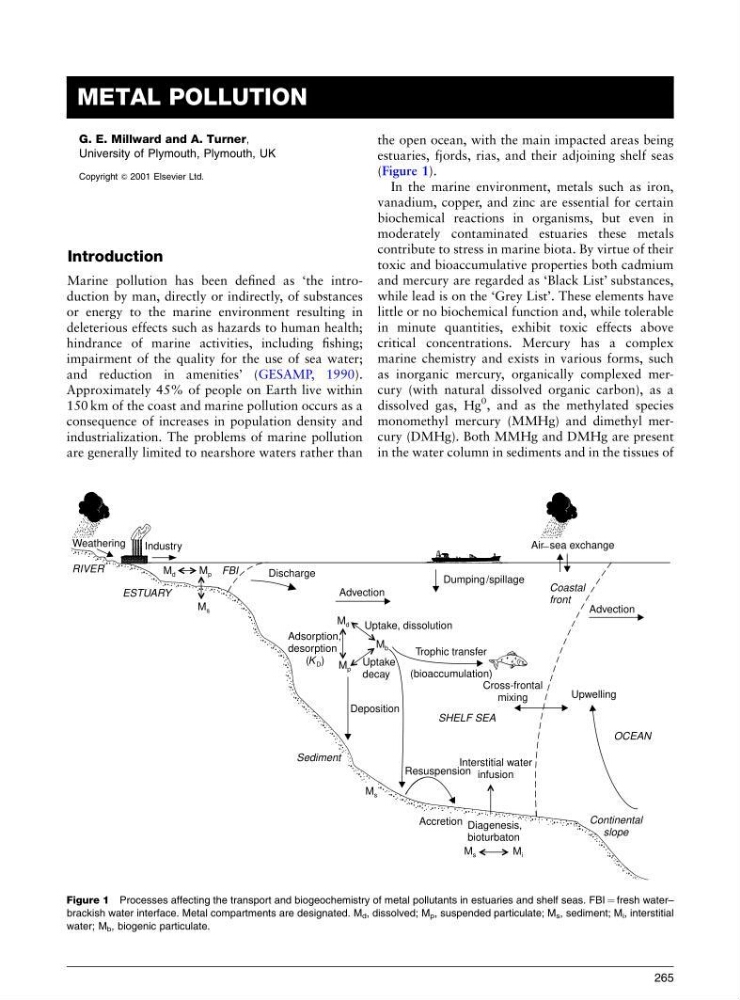
industrialization. The problems of marine pollution
are generally limited to nearshore waters rather than
the open ocean, with the main impacted areas being
estuaries, fjords, rias, and their adjoining shelf seas
(Figure 1).
In the marine environment, metals such as iron,
vanadium, copper, and zinc are essential for certain
biochemical reactions in organisms, but even in
moderately contaminated estuaries these metals
contribute to stress in marine biota. By virtue of their
toxic and bioaccumulative properties both cadmium
and mercury are regarded as ‘Black List’ substances,
while lead is on the ‘Grey List’. These elements have
little or no biochemical function and, while tolerable
in minute quantities, exhibit toxic effects above
critical concentrations. Mercury has a complex
marine chemistry and exists in various forms, such
as inorganic mercury, organically complexed mercury (with natural dissolved organic carbon), as a
dissolved gas, Hg
0 , and as the methylated species
monomethyl mercury (MMHg) and dimethyl mercury (DMHg). Both MMHg and DMHg are present
in the water column in sediments and in the tissues of
Industry
Weathering
RIVER
ESTUARY
M d
M s
M d
M p FBI
Discharge
Advection
Dumping /spillage
Air _ sea exchange
Coastal
front
Advection
Uptake, dissolution
Trophic transfer
Adsorption,
desorption
M p
( )
K D
M b
Uptake
decay
(bioaccumulation)
Cross-frontal
mixing
Upwelling
OCEAN
SHELF SEA
Deposition
Sediment
Resuspension
Interstitial water
infusion
Continental
slope
Diagenesis,
bioturbaton
Accretion
M s
M s
M i
Figure 1 Processes affecting the transport and biogeochemistry of metal pollutants in estuaries and shelf seas. FBI ¼ fresh water–
brackish water interface. Metal compartments are designated. M d , dissolved; M p , suspended particulate; M s , sediment; M i , interstitial
water; M b , biogenic particulate.
265
G. E. Millward and A. Turner,
University of Plymouth, Plymouth, UK
Copyright & 2001 Elsevier Ltd.
Introduction
Marine pollution has been defined as ‘the introduction by man, directly or indirectly, of substances
or energy to the marine environment resulting in
deleterious effects such as hazards to human health;
hindrance of marine activities, including fishing;
impairment of the quality for the use of sea water;
and reduction in amenities’ (GESAMP, 1990).
Approximately 45% of people on Earth live within
150 km of the coast and marine pollution occurs as a
consequence of increases in population density and
industrialization. The problems of marine pollution
are generally limited to nearshore waters rather than
the open ocean, with the main impacted areas being
estuaries, fjords, rias, and their adjoining shelf seas
(Figure 1).
In the marine environment, metals such as iron,
vanadium, copper, and zinc are essential for certain
biochemical reactions in organisms, but even in
moderately contaminated estuaries these metals
contribute to stress in marine biota. By virtue of their
toxic and bioaccumulative properties both cadmium
and mercury are regarded as ‘Black List’ substances,
while lead is on the ‘Grey List’. These elements have
little or no biochemical function and, while tolerable
in minute quantities, exhibit toxic effects above
critical concentrations. Mercury has a complex
marine chemistry and exists in various forms, such
as inorganic mercury, organically complexed mercury (with natural dissolved organic carbon), as a
dissolved gas, Hg
0 , and as the methylated species
monomethyl mercury (MMHg) and dimethyl mercury (DMHg). Both MMHg and DMHg are present
in the water column in sediments and in the tissues of
Industry
Weathering
RIVER
ESTUARY
M d
M s
M d
M p FBI
Discharge
Advection
Dumping /spillage
Air _ sea exchange
Coastal
front
Advection
Uptake, dissolution
Trophic transfer
Adsorption,
desorption
M p
( )
K D
M b
Uptake
decay
(bioaccumulation)
Cross-frontal
mixing
Upwelling
OCEAN
SHELF SEA
Deposition
Sediment
Resuspension
Interstitial water
infusion
Continental
slope
Diagenesis,
bioturbaton
Accretion
M s
M s
M i
Figure 1 Processes affecting the transport and biogeochemistry of metal pollutants in estuaries and shelf seas. FBI ¼ fresh water–
brackish water interface. Metal compartments are designated. M d , dissolved; M p , suspended particulate; M s , sediment; M i , interstitial
water; M b , biogenic particulate.
265