

also dependent on the partial pressure of CO 2 in the
atmosphere, for example:
CaAl 2 Si 2 O 8 s
ð Þ þ 6H 2 O þ 2CO 2 g
ð Þ )
Ca
2þ þ 2HCO
À
3 þ 2AlOOH s
ð Þ þ 2Si OH
ð
Þ 4
Hot Vents
About 5000 m
3 s
À1 of sea water reacts with fresh hot
basalt in the rift zones. Hydrothermal reactions
produce large changes in the composition of the sea
salts. The reactions lead to a loss of magnesium,
sulfate, and fluoride, but to an addition of calcium
and potassium. The hydrothermal activity balances
some of the river inputs and contributes to maintenance of the steady state and the conservation of
the constant composition of sea salts.
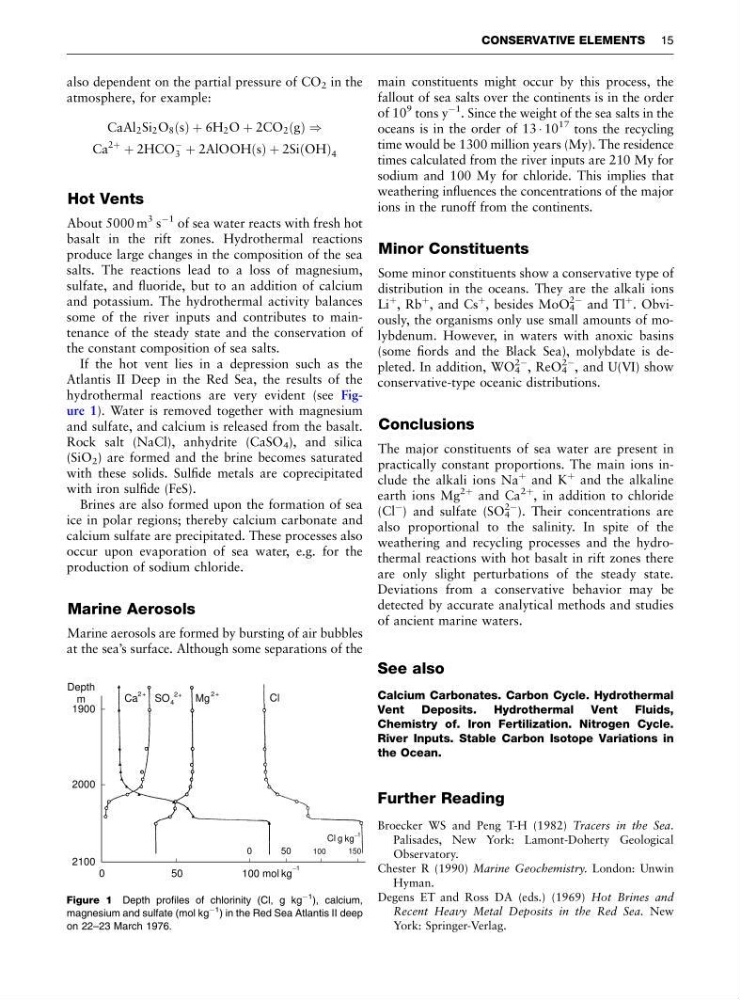
If the hot vent lies in a depression such as the
Atlantis II Deep in the Red Sea, the results of the
hydrothermal reactions are very evident (see Figure 1). Water is removed together with magnesium
and sulfate, and calcium is released from the basalt.
Rock salt (NaCl), anhydrite (CaSO 4 ), and silica
(SiO 2 ) are formed and the brine becomes saturated
with these solids. Sulfide metals are coprecipitated
with iron sulfide (FeS).
Brines are also formed upon the formation of sea
ice in polar regions; thereby calcium carbonate and
calcium sulfate are precipitated. These processes also
occur upon evaporation of sea water, e.g. for the
production of sodium chloride.
Marine Aerosols
Marine aerosols are formed by bursting of air bubbles
at the sea’s surface. Although some separations of the
main constituents might occur by this process, the
fallout of sea salts over the continents is in the order
of 10
9 tons y
À1
. Since the weight of the sea salts in the
oceans is in the order of 13 Á 10
17 tons the recycling
time would be 1300 million years (My). The residence
times calculated from the river inputs are 210 My for
sodium and 100 My for chloride. This implies that
weathering influences the concentrations of the major
ions in the runoff from the continents.
Minor Constituents
Some minor constituents show a conservative type of
distribution in the oceans. They are the alkali ions
Li
þ
, Rb
þ , and Cs
þ , besides MoO 4
2À and Tl
þ . Obviously, the organisms only use small amounts of molybdenum. However, in waters with anoxic basins
(some fiords and the Black Sea), molybdate is depleted. In addition, WO 4
2À
, ReO 4
2À , and U(VI) show
conservative-type oceanic distributions.
Conclusions
The major constituents of sea water are present in
practically constant proportions. The main ions include the alkali ions Na
þ and K
þ and the alkaline
earth ions Mg
2þ and Ca
2þ , in addition to chloride
(Cl
À
) and sulfate (SO 4
2À ). Their concentrations are
also proportional to the salinity. In spite of the
weathering and recycling processes and the hydrothermal reactions with hot basalt in rift zones there
are only slight perturbations of the steady state.
Deviations from a conservative behavior may be
detected by accurate analytical methods and studies
of ancient marine waters.
See also
Calcium Carbonates. Carbon Cycle. Hydrothermal
Vent Deposits. Hydrothermal Vent Fluids,
Chemistry of. Iron Fertilization. Nitrogen Cycle.
River Inputs. Stable Carbon Isotope Variations in
the Ocean.
Further Reading
Broecker WS and Peng T-H (1982) Tracers in the Sea.
Palisades, New York: Lamont-Doherty Geological
Observatory.
Chester R (1990) Marine Geochemistry. London: Unwin
Hyman.
Degens ET and Ross DA (eds.) (1969) Hot Brines and
Recent Heavy Metal Deposits in the Red Sea. New
York: Springer-Verlag.
0
5 0
100
Cl g kg
_ 1
150
1900
2000
2100
0
50
100 mol kg
Depth
m
Ca
2+ SO 4
2+
Mg
2 +
Cl
_ 1
Figure 1 Depth profiles of chlorinity (Cl, g kg
À1 ), calcium,
magnesium and sulfate (mol kg
À1 ) in the Red Sea Atlantis II deep
on 22–23 March 1976.
CONSERVATIVE ELEMENTS 15
atmosphere, for example:
CaAl 2 Si 2 O 8 s
ð Þ þ 6H 2 O þ 2CO 2 g
ð Þ )
Ca
2þ þ 2HCO
À
3 þ 2AlOOH s
ð Þ þ 2Si OH
ð
Þ 4
Hot Vents
About 5000 m
3 s
À1 of sea water reacts with fresh hot
basalt in the rift zones. Hydrothermal reactions
produce large changes in the composition of the sea
salts. The reactions lead to a loss of magnesium,
sulfate, and fluoride, but to an addition of calcium
and potassium. The hydrothermal activity balances
some of the river inputs and contributes to maintenance of the steady state and the conservation of
the constant composition of sea salts.
If the hot vent lies in a depression such as the
Atlantis II Deep in the Red Sea, the results of the
hydrothermal reactions are very evident (see Figure 1). Water is removed together with magnesium
and sulfate, and calcium is released from the basalt.
Rock salt (NaCl), anhydrite (CaSO 4 ), and silica
(SiO 2 ) are formed and the brine becomes saturated
with these solids. Sulfide metals are coprecipitated
with iron sulfide (FeS).
Brines are also formed upon the formation of sea
ice in polar regions; thereby calcium carbonate and
calcium sulfate are precipitated. These processes also
occur upon evaporation of sea water, e.g. for the
production of sodium chloride.
Marine Aerosols
Marine aerosols are formed by bursting of air bubbles
at the sea’s surface. Although some separations of the
main constituents might occur by this process, the
fallout of sea salts over the continents is in the order
of 10
9 tons y
À1
. Since the weight of the sea salts in the
oceans is in the order of 13 Á 10
17 tons the recycling
time would be 1300 million years (My). The residence
times calculated from the river inputs are 210 My for
sodium and 100 My for chloride. This implies that
weathering influences the concentrations of the major
ions in the runoff from the continents.
Minor Constituents
Some minor constituents show a conservative type of
distribution in the oceans. They are the alkali ions
Li
þ
, Rb
þ , and Cs
þ , besides MoO 4
2À and Tl
þ . Obviously, the organisms only use small amounts of molybdenum. However, in waters with anoxic basins
(some fiords and the Black Sea), molybdate is depleted. In addition, WO 4
2À
, ReO 4
2À , and U(VI) show
conservative-type oceanic distributions.
Conclusions
The major constituents of sea water are present in
practically constant proportions. The main ions include the alkali ions Na
þ and K
þ and the alkaline
earth ions Mg
2þ and Ca
2þ , in addition to chloride
(Cl
À
) and sulfate (SO 4
2À ). Their concentrations are
also proportional to the salinity. In spite of the
weathering and recycling processes and the hydrothermal reactions with hot basalt in rift zones there
are only slight perturbations of the steady state.
Deviations from a conservative behavior may be
detected by accurate analytical methods and studies
of ancient marine waters.
See also
Calcium Carbonates. Carbon Cycle. Hydrothermal
Vent Deposits. Hydrothermal Vent Fluids,
Chemistry of. Iron Fertilization. Nitrogen Cycle.
River Inputs. Stable Carbon Isotope Variations in
the Ocean.
Further Reading
Broecker WS and Peng T-H (1982) Tracers in the Sea.
Palisades, New York: Lamont-Doherty Geological
Observatory.
Chester R (1990) Marine Geochemistry. London: Unwin
Hyman.
Degens ET and Ross DA (eds.) (1969) Hot Brines and
Recent Heavy Metal Deposits in the Red Sea. New
York: Springer-Verlag.
0
5 0
100
Cl g kg
_ 1
150
1900
2000
2100
0
50
100 mol kg
Depth
m
Ca
2+ SO 4
2+
Mg
2 +
Cl
_ 1
Figure 1 Depth profiles of chlorinity (Cl, g kg
À1 ), calcium,
magnesium and sulfate (mol kg
À1 ) in the Red Sea Atlantis II deep
on 22–23 March 1976.
CONSERVATIVE ELEMENTS 15