

The CO 2 is supplied by microbial decomposition of
carbohydrates
CH 2 O org
ð ÞþO 2 ) CO 2 þ H 2 O
In the past, the alkalinity (A t ) was considered to be a
conservative property of sea water. With high precision titration techniques variations in A t S/35 can be
measured, as well as in (Ca t þ Sr t )S/35.
The most important carbonate-secreting organisms in the oceans are foraminifera, coccolithophorides, and pteropods. The carbonate tests
vary in size, appearance, crystal form (calcite or
aragonite), and magnesium content. The solubility
depends on the depth (pressure), temperature, and
concentration of CO 2 besides the crystal form.
For example, the pteropods which secrete shells of
aragonite undergo dissolution at shallower depths
than the coccolithophorides which secrete calcite
shells.
River Inputs
The river inputs into the oceans vary between the
oceans. Ten percent of the total inflow of 10
6 m
3 s
À1
(1 Sverdrup, Sv) flows into the Arctic Ocean,
whereby the normalized alkalinity (A t S/35) is increased in the outflow along the east coast of
Greenland. The average composition of the major
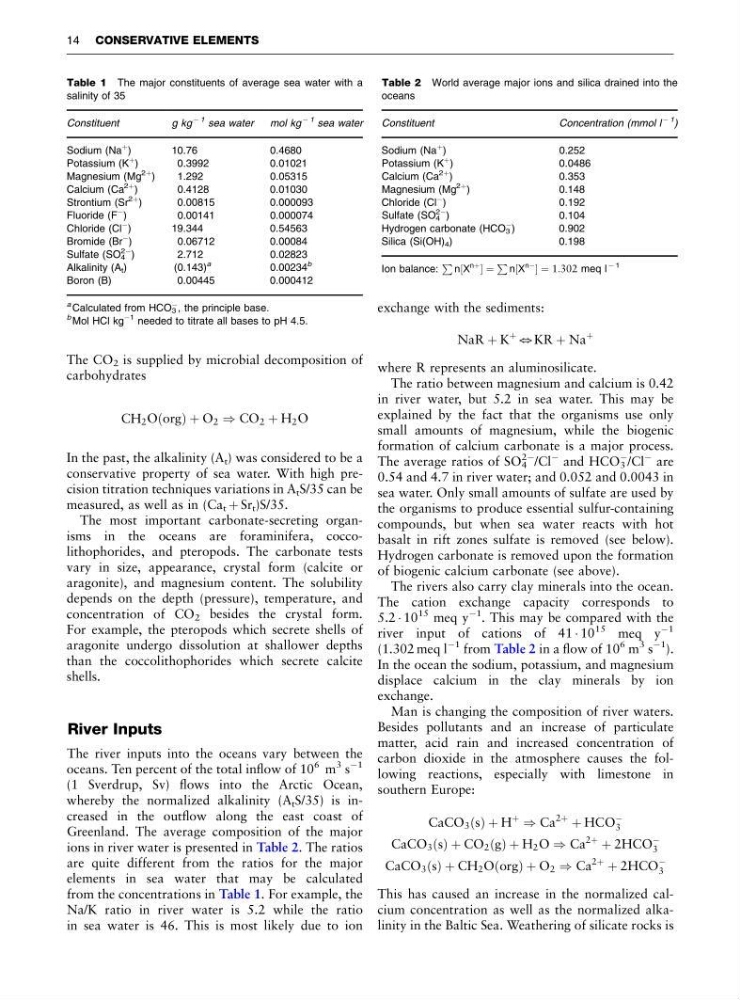
ions in river water is presented in Table 2. The ratios
are quite different from the ratios for the major
elements in sea water that may be calculated
from the concentrations in Table 1. For example, the
Na/K ratio in river water is 5.2 while the ratio
in sea water is 46. This is most likely due to ion
exchange with the sediments:
NaR þ K
þ
3KR þ Na
þ
where R represents an aluminosilicate.
The ratio between magnesium and calcium is 0.42
in river water, but 5.2 in sea water. This may be
explained by the fact that the organisms use only
small amounts of magnesium, while the biogenic
formation of calcium carbonate is a major process.
The average ratios of SO 4
2À /Cl
À and HCO 3
À /Cl
À are
0.54 and 4.7 in river water; and 0.052 and 0.0043 in
sea water. Only small amounts of sulfate are used by
the organisms to produce essential sulfur-containing
compounds, but when sea water reacts with hot
basalt in rift zones sulfate is removed (see below).
Hydrogen carbonate is removed upon the formation
of biogenic calcium carbonate (see above).
The rivers also carry clay minerals into the ocean.
The cation exchange capacity corresponds to
5.2 Á 10
15 meq y
À1
. This may be compared with the
river input of cations of 41 Á 10
15 meq y
À1
(1.302 meq l
À1 from Table 2 in a flow of 10
6 m
3 s
À1
).
In the ocean the sodium, potassium, and magnesium
displace calcium in the clay minerals by ion
exchange.
Man is changing the composition of river waters.
Besides pollutants and an increase of particulate
matter, acid rain and increased concentration of
carbon dioxide in the atmosphere causes the following reactions, especially with limestone in
southern Europe:
CaCO 3 s
ð Þ þ H
þ ) Ca
2þ þ HCO
À
3
CaCO 3 s
ð Þ þ CO 2 g
ð Þ þ H 2 O ) Ca
2þ þ 2HCO
À
3
CaCO 3 s
ð Þ þ CH 2 O org
ð ÞþO 2 ) Ca
2þ þ 2HCO
À
3
This has caused an increase in the normalized calcium concentration as well as the normalized alkalinity in the Baltic Sea. Weathering of silicate rocks is
Table 2 World average major ions and silica drained into the
oceans
Constituent
Concentration (mmol l
À 1
)
Sodium (Na
þ
)
0.252
Potassium (K
þ )
0.0486
Calcium (Ca
2þ )
0.353
Magnesium (Mg
2þ )
0.148
Chloride (Cl
À
)
0.192
Sulfate (SO 4
2À
)
0.104
Hydrogen carbonate (HCO 3
À
)
0.902
Silica (Si(OH) 4 )
0.198
Ion balance:
P
n½X
nþ ¼
P
n½X
nÀ ¼ 1:302 meq l
À 1
Table 1 The major constituents of average sea water with a
salinity of 35
Constituent
g kg
À 1 sea water
mol kg
À 1 sea water
Sodium (Na
þ
)
10.76
0.4680
Potassium (K
þ
)
0.3992
0.01021
Magnesium (Mg
2þ )
1.292
0.05315
Calcium (Ca
2þ
)
0.4128
0.01030
Strontium (Sr
2þ
)
0.00815
0.000093
Fluoride (F
À )
0.00141
0.000074
Chloride (Cl
À )
19.344
0.54563
Bromide (Br
À
)
0.06712
0.00084
Sulfate (SO 4
2À
)
2.712
0.02823
Alkalinity (A t )
(0.143)
a
0.00234
b
Boron (B)
0.00445
0.000412
a Calculated from HCO 3
À
, the principle base.
b Mol HCl kg
À1 needed to titrate all bases to pH 4.5.
14 CONSERVATIVE ELEMENTS
carbohydrates
CH 2 O org
ð ÞþO 2 ) CO 2 þ H 2 O
In the past, the alkalinity (A t ) was considered to be a
conservative property of sea water. With high precision titration techniques variations in A t S/35 can be
measured, as well as in (Ca t þ Sr t )S/35.
The most important carbonate-secreting organisms in the oceans are foraminifera, coccolithophorides, and pteropods. The carbonate tests
vary in size, appearance, crystal form (calcite or
aragonite), and magnesium content. The solubility
depends on the depth (pressure), temperature, and
concentration of CO 2 besides the crystal form.
For example, the pteropods which secrete shells of
aragonite undergo dissolution at shallower depths
than the coccolithophorides which secrete calcite
shells.
River Inputs
The river inputs into the oceans vary between the
oceans. Ten percent of the total inflow of 10
6 m
3 s
À1
(1 Sverdrup, Sv) flows into the Arctic Ocean,
whereby the normalized alkalinity (A t S/35) is increased in the outflow along the east coast of
Greenland. The average composition of the major
ions in river water is presented in Table 2. The ratios
are quite different from the ratios for the major
elements in sea water that may be calculated
from the concentrations in Table 1. For example, the
Na/K ratio in river water is 5.2 while the ratio
in sea water is 46. This is most likely due to ion
exchange with the sediments:
NaR þ K
þ
3KR þ Na
þ
where R represents an aluminosilicate.
The ratio between magnesium and calcium is 0.42
in river water, but 5.2 in sea water. This may be
explained by the fact that the organisms use only
small amounts of magnesium, while the biogenic
formation of calcium carbonate is a major process.
The average ratios of SO 4
2À /Cl
À and HCO 3
À /Cl
À are
0.54 and 4.7 in river water; and 0.052 and 0.0043 in
sea water. Only small amounts of sulfate are used by
the organisms to produce essential sulfur-containing
compounds, but when sea water reacts with hot
basalt in rift zones sulfate is removed (see below).
Hydrogen carbonate is removed upon the formation
of biogenic calcium carbonate (see above).
The rivers also carry clay minerals into the ocean.
The cation exchange capacity corresponds to
5.2 Á 10
15 meq y
À1
. This may be compared with the
river input of cations of 41 Á 10
15 meq y
À1
(1.302 meq l
À1 from Table 2 in a flow of 10
6 m
3 s
À1
).
In the ocean the sodium, potassium, and magnesium
displace calcium in the clay minerals by ion
exchange.
Man is changing the composition of river waters.
Besides pollutants and an increase of particulate
matter, acid rain and increased concentration of
carbon dioxide in the atmosphere causes the following reactions, especially with limestone in
southern Europe:
CaCO 3 s
ð Þ þ H
þ ) Ca
2þ þ HCO
À
3
CaCO 3 s
ð Þ þ CO 2 g
ð Þ þ H 2 O ) Ca
2þ þ 2HCO
À
3
CaCO 3 s
ð Þ þ CH 2 O org
ð ÞþO 2 ) Ca
2þ þ 2HCO
À
3
This has caused an increase in the normalized calcium concentration as well as the normalized alkalinity in the Baltic Sea. Weathering of silicate rocks is
Table 2 World average major ions and silica drained into the
oceans
Constituent
Concentration (mmol l
À 1
)
Sodium (Na
þ
)
0.252
Potassium (K
þ )
0.0486
Calcium (Ca
2þ )
0.353
Magnesium (Mg
2þ )
0.148
Chloride (Cl
À
)
0.192
Sulfate (SO 4
2À
)
0.104
Hydrogen carbonate (HCO 3
À
)
0.902
Silica (Si(OH) 4 )
0.198
Ion balance:
P
n½X
nþ ¼
P
n½X
nÀ ¼ 1:302 meq l
À 1
Table 1 The major constituents of average sea water with a
salinity of 35
Constituent
g kg
À 1 sea water
mol kg
À 1 sea water
Sodium (Na
þ
)
10.76
0.4680
Potassium (K
þ
)
0.3992
0.01021
Magnesium (Mg
2þ )
1.292
0.05315
Calcium (Ca
2þ
)
0.4128
0.01030
Strontium (Sr
2þ
)
0.00815
0.000093
Fluoride (F
À )
0.00141
0.000074
Chloride (Cl
À )
19.344
0.54563
Bromide (Br
À
)
0.06712
0.00084
Sulfate (SO 4
2À
)
2.712
0.02823
Alkalinity (A t )
(0.143)
a
0.00234
b
Boron (B)
0.00445
0.000412
a Calculated from HCO 3
À
, the principle base.
b Mol HCl kg
À1 needed to titrate all bases to pH 4.5.
14 CONSERVATIVE ELEMENTS