

essentially ‘froze’ development of the underlying
physics in their model and then used the same
boundary conditions and forcing in order to eliminate
as many potential variables as possible. Radiocarbon,
both bomb-derived and natural, were used as tracers
in each model to examine air–sea gas exchange and
long-term circulation. Figure 13 compares results
from 12 global ocean circulation models with WOCE
data from section P16. The tag in the top left corner
of each panel identifies the institution of the modeling
group. All of the model results and the data are colored and scaled identically and the portion of the
section containing bomb radiocarbon has been
masked. While all of the models get the general shape
of the contours, the concentrations vary widely. Detailed comparison is currently under way, but cursory
examination points out significant discrepancies in all
model results and remarkable model-to-model differences. Similar comparisons can be made focusing
on the bomb component. Discussion of model differences is beyond the scope of this work. For information, see publications by the various groups having
results in Figure 13 (listed in Table 1). These radiocarbon results are not yet published, but an overview
of the OCMIP-2 program can be found in the work
of Dutay on chlorofluorocarbon in the same models
(see Further Reading).
Air–Sea Gas Exchange and
Thermocline Ventilation Rate
Radiocarbon has been used to estimate air–sea gas
exchange rates for almost as long as it has been
measured in the atmosphere and ocean. Generally,
these calculations are based on box models, which
have both included and excluded the influence of
bomb contamination. W. Broecker and T.-H. Peng
summarized efforts to estimate air–sea transfer rates
up to 1974 and gave examples based on GEOSECS
results using both natural and bomb14 C and a
stagnant film model. In this, the rate-limiting step for
transfer is assumed to be molecular diffusion of the
gas across a thin layer separating the mixed layer of
the ocean from the atmosphere. In this model, if one
assumes steady state for the
14
C and
12 C distribution
and uniform
14
C/
12 C for the atmosphere and surface
ocean then the amount of
14 C entering the ocean
must be balanced by decay. For this model the solution is given by eqn [3].
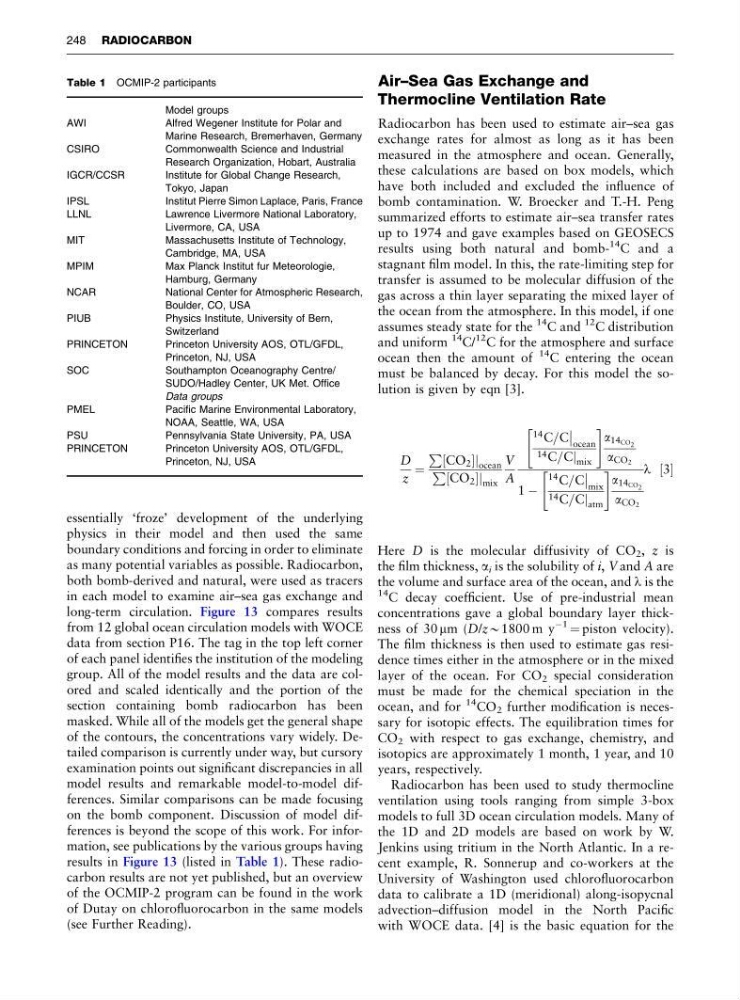
D
z
¼
P CO 2
½
j ocean
P CO 2
½
j mix
V
A
14 C=C
ocean
14 C=Cj mix
"
#
a 14 CO 2
a CO 2
1 À
14 C=C
mix
14 C=Cj atm
"
#
a 14 CO 2
a CO2
l ½3
Here D is the molecular diffusivity of CO 2 , z is
the film thickness, a i is the solubility of i, V and A are
the volume and surface area of the ocean, and l is the
14 C decay coefficient. Use of pre-industrial mean
concentrations gave a global boundary layer thickness of 30 mm (D/zB1800 m y
À1 ¼ piston velocity).
The film thickness is then used to estimate gas residence times either in the atmosphere or in the mixed
layer of the ocean. For CO 2 special consideration
must be made for the chemical speciation in the
ocean, and for
14 CO 2 further modification is necessary for isotopic effects. The equilibration times for
CO 2 with respect to gas exchange, chemistry, and
isotopics are approximately 1 month, 1 year, and 10
years, respectively.
Radiocarbon has been used to study thermocline
ventilation using tools ranging from simple 3-box
models to full 3D ocean circulation models. Many of
the 1D and 2D models are based on work by W.
Jenkins using tritium in the North Atlantic. In a recent example, R. Sonnerup and co-workers at the
University of Washington used chlorofluorocarbon
data to calibrate a 1D (meridional) along-isopycnal
advection–diffusion model in the North Pacific
with WOCE data. [4] is the basic equation for the
Table 1 OCMIP-2 participants
Model groups
AWI
Alfred Wegener Institute for Polar and
Marine Research, Bremerhaven, Germany
CSIRO
Commonwealth Science and Industrial
Research Organization, Hobart, Australia
IGCR/CCSR
Institute for Global Change Research,
Tokyo, Japan
IPSL
Institut Pierre Simon Laplace, Paris, France
LLNL
Lawrence Livermore National Laboratory,
Livermore, CA, USA
MIT
Massachusetts Institute of Technology,
Cambridge, MA, USA
MPIM
Max Planck Institut fur Meteorologie,
Hamburg, Germany
NCAR
National Center for Atmospheric Research,
Boulder, CO, USA
PIUB
Physics Institute, University of Bern,
Switzerland
PRINCETON
Princeton University AOS, OTL/GFDL,
Princeton, NJ, USA
SOC
Southampton Oceanography Centre/
SUDO/Hadley Center, UK Met. Office
Data groups
PMEL
Pacific Marine Environmental Laboratory,
NOAA, Seattle, WA, USA
PSU
Pennsylvania State University, PA, USA
PRINCETON
Princeton University AOS, OTL/GFDL,
Princeton, NJ, USA
248 RADIOCARBON
physics in their model and then used the same
boundary conditions and forcing in order to eliminate
as many potential variables as possible. Radiocarbon,
both bomb-derived and natural, were used as tracers
in each model to examine air–sea gas exchange and
long-term circulation. Figure 13 compares results
from 12 global ocean circulation models with WOCE
data from section P16. The tag in the top left corner
of each panel identifies the institution of the modeling
group. All of the model results and the data are colored and scaled identically and the portion of the
section containing bomb radiocarbon has been
masked. While all of the models get the general shape
of the contours, the concentrations vary widely. Detailed comparison is currently under way, but cursory
examination points out significant discrepancies in all
model results and remarkable model-to-model differences. Similar comparisons can be made focusing
on the bomb component. Discussion of model differences is beyond the scope of this work. For information, see publications by the various groups having
results in Figure 13 (listed in Table 1). These radiocarbon results are not yet published, but an overview
of the OCMIP-2 program can be found in the work
of Dutay on chlorofluorocarbon in the same models
(see Further Reading).
Air–Sea Gas Exchange and
Thermocline Ventilation Rate
Radiocarbon has been used to estimate air–sea gas
exchange rates for almost as long as it has been
measured in the atmosphere and ocean. Generally,
these calculations are based on box models, which
have both included and excluded the influence of
bomb contamination. W. Broecker and T.-H. Peng
summarized efforts to estimate air–sea transfer rates
up to 1974 and gave examples based on GEOSECS
results using both natural and bomb14 C and a
stagnant film model. In this, the rate-limiting step for
transfer is assumed to be molecular diffusion of the
gas across a thin layer separating the mixed layer of
the ocean from the atmosphere. In this model, if one
assumes steady state for the
14
C and
12 C distribution
and uniform
14
C/
12 C for the atmosphere and surface
ocean then the amount of
14 C entering the ocean
must be balanced by decay. For this model the solution is given by eqn [3].
D
z
¼
P CO 2
½
j ocean
P CO 2
½
j mix
V
A
14 C=C
ocean
14 C=Cj mix
"
#
a 14 CO 2
a CO 2
1 À
14 C=C
mix
14 C=Cj atm
"
#
a 14 CO 2
a CO2
l ½3
Here D is the molecular diffusivity of CO 2 , z is
the film thickness, a i is the solubility of i, V and A are
the volume and surface area of the ocean, and l is the
14 C decay coefficient. Use of pre-industrial mean
concentrations gave a global boundary layer thickness of 30 mm (D/zB1800 m y
À1 ¼ piston velocity).
The film thickness is then used to estimate gas residence times either in the atmosphere or in the mixed
layer of the ocean. For CO 2 special consideration
must be made for the chemical speciation in the
ocean, and for
14 CO 2 further modification is necessary for isotopic effects. The equilibration times for
CO 2 with respect to gas exchange, chemistry, and
isotopics are approximately 1 month, 1 year, and 10
years, respectively.
Radiocarbon has been used to study thermocline
ventilation using tools ranging from simple 3-box
models to full 3D ocean circulation models. Many of
the 1D and 2D models are based on work by W.
Jenkins using tritium in the North Atlantic. In a recent example, R. Sonnerup and co-workers at the
University of Washington used chlorofluorocarbon
data to calibrate a 1D (meridional) along-isopycnal
advection–diffusion model in the North Pacific
with WOCE data. [4] is the basic equation for the
Table 1 OCMIP-2 participants
Model groups
AWI
Alfred Wegener Institute for Polar and
Marine Research, Bremerhaven, Germany
CSIRO
Commonwealth Science and Industrial
Research Organization, Hobart, Australia
IGCR/CCSR
Institute for Global Change Research,
Tokyo, Japan
IPSL
Institut Pierre Simon Laplace, Paris, France
LLNL
Lawrence Livermore National Laboratory,
Livermore, CA, USA
MIT
Massachusetts Institute of Technology,
Cambridge, MA, USA
MPIM
Max Planck Institut fur Meteorologie,
Hamburg, Germany
NCAR
National Center for Atmospheric Research,
Boulder, CO, USA
PIUB
Physics Institute, University of Bern,
Switzerland
PRINCETON
Princeton University AOS, OTL/GFDL,
Princeton, NJ, USA
SOC
Southampton Oceanography Centre/
SUDO/Hadley Center, UK Met. Office
Data groups
PMEL
Pacific Marine Environmental Laboratory,
NOAA, Seattle, WA, USA
PSU
Pennsylvania State University, PA, USA
PRINCETON
Princeton University AOS, OTL/GFDL,
Princeton, NJ, USA
248 RADIOCARBON