

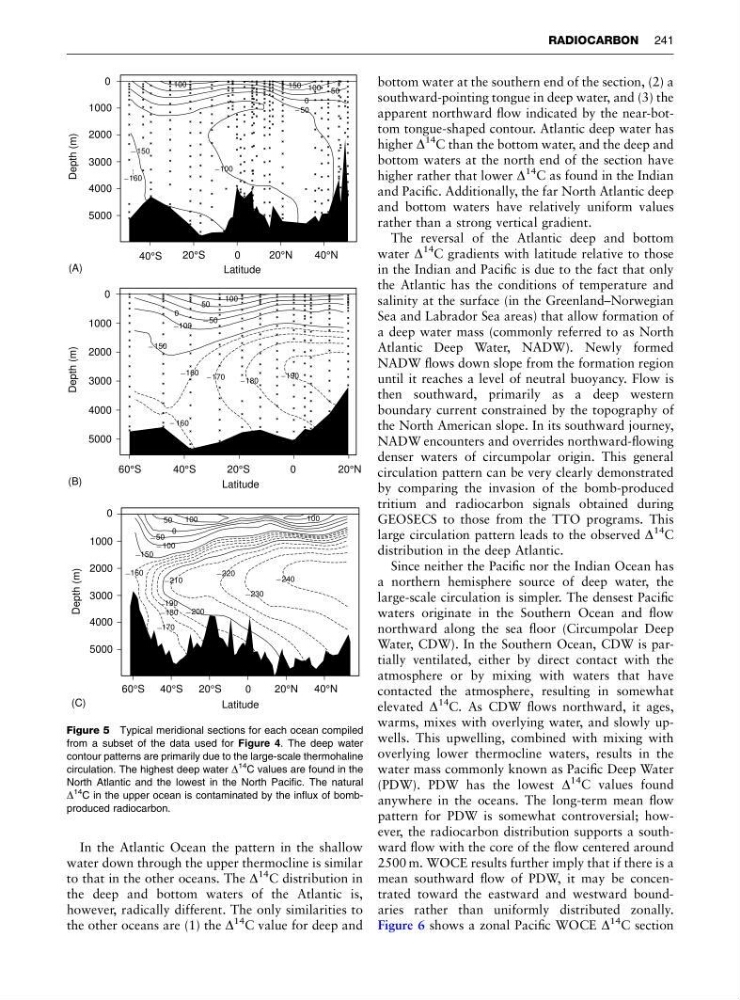
In the Atlantic Ocean the pattern in the shallow
water down through the upper thermocline is similar
to that in the other oceans. The D
14 C distribution in
the deep and bottom waters of the Atlantic is,
however, radically different. The only similarities to
the other oceans are (1) the D
14 C value for deep and
bottom water at the southern end of the section, (2) a
southward-pointing tongue in deep water, and (3) the
apparent northward flow indicated by the near-bottom tongue-shaped contour. Atlantic deep water has
higher D
14
C than the bottom water, and the deep and
bottom waters at the north end of the section have
higher rather that lower D
14
C as found in the Indian
and Pacific. Additionally, the far North Atlantic deep
and bottom waters have relatively uniform values
rather than a strong vertical gradient.
The reversal of the Atlantic deep and bottom
water D
14
C gradients with latitude relative to those
in the Indian and Pacific is due to the fact that only
the Atlantic has the conditions of temperature and
salinity at the surface (in the Greenland–Norwegian
Sea and Labrador Sea areas) that allow formation of
a deep water mass (commonly referred to as North
Atlantic Deep Water, NADW). Newly formed
NADW flows down slope from the formation region
until it reaches a level of neutral buoyancy. Flow is
then southward, primarily as a deep western
boundary current constrained by the topography of
the North American slope. In its southward journey,
NADW encounters and overrides northward-flowing
denser waters of circumpolar origin. This general
circulation pattern can be very clearly demonstrated
by comparing the invasion of the bomb-produced
tritium and radiocarbon signals obtained during
GEOSECS to those from the TTO programs. This
large circulation pattern leads to the observed D
14
C
distribution in the deep Atlantic.
Since neither the Pacific nor the Indian Ocean has
a northern hemisphere source of deep water, the
large-scale circulation is simpler. The densest Pacific
waters originate in the Southern Ocean and flow
northward along the sea floor (Circumpolar Deep
Water, CDW). In the Southern Ocean, CDW is partially ventilated, either by direct contact with the
atmosphere or by mixing with waters that have
contacted the atmosphere, resulting in somewhat
elevated D
14
C. As CDW flows northward, it ages,
warms, mixes with overlying water, and slowly upwells. This upwelling, combined with mixing with
overlying lower thermocline waters, results in the
water mass commonly known as Pacific Deep Water
(PDW). PDW has the lowest D
14 C values found
anywhere in the oceans. The long-term mean flow
pattern for PDW is somewhat controversial; however, the radiocarbon distribution supports a southward flow with the core of the flow centered around
2500 m. WOCE results further imply that if there is a
mean southward flow of PDW, it may be concentrated toward the eastward and westward boundaries rather than uniformly distributed zonally.
Figure 6 shows a zonal Pacific WOCE D
14 C section
Latitude
Depth (m)
40°S
20°S
0
20°N
40°N
5000
4000
3000
2000
1000
0
_ 150
−100
− 50
0
50
100
100
150
−160
Latitude
Depth (m)
60°S
40°S
20°S
0
20°N
5000
4000
3000
2000
1000
0
_ 150
_ 100
_ 50
50
100
−190
−180
−170
_ 160
− 160
0
(A)
(B)
Latitude
Depth (m)
60°S 40°S
20°S
0
20°N
40°N
5000
4000
3000
2000
1000
0
_ 200
_ 150
_ 100
_ 50
0
50
100
100
_ 240
_ 230
_ 220
_ 210
_ 190
_ 180
_ 170
_ 160
(C)
Figure 5 Typical meridional sections for each ocean compiled
from a subset of the data used for Figure 4. The deep water
contour patterns are primarily due to the large-scale thermohaline
circulation. The highest deep water D
14 C values are found in the
North Atlantic and the lowest in the North Pacific. The natural
D
14 C in the upper ocean is contaminated by the influx of bombproduced radiocarbon.
RADIOCARBON 241
water down through the upper thermocline is similar
to that in the other oceans. The D
14 C distribution in
the deep and bottom waters of the Atlantic is,
however, radically different. The only similarities to
the other oceans are (1) the D
14 C value for deep and
bottom water at the southern end of the section, (2) a
southward-pointing tongue in deep water, and (3) the
apparent northward flow indicated by the near-bottom tongue-shaped contour. Atlantic deep water has
higher D
14
C than the bottom water, and the deep and
bottom waters at the north end of the section have
higher rather that lower D
14
C as found in the Indian
and Pacific. Additionally, the far North Atlantic deep
and bottom waters have relatively uniform values
rather than a strong vertical gradient.
The reversal of the Atlantic deep and bottom
water D
14
C gradients with latitude relative to those
in the Indian and Pacific is due to the fact that only
the Atlantic has the conditions of temperature and
salinity at the surface (in the Greenland–Norwegian
Sea and Labrador Sea areas) that allow formation of
a deep water mass (commonly referred to as North
Atlantic Deep Water, NADW). Newly formed
NADW flows down slope from the formation region
until it reaches a level of neutral buoyancy. Flow is
then southward, primarily as a deep western
boundary current constrained by the topography of
the North American slope. In its southward journey,
NADW encounters and overrides northward-flowing
denser waters of circumpolar origin. This general
circulation pattern can be very clearly demonstrated
by comparing the invasion of the bomb-produced
tritium and radiocarbon signals obtained during
GEOSECS to those from the TTO programs. This
large circulation pattern leads to the observed D
14
C
distribution in the deep Atlantic.
Since neither the Pacific nor the Indian Ocean has
a northern hemisphere source of deep water, the
large-scale circulation is simpler. The densest Pacific
waters originate in the Southern Ocean and flow
northward along the sea floor (Circumpolar Deep
Water, CDW). In the Southern Ocean, CDW is partially ventilated, either by direct contact with the
atmosphere or by mixing with waters that have
contacted the atmosphere, resulting in somewhat
elevated D
14
C. As CDW flows northward, it ages,
warms, mixes with overlying water, and slowly upwells. This upwelling, combined with mixing with
overlying lower thermocline waters, results in the
water mass commonly known as Pacific Deep Water
(PDW). PDW has the lowest D
14 C values found
anywhere in the oceans. The long-term mean flow
pattern for PDW is somewhat controversial; however, the radiocarbon distribution supports a southward flow with the core of the flow centered around
2500 m. WOCE results further imply that if there is a
mean southward flow of PDW, it may be concentrated toward the eastward and westward boundaries rather than uniformly distributed zonally.
Figure 6 shows a zonal Pacific WOCE D
14 C section
Latitude
Depth (m)
40°S
20°S
0
20°N
40°N
5000
4000
3000
2000
1000
0
_ 150
−100
− 50
0
50
100
100
150
−160
Latitude
Depth (m)
60°S
40°S
20°S
0
20°N
5000
4000
3000
2000
1000
0
_ 150
_ 100
_ 50
50
100
−190
−180
−170
_ 160
− 160
0
(A)
(B)
Latitude
Depth (m)
60°S 40°S
20°S
0
20°N
40°N
5000
4000
3000
2000
1000
0
_ 200
_ 150
_ 100
_ 50
0
50
100
100
_ 240
_ 230
_ 220
_ 210
_ 190
_ 180
_ 170
_ 160
(C)
Figure 5 Typical meridional sections for each ocean compiled
from a subset of the data used for Figure 4. The deep water
contour patterns are primarily due to the large-scale thermohaline
circulation. The highest deep water D
14 C values are found in the
North Atlantic and the lowest in the North Pacific. The natural
D
14 C in the upper ocean is contaminated by the influx of bombproduced radiocarbon.
RADIOCARBON 241