

RADIOCARBON
R. M. Key, Princeton University, Princeton, NJ, USA
Copyright & 2001 Elsevier Ltd.
Introduction
In 1934 F.N.D. Kurie at Yale University obtained the
first evidence for existence of radiocarbon (carbon14,
14 C). Over the next 20 years most of the details
for measuring
14
C and for its application to dating
were worked out by W.F. Libby and co-workers.
Libby received the 1960 Nobel Prize in chemistry for
this research.
The primary application of
14
C is to date objects or
to determine various environmental process rates. The
14
C method is based on the assumption of a constant
atmospheric formation rate. Once produced, atmospheric
14
C reacts to form
14
CO 2 , which participates in
the global carbon cycle processes of photosynthesis
and respiration as well as the physical processes of
dissolution, particulate deposition, evaporation, precipitation, transport, etc. Atmospheric radiocarbon is
transferred to the ocean primarily by air–sea gas exchange of
14
CO 2 . Once in the ocean,
14
CO 2 is subject
to the same physical, chemical, and biological processes that affect CO 2 . While alive, biota establish an
equilibrium concentration of radiocarbon with their
surroundings; that is,
14
C lost by decay is replaced by
uptake from the environment. Once the tissue dies or
is removed from an environment that contains
14
C, the
decay is no longer compensated. The loss of
14
C by
decay can then be used to determine the time of death
or removal from the original
14
C source. After death
or removal of the organism, it is generally assumed
that no exchange occurs between the tissue and its
surroundings; that is, the system is assumed to be
closed. As a result of the
14
C decay rate, the various
reservoir sizes involved in the carbon cycle, and exchange rates between the reservoirs, the ocean contains approximately 50 times as much natural
radiocarbon as does the atmosphere.
Carbon-14 is one of three naturally occurring carbon isotopes;
14
C is radioactive, has a half-life of 5730
years and decays by emitting a b-particle with an energy of about 156 keV. On the surface of the earth, the
abundance of natural
14
C relative to the two stable
naturally occurring carbon isotopes is
12
C :
13
C :
14
C ¼ 98.9% : 1.1% : 1.2 Â 10
À10 %. Natural radiocarbon is produced in the atmosphere, primarily by the
collision of cosmic ray produced neutrons with nitrogen according to the reaction [I].
1
0 n þ
14
7 N )
14
6 C þ
1
1 H
½I
where n is a neutron and H is the proton emitted by
the product nucleus. Similarly, the decay of
14
C takes
place by emission of a b-particle and leads to stable
nitrogen according to reaction (II),
14
6 C )
14
7 N þ b
À þ ¯
v þ Q
½II
where ¯
v is an antineutrino and Q is the decay energy.
The atmospheric production rate varies somewhat
and is influenced by changes in the solar wind and in
the earth’s geomagnetic field intensity. A mean of
1.57 atom cm
À2 s
À1 is estimated based on the longterm record preserved in tree rings and a carbon
reservoir model. This long-term production rate
yields a global natural
14 C inventory of approximately 50 t (1t ¼ 10
6 g). Production estimates based
on the more recent record of neutron flux measurements tend to be higher, with values approaching 2
atom cm
À2 s
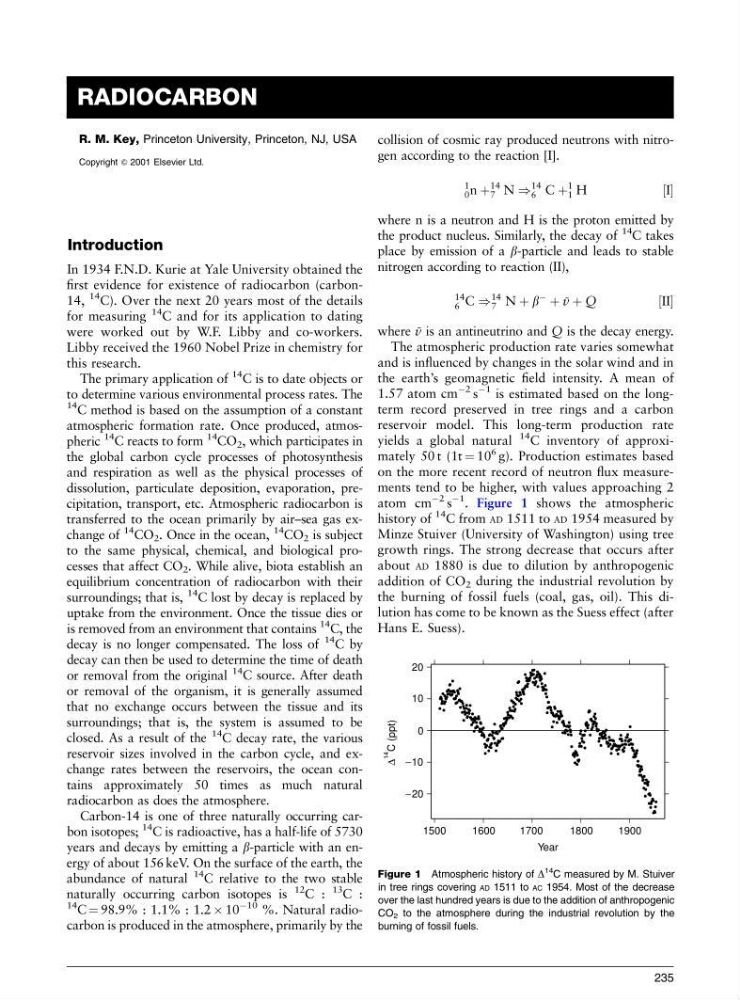
À1 . Figure 1 shows the atmospheric
history of
14
C from AD 1511 to AD 1954 measured by
Minze Stuiver (University of Washington) using tree
growth rings. The strong decrease that occurs after
about AD 1880 is due to dilution by anthropogenic
addition of CO 2 during the industrial revolution by
the burning of fossil fuels (coal, gas, oil). This dilution has come to be known as the Suess effect (after
Hans E. Suess).
−20
−10
0
10
20
1500
1600
1700
1800
1900
Year
Δ
14
C (ppt)
Figure 1 Atmospheric history of D
14
C measured by M. Stuiver
in tree rings covering AD 1511 to AC 1954. Most of the decrease
over the last hundred years is due to the addition of anthropogenic
CO 2 to the atmosphere during the industrial revolution by the
burning of fossil fuels.
235
R. M. Key, Princeton University, Princeton, NJ, USA
Copyright & 2001 Elsevier Ltd.
Introduction
In 1934 F.N.D. Kurie at Yale University obtained the
first evidence for existence of radiocarbon (carbon14,
14 C). Over the next 20 years most of the details
for measuring
14
C and for its application to dating
were worked out by W.F. Libby and co-workers.
Libby received the 1960 Nobel Prize in chemistry for
this research.
The primary application of
14
C is to date objects or
to determine various environmental process rates. The
14
C method is based on the assumption of a constant
atmospheric formation rate. Once produced, atmospheric
14
C reacts to form
14
CO 2 , which participates in
the global carbon cycle processes of photosynthesis
and respiration as well as the physical processes of
dissolution, particulate deposition, evaporation, precipitation, transport, etc. Atmospheric radiocarbon is
transferred to the ocean primarily by air–sea gas exchange of
14
CO 2 . Once in the ocean,
14
CO 2 is subject
to the same physical, chemical, and biological processes that affect CO 2 . While alive, biota establish an
equilibrium concentration of radiocarbon with their
surroundings; that is,
14
C lost by decay is replaced by
uptake from the environment. Once the tissue dies or
is removed from an environment that contains
14
C, the
decay is no longer compensated. The loss of
14
C by
decay can then be used to determine the time of death
or removal from the original
14
C source. After death
or removal of the organism, it is generally assumed
that no exchange occurs between the tissue and its
surroundings; that is, the system is assumed to be
closed. As a result of the
14
C decay rate, the various
reservoir sizes involved in the carbon cycle, and exchange rates between the reservoirs, the ocean contains approximately 50 times as much natural
radiocarbon as does the atmosphere.
Carbon-14 is one of three naturally occurring carbon isotopes;
14
C is radioactive, has a half-life of 5730
years and decays by emitting a b-particle with an energy of about 156 keV. On the surface of the earth, the
abundance of natural
14
C relative to the two stable
naturally occurring carbon isotopes is
12
C :
13
C :
14
C ¼ 98.9% : 1.1% : 1.2 Â 10
À10 %. Natural radiocarbon is produced in the atmosphere, primarily by the
collision of cosmic ray produced neutrons with nitrogen according to the reaction [I].
1
0 n þ
14
7 N )
14
6 C þ
1
1 H
½I
where n is a neutron and H is the proton emitted by
the product nucleus. Similarly, the decay of
14
C takes
place by emission of a b-particle and leads to stable
nitrogen according to reaction (II),
14
6 C )
14
7 N þ b
À þ ¯
v þ Q
½II
where ¯
v is an antineutrino and Q is the decay energy.
The atmospheric production rate varies somewhat
and is influenced by changes in the solar wind and in
the earth’s geomagnetic field intensity. A mean of
1.57 atom cm
À2 s
À1 is estimated based on the longterm record preserved in tree rings and a carbon
reservoir model. This long-term production rate
yields a global natural
14 C inventory of approximately 50 t (1t ¼ 10
6 g). Production estimates based
on the more recent record of neutron flux measurements tend to be higher, with values approaching 2
atom cm
À2 s
À1 . Figure 1 shows the atmospheric
history of
14
C from AD 1511 to AD 1954 measured by
Minze Stuiver (University of Washington) using tree
growth rings. The strong decrease that occurs after
about AD 1880 is due to dilution by anthropogenic
addition of CO 2 during the industrial revolution by
the burning of fossil fuels (coal, gas, oil). This dilution has come to be known as the Suess effect (after
Hans E. Suess).
−20
−10
0
10
20
1500
1600
1700
1800
1900
Year
Δ
14
C (ppt)
Figure 1 Atmospheric history of D
14
C measured by M. Stuiver
in tree rings covering AD 1511 to AC 1954. Most of the decrease
over the last hundred years is due to the addition of anthropogenic
CO 2 to the atmosphere during the industrial revolution by the
burning of fossil fuels.
235