

cause a separation between parent and daughter
nuclides. The resulting disequilibria between parent
and daughter nuclide can be used to calculate the
rate of the responsible processes.
Disequilibrium: The Basis for Flux
Calculations (Figure 2)
Mobile Parent with Particle-reactive Daughter
(Table 3)
Tracers in this group are produced in the water
column and removed on sinking particles, a process
called scavenging. They allow us to determine particle transport rates in the ocean.
In a simple box model the total daughter activity
(A D
t ) is determined by decay (decay constant l ¼ ln(2)/
t 1/2 ), ingrowth from the parent nuclide (activity A p ,
production rate of daughter nuclide P D ¼ lA p ) and
removal on sinking particles J (Figure 3):
dA
t
D
dt
¼ P D À lA
t
D À J ¼lðA P À A
t
D Þ À J
½1
In steady-state the flux is directly related to the depletion of the daughter with respect to the parent:
J ¼ lðA P À A
t
D Þ
½ 2
and the residence time of the daughter nuclide with
respect to scavenging, t sc , is given by the quotient of
Element
Uranium-238 series
Th-232 series
U-235 series
Uranium
Protactinium
Thorium
Actinium
Radium
Francium
Radon
Astatine
Polonium
Bismuth
Lead
U-238
4.5*10 9 y
Th-234
24.1 d
U-234
245500 y
Th-230
75400 y
Ra-226
1600 y
Rn-222
3.8 d
Po-218
3.1 min
Pb-214
26.8 min
Th-232
1.4*10
10 y
Ra-228
5.75 y
Th-228
1.91 y
Ra-224
3.7 d
Pb-208
stable
Po-214
0.00014 s
Pb-210
22.3 y
Po-210
138 d
Pb-206
stable
Pa-234
1.2 min
Bi-214
19.9 min
Bi-210
5.0 d
Ac-228
6.1 h
U-235
7.0*10 8 y
Th-231
25.5 h
Ra-223
11.4 d
Pb-207
stable
Pa-231
32800 y
Ac-227
21.8 y
-decay
Z: _ 2
N: _ 4
-decay
Z: +1
N: +/ _ 0
Decay series
of short-lived
nuclides
Symbol of the
element
Pa-231
32500 y
Mass
number
Particle reactivity
Low
Intermediate
High
Half-life
Th-227
18.7 d
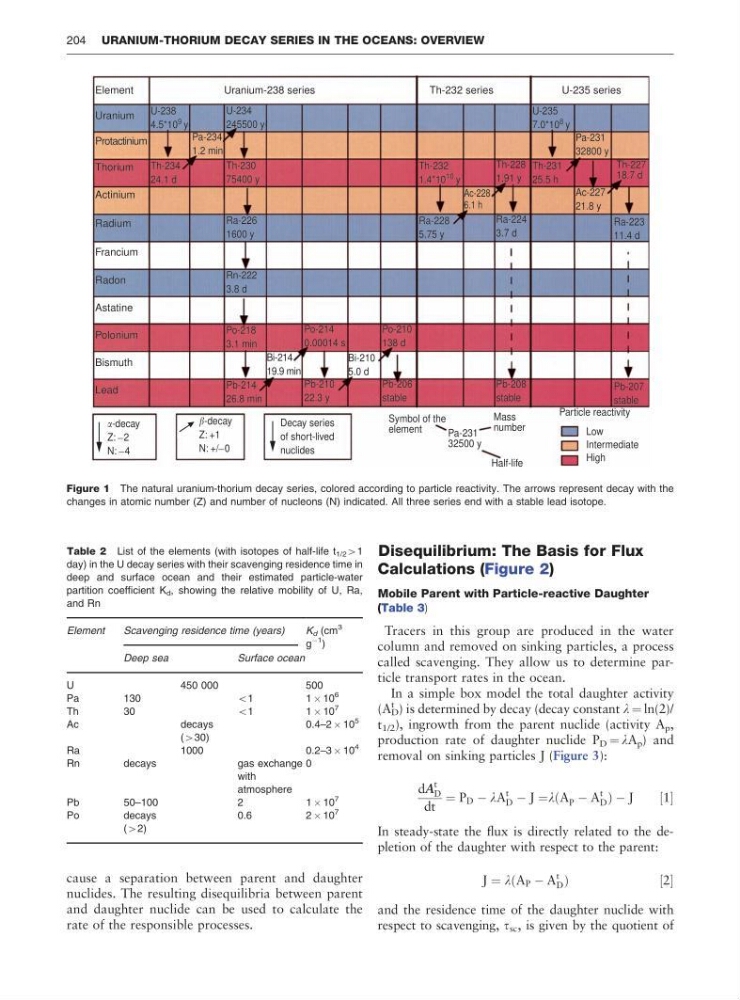
Figure 1 The natural uranium-thorium decay series, colored according to particle reactivity. The arrows represent decay with the
changes in atomic number (Z) and number of nucleons (N) indicated. All three series end with a stable lead isotope.
Table 2 List of the elements (with isotopes of half-life t 1/2 41
day) in the U decay series with their scavenging residence time in
deep and surface ocean and their estimated particle-water
partition coefficient K d , showing the relative mobility of U, Ra,
and Rn
Element
Scavenging residence time (years)
K d (cm
3
g
À1
)
Deep sea
Surface ocean
U
450 000
500
Pa
130
o1
1 Â 10
6
Th
30
o1
1 Â 10
7
Ac
decays
(430)
0.4–2 Â 10
5
Ra
1000
0.2–3 Â 10
4
Rn
decays
gas exchange
with
atmosphere
0
Pb
50–100
2
1 Â 10
7
Po
decays
(42)
0.6
2 Â 10
7
204 URANIUM-THORIUM DECAY SERIES IN THE OCEANS: OVERVIEW
nuclides. The resulting disequilibria between parent
and daughter nuclide can be used to calculate the
rate of the responsible processes.
Disequilibrium: The Basis for Flux
Calculations (Figure 2)
Mobile Parent with Particle-reactive Daughter
(Table 3)
Tracers in this group are produced in the water
column and removed on sinking particles, a process
called scavenging. They allow us to determine particle transport rates in the ocean.
In a simple box model the total daughter activity
(A D
t ) is determined by decay (decay constant l ¼ ln(2)/
t 1/2 ), ingrowth from the parent nuclide (activity A p ,
production rate of daughter nuclide P D ¼ lA p ) and
removal on sinking particles J (Figure 3):
dA
t
D
dt
¼ P D À lA
t
D À J ¼lðA P À A
t
D Þ À J
½1
In steady-state the flux is directly related to the depletion of the daughter with respect to the parent:
J ¼ lðA P À A
t
D Þ
½ 2
and the residence time of the daughter nuclide with
respect to scavenging, t sc , is given by the quotient of
Element
Uranium-238 series
Th-232 series
U-235 series
Uranium
Protactinium
Thorium
Actinium
Radium
Francium
Radon
Astatine
Polonium
Bismuth
Lead
U-238
4.5*10 9 y
Th-234
24.1 d
U-234
245500 y
Th-230
75400 y
Ra-226
1600 y
Rn-222
3.8 d
Po-218
3.1 min
Pb-214
26.8 min
Th-232
1.4*10
10 y
Ra-228
5.75 y
Th-228
1.91 y
Ra-224
3.7 d
Pb-208
stable
Po-214
0.00014 s
Pb-210
22.3 y
Po-210
138 d
Pb-206
stable
Pa-234
1.2 min
Bi-214
19.9 min
Bi-210
5.0 d
Ac-228
6.1 h
U-235
7.0*10 8 y
Th-231
25.5 h
Ra-223
11.4 d
Pb-207
stable
Pa-231
32800 y
Ac-227
21.8 y
-decay
Z: _ 2
N: _ 4
-decay
Z: +1
N: +/ _ 0
Decay series
of short-lived
nuclides
Symbol of the
element
Pa-231
32500 y
Mass
number
Particle reactivity
Low
Intermediate
High
Half-life
Th-227
18.7 d
Figure 1 The natural uranium-thorium decay series, colored according to particle reactivity. The arrows represent decay with the
changes in atomic number (Z) and number of nucleons (N) indicated. All three series end with a stable lead isotope.
Table 2 List of the elements (with isotopes of half-life t 1/2 41
day) in the U decay series with their scavenging residence time in
deep and surface ocean and their estimated particle-water
partition coefficient K d , showing the relative mobility of U, Ra,
and Rn
Element
Scavenging residence time (years)
K d (cm
3
g
À1
)
Deep sea
Surface ocean
U
450 000
500
Pa
130
o1
1 Â 10
6
Th
30
o1
1 Â 10
7
Ac
decays
(430)
0.4–2 Â 10
5
Ra
1000
0.2–3 Â 10
4
Rn
decays
gas exchange
with
atmosphere
0
Pb
50–100
2
1 Â 10
7
Po
decays
(42)
0.6
2 Â 10
7
204 URANIUM-THORIUM DECAY SERIES IN THE OCEANS: OVERVIEW