

URANIUM-THORIUM DECAY SERIES IN THE
OCEANS: OVERVIEW
M. M. R. van der Loeff, Alfred-Wegener-Institut fu ¨ r
Polar und Meereforschung Bremerhaven, Germany
Copyright & 2001 Elsevier Ltd.
Introduction
Natural radioactivity provides tracers in a wide
range of characteristic timescales and reactivities,
which can be used as tools to study the rate of reaction and transport processes in the ocean. Apart
from cosmogenic nuclides and the long-lived radioisotope K-40, the natural radioactivity in the ocean is
primarily derived from the decay series of three
radionuclides that were produced in the period of
nucleosynthesis preceding the birth of our solar system: Uranium-238, Thorium-232, and Uranium-235
(a fourth series, including Uranium-233, has already
decayed away). The remaining activity of these socalled primordial nuclides in the Earth’s crust, and
the range of half-lives and reactivities of the elements
in their decay schemes, control the present distribution of U-series nuclides in the ocean.
The Distribution of Radionuclides of
the Uranium Thorium Series in the
Ocean
Distribution of
238
U,
235
U,
234 U, and
232
Th (see
Uranium-Thorium Series Isotopes in Ocean Profiles)
Uranium is supplied to the ocean by rivers. In sea
water it is stabilized by a strong complexation as
uranyl carbonate UO 2 (CO 3 ) 3
4À , causing its long
residence time in the ocean. U follows closely the
distribution of salinity with
238 U (in dpm
l
À1 ) ¼ 0.0704* salinity. (Note: dpm ¼ disintegrations
per minute. The SI Unit Bq, 60 dpm ¼ 1 Bq, is not
used in the literature on natural radioactivity in the
ocean.) Under anoxic conditions, U is reduced from
the soluble (VI) to the insoluble (IV) oxidation state
and rapidly removed from sea water. Reductive removal occurs especially in sediments underlying high
productivity or low-oxygen bottom waters. Locally
this may influence the U–salinity relationship. Salinity-corrected U contents have a variation of 3.8% in
the world ocean and are about 1% higher in the
Pacific than in the Atlantic Ocean. At lower salinities
in estuaries, salinity-corrected U contents are much
more variable as a result of removal and release
processes and of interaction with organic complexants and colloids.
235 U is chemically equivalent to
238 U and occurs
with a
235 U/
238 U activity ratio of 0.046. As a result
of the preferential mobilization of
234 U during
chemical weathering, the river supply of
234 U activity
exceeds the supply of
238 U, causing a
234 U/
238
U ratio
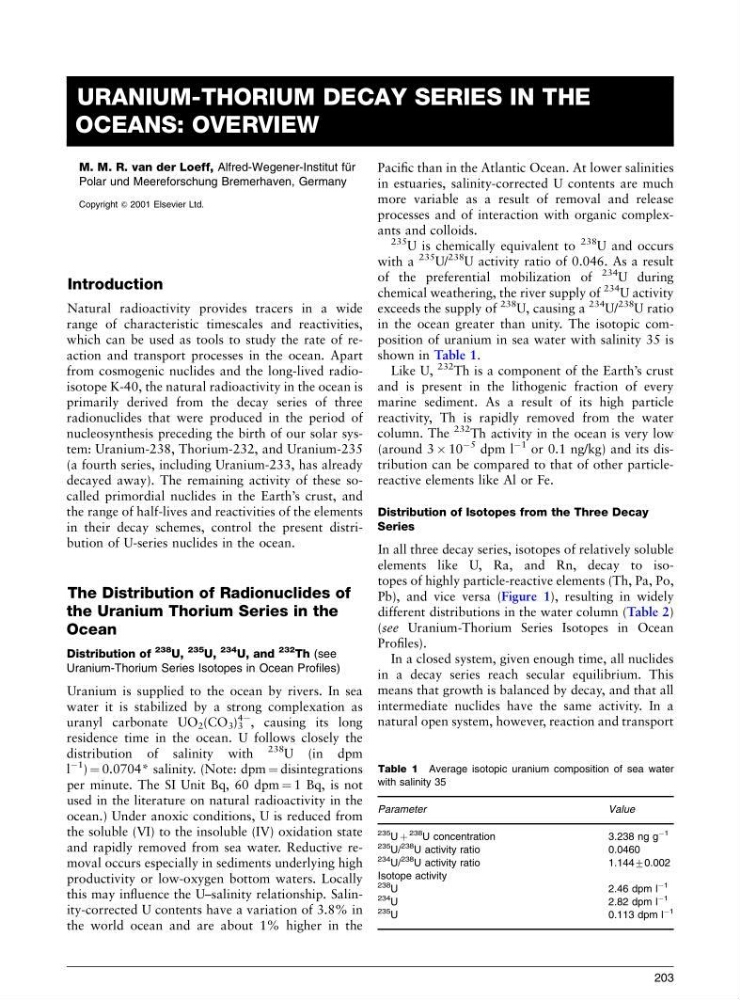
in the ocean greater than unity. The isotopic composition of uranium in sea water with salinity 35 is
shown in Table 1.
Like U,
232 Th is a component of the Earth’s crust
and is present in the lithogenic fraction of every
marine sediment. As a result of its high particle
reactivity, Th is rapidly removed from the water
column. The
232 Th activity in the ocean is very low
(around 3 Â 10
À5 dpm l
À1 or 0.1 ng/kg) and its distribution can be compared to that of other particlereactive elements like Al or Fe.
Distribution of Isotopes from the Three Decay
Series
In all three decay series, isotopes of relatively soluble
elements like U, Ra, and Rn, decay to isotopes of highly particle-reactive elements (Th, Pa, Po,
Pb), and vice versa (Figure 1), resulting in widely
different distributions in the water column (Table 2)
(see Uranium-Thorium Series Isotopes in Ocean
Profiles).
In a closed system, given enough time, all nuclides
in a decay series reach secular equilibrium. This
means that growth is balanced by decay, and that all
intermediate nuclides have the same activity. In a
natural open system, however, reaction and transport
Table 1 Average isotopic uranium composition of sea water
with salinity 35
Parameter
Value
235 U þ
238 U concentration
3.238 ng g
À1
235
U/
238 U activity ratio
0.0460
234 U/
238 U activity ratio
1.14470.002
Isotope activity
238 U
2.46 dpm l
À1
234
U
2.82 dpm l
À1
235
U
0.113 dpm l
À1
203
OCEANS: OVERVIEW
M. M. R. van der Loeff, Alfred-Wegener-Institut fu ¨ r
Polar und Meereforschung Bremerhaven, Germany
Copyright & 2001 Elsevier Ltd.
Introduction
Natural radioactivity provides tracers in a wide
range of characteristic timescales and reactivities,
which can be used as tools to study the rate of reaction and transport processes in the ocean. Apart
from cosmogenic nuclides and the long-lived radioisotope K-40, the natural radioactivity in the ocean is
primarily derived from the decay series of three
radionuclides that were produced in the period of
nucleosynthesis preceding the birth of our solar system: Uranium-238, Thorium-232, and Uranium-235
(a fourth series, including Uranium-233, has already
decayed away). The remaining activity of these socalled primordial nuclides in the Earth’s crust, and
the range of half-lives and reactivities of the elements
in their decay schemes, control the present distribution of U-series nuclides in the ocean.
The Distribution of Radionuclides of
the Uranium Thorium Series in the
Ocean
Distribution of
238
U,
235
U,
234 U, and
232
Th (see
Uranium-Thorium Series Isotopes in Ocean Profiles)
Uranium is supplied to the ocean by rivers. In sea
water it is stabilized by a strong complexation as
uranyl carbonate UO 2 (CO 3 ) 3
4À , causing its long
residence time in the ocean. U follows closely the
distribution of salinity with
238 U (in dpm
l
À1 ) ¼ 0.0704* salinity. (Note: dpm ¼ disintegrations
per minute. The SI Unit Bq, 60 dpm ¼ 1 Bq, is not
used in the literature on natural radioactivity in the
ocean.) Under anoxic conditions, U is reduced from
the soluble (VI) to the insoluble (IV) oxidation state
and rapidly removed from sea water. Reductive removal occurs especially in sediments underlying high
productivity or low-oxygen bottom waters. Locally
this may influence the U–salinity relationship. Salinity-corrected U contents have a variation of 3.8% in
the world ocean and are about 1% higher in the
Pacific than in the Atlantic Ocean. At lower salinities
in estuaries, salinity-corrected U contents are much
more variable as a result of removal and release
processes and of interaction with organic complexants and colloids.
235 U is chemically equivalent to
238 U and occurs
with a
235 U/
238 U activity ratio of 0.046. As a result
of the preferential mobilization of
234 U during
chemical weathering, the river supply of
234 U activity
exceeds the supply of
238 U, causing a
234 U/
238
U ratio
in the ocean greater than unity. The isotopic composition of uranium in sea water with salinity 35 is
shown in Table 1.
Like U,
232 Th is a component of the Earth’s crust
and is present in the lithogenic fraction of every
marine sediment. As a result of its high particle
reactivity, Th is rapidly removed from the water
column. The
232 Th activity in the ocean is very low
(around 3 Â 10
À5 dpm l
À1 or 0.1 ng/kg) and its distribution can be compared to that of other particlereactive elements like Al or Fe.
Distribution of Isotopes from the Three Decay
Series
In all three decay series, isotopes of relatively soluble
elements like U, Ra, and Rn, decay to isotopes of highly particle-reactive elements (Th, Pa, Po,
Pb), and vice versa (Figure 1), resulting in widely
different distributions in the water column (Table 2)
(see Uranium-Thorium Series Isotopes in Ocean
Profiles).
In a closed system, given enough time, all nuclides
in a decay series reach secular equilibrium. This
means that growth is balanced by decay, and that all
intermediate nuclides have the same activity. In a
natural open system, however, reaction and transport
Table 1 Average isotopic uranium composition of sea water
with salinity 35
Parameter
Value
235 U þ
238 U concentration
3.238 ng g
À1
235
U/
238 U activity ratio
0.0460
234 U/
238 U activity ratio
1.14470.002
Isotope activity
238 U
2.46 dpm l
À1
234
U
2.82 dpm l
À1
235
U
0.113 dpm l
À1
203