

We can estimate how much water was dissociated
by considering the oxidation of the mantle. If the
Earth started out with the oxidation state of chondrites (although not necessarily of total chondritic
composition), it would take the oxygen from about
one present-day ocean volume to reach the oxidation
state of the mantle inferred from mantle-derived
rocks. Alternatively, if we start with a more reduced
ensemble, suggested by condensation calculations
from a solar nebula, we will have primarily enstatite
(MgSiO 3 ) and metallic iron as the original source to
be oxidized. The oxidation reaction would then be as
shown in eqn [1].
2 MgSiO 3 þ Fe þ 2 H 2 O
-Mg 2 SiO 4 þ Fe 2 Sio 4 þ 2 H 2
½1
To oxidize the mass of the Earth with this initial
make-up to the present oxidized level would require
the dissociation of 60 present-day ocean volumes.
Clearly, the results indicate hydrogen loss and planetary oxidation, although the exact starting material
is not precisely defined.
In either case, the oxidation of the planet is the
consequence of the photodissociation of water vapor
and loss of hydrogen to space. In order to fractionate
the rare gases by entrainment in the hydrogen
streaming from Earth, this process must have occurred almost instantaneously in the early history of
the Earth. Therefore, it is reasonable to assume that
both water and rare gases were at the Earth’s surface
virtually at the time of formation of the Earth.
Sources of Water
Water reached Earth by one of two processes. The
first is by way of the capture of water from the solar
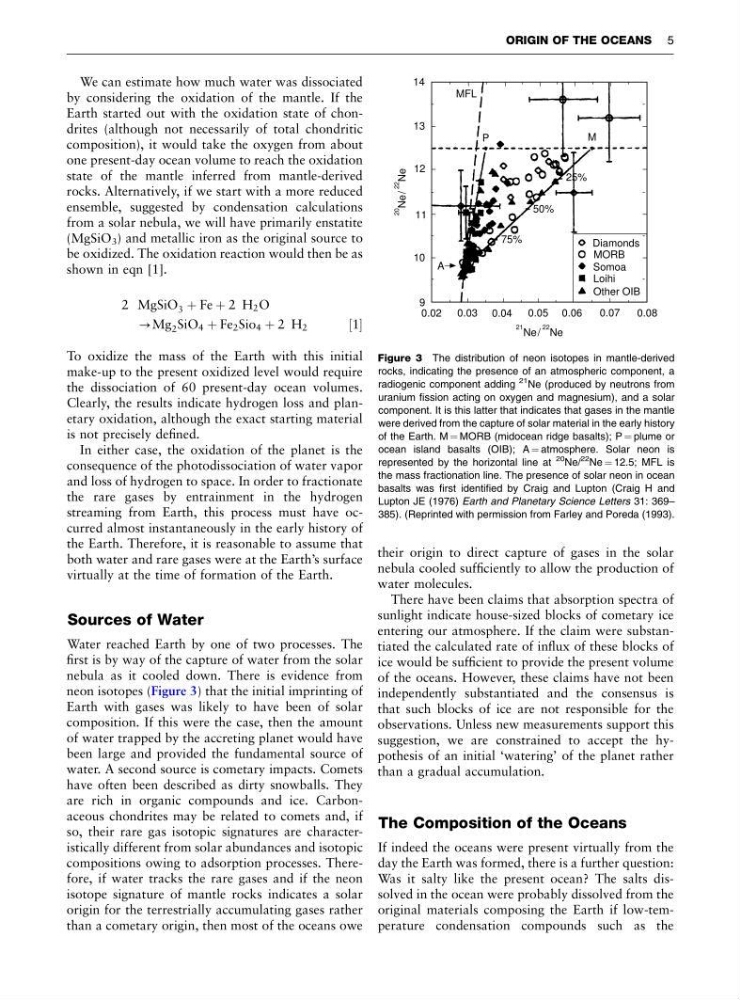
nebula as it cooled down. There is evidence from
neon isotopes (Figure 3) that the initial imprinting of
Earth with gases was likely to have been of solar
composition. If this were the case, then the amount
of water trapped by the accreting planet would have
been large and provided the fundamental source of
water. A second source is cometary impacts. Comets
have often been described as dirty snowballs. They
are rich in organic compounds and ice. Carbonaceous chondrites may be related to comets and, if
so, their rare gas isotopic signatures are characteristically different from solar abundances and isotopic
compositions owing to adsorption processes. Therefore, if water tracks the rare gases and if the neon
isotope signature of mantle rocks indicates a solar
origin for the terrestrially accumulating gases rather
than a cometary origin, then most of the oceans owe
their origin to direct capture of gases in the solar
nebula cooled sufficiently to allow the production of
water molecules.
There have been claims that absorption spectra of
sunlight indicate house-sized blocks of cometary ice
entering our atmosphere. If the claim were substantiated the calculated rate of influx of these blocks of
ice would be sufficient to provide the present volume
of the oceans. However, these claims have not been
independently substantiated and the consensus is
that such blocks of ice are not responsible for the
observations. Unless new measurements support this
suggestion, we are constrained to accept the hypothesis of an initial ‘watering’ of the planet rather
than a gradual accumulation.
The Composition of the Oceans
If indeed the oceans were present virtually from the
day the Earth was formed, there is a further question:
Was it salty like the present ocean? The salts dissolved in the ocean were probably dissolved from the
original materials composing the Earth if low-temperature condensation compounds such as the
0.02 0.03 0.04
0.05 0.06
0.07
0.08
9
10
11
12
13
14
21
22
Ne/ Ne
20 22
Ne/ Ne
Diamonds
MORB
Somoa
Loihi
Other OIB
M
MFL
P
50%
25%
A
75%
Figure 3 The distribution of neon isotopes in mantle-derived
rocks, indicating the presence of an atmospheric component, a
radiogenic component adding
21 Ne (produced by neutrons from
uranium fission acting on oxygen and magnesium), and a solar
component. It is this latter that indicates that gases in the mantle
were derived from the capture of solar material in the early history
of the Earth. M ¼ MORB (midocean ridge basalts); P ¼ plume or
ocean island basalts (OIB); A ¼ atmosphere. Solar neon is
represented by the horizontal line at
20 Ne/
22 Ne ¼ 12.5; MFL is
the mass fractionation line. The presence of solar neon in ocean
basalts was first identified by Craig and Lupton (Craig H and
Lupton JE (1976) Earth and Planetary Science Letters 31: 369–
385). (Reprinted with permission from Farley and Poreda (1993).
ORIGIN OF THE OCEANS 5
by considering the oxidation of the mantle. If the
Earth started out with the oxidation state of chondrites (although not necessarily of total chondritic
composition), it would take the oxygen from about
one present-day ocean volume to reach the oxidation
state of the mantle inferred from mantle-derived
rocks. Alternatively, if we start with a more reduced
ensemble, suggested by condensation calculations
from a solar nebula, we will have primarily enstatite
(MgSiO 3 ) and metallic iron as the original source to
be oxidized. The oxidation reaction would then be as
shown in eqn [1].
2 MgSiO 3 þ Fe þ 2 H 2 O
-Mg 2 SiO 4 þ Fe 2 Sio 4 þ 2 H 2
½1
To oxidize the mass of the Earth with this initial
make-up to the present oxidized level would require
the dissociation of 60 present-day ocean volumes.
Clearly, the results indicate hydrogen loss and planetary oxidation, although the exact starting material
is not precisely defined.
In either case, the oxidation of the planet is the
consequence of the photodissociation of water vapor
and loss of hydrogen to space. In order to fractionate
the rare gases by entrainment in the hydrogen
streaming from Earth, this process must have occurred almost instantaneously in the early history of
the Earth. Therefore, it is reasonable to assume that
both water and rare gases were at the Earth’s surface
virtually at the time of formation of the Earth.
Sources of Water
Water reached Earth by one of two processes. The
first is by way of the capture of water from the solar
nebula as it cooled down. There is evidence from
neon isotopes (Figure 3) that the initial imprinting of
Earth with gases was likely to have been of solar
composition. If this were the case, then the amount
of water trapped by the accreting planet would have
been large and provided the fundamental source of
water. A second source is cometary impacts. Comets
have often been described as dirty snowballs. They
are rich in organic compounds and ice. Carbonaceous chondrites may be related to comets and, if
so, their rare gas isotopic signatures are characteristically different from solar abundances and isotopic
compositions owing to adsorption processes. Therefore, if water tracks the rare gases and if the neon
isotope signature of mantle rocks indicates a solar
origin for the terrestrially accumulating gases rather
than a cometary origin, then most of the oceans owe
their origin to direct capture of gases in the solar
nebula cooled sufficiently to allow the production of
water molecules.
There have been claims that absorption spectra of
sunlight indicate house-sized blocks of cometary ice
entering our atmosphere. If the claim were substantiated the calculated rate of influx of these blocks of
ice would be sufficient to provide the present volume
of the oceans. However, these claims have not been
independently substantiated and the consensus is
that such blocks of ice are not responsible for the
observations. Unless new measurements support this
suggestion, we are constrained to accept the hypothesis of an initial ‘watering’ of the planet rather
than a gradual accumulation.
The Composition of the Oceans
If indeed the oceans were present virtually from the
day the Earth was formed, there is a further question:
Was it salty like the present ocean? The salts dissolved in the ocean were probably dissolved from the
original materials composing the Earth if low-temperature condensation compounds such as the
0.02 0.03 0.04
0.05 0.06
0.07
0.08
9
10
11
12
13
14
21
22
Ne/ Ne
20 22
Ne/ Ne
Diamonds
MORB
Somoa
Loihi
Other OIB
M
MFL
P
50%
25%
A
75%
Figure 3 The distribution of neon isotopes in mantle-derived
rocks, indicating the presence of an atmospheric component, a
radiogenic component adding
21 Ne (produced by neutrons from
uranium fission acting on oxygen and magnesium), and a solar
component. It is this latter that indicates that gases in the mantle
were derived from the capture of solar material in the early history
of the Earth. M ¼ MORB (midocean ridge basalts); P ¼ plume or
ocean island basalts (OIB); A ¼ atmosphere. Solar neon is
represented by the horizontal line at
20 Ne/
22 Ne ¼ 12.5; MFL is
the mass fractionation line. The presence of solar neon in ocean
basalts was first identified by Craig and Lupton (Craig H and
Lupton JE (1976) Earth and Planetary Science Letters 31: 369–
385). (Reprinted with permission from Farley and Poreda (1993).
ORIGIN OF THE OCEANS 5