

We are thus left with the possibility that the
oceans, including both the water and the soluble salts
found therein, were present at the Earth’s surface
right at the beginning and subsequently have been
subjected to recycling between crust and mantle via
the plate tectonic cycle.
The Loss of Water from the Earth’s
Surface
If the oceans were effectively at the surface at the
beginning, what processes could diminish the
original inventory? There are two ways to lose water
from the Earth’s surface: (1) the photolytic dissociation of water vapor in the atmosphere with subsequent loss of hydrogen to space and the utilization
of the released oxygen to oxidize reduced iron and
sulfur compounds from the mantle; and (2) the loss
of water, as well as of the oxidized components, to
the mantle by way of hydrated minerals (such as clay,
minerals, micas, and amphiboles) and minerals with
oxidized iron and sulfur.
Although the first process is occurring today, it is
not very efficient because of recombination with the
abundant oxygen in the atmosphere as well as the
fact that the supply of solar hydrogen to Earth may
compensate for the loss of hydrogen. In the early
history of the solar system, the flux of high-energy
photons from the sun is thought to have been much
greater than it is today, resulting in a very efficient
conversion of water to hydrogen and oxygen. The
stream of hydrogen from the atmosphere to outer
space may have entrained heavier gases and caused
the mass fractionation of the rare gases relative to
each other and the fractionation of the isotopes of
individual rare gases relative to solar composition.
0
0.2
0.4
0.6
0.8
1.0
1.2
1.4
1.6
1.8
2.0
2.2
2.4
2.6
2.8
3.0
3.2
3.4
0 0.5 1.0 1.5 2.0 2.5 3.0 3.5 4.0 4.5
A t m o s p h er e
S o l i d
E a r t h
P r o d u
c t i o n
b y
Time (10 years)
9
Argon-40 (10 atoms)
42
4 0
K
d
e c a y
Present
Initial
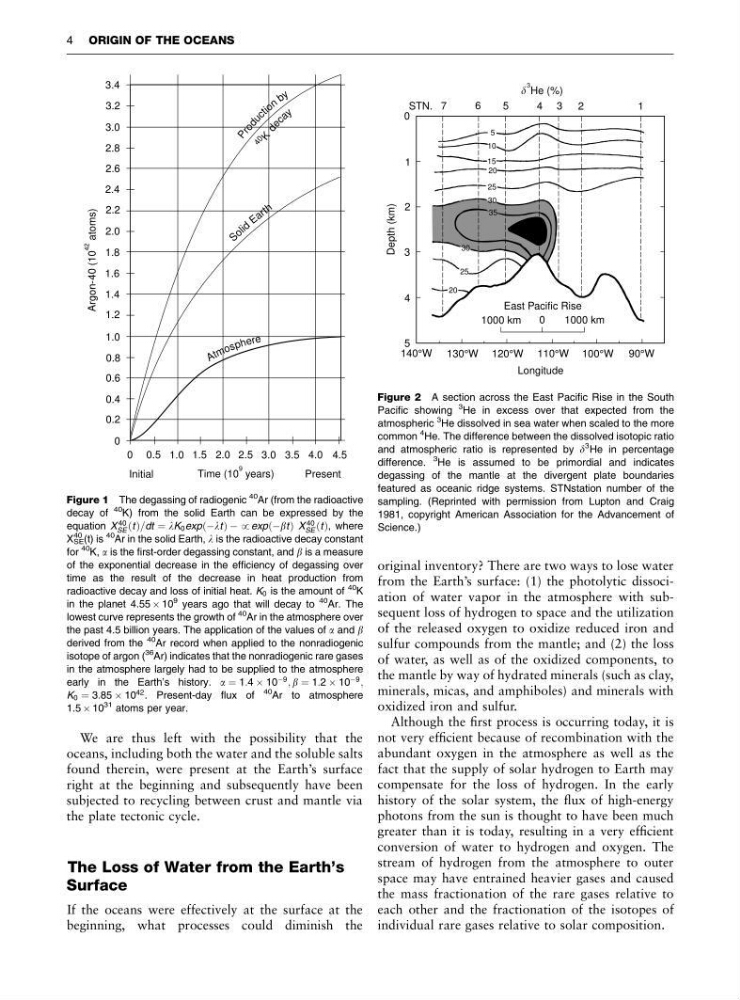
Figure 1 The degassing of radiogenic
40
Ar (from the radioactive
decay of
40
K) from the solid Earth can be expressed by the
equation X
40
SE ðtÞ=dt ¼ lK 0 expðÀltÞ À pexpðÀbtÞ X
40
SE ðtÞ, where
X
40
SE (t) is
40
Ar in the solid Earth, l is the radioactive decay constant
for
40
K, a is the first-order degassing constant, and b is a measure
of the exponential decrease in the efficiency of degassing over
time as the result of the decrease in heat production from
radioactive decay and loss of initial heat. K 0 is the amount of
40
K
in the planet 4.55 Â 10
9 years ago that will decay to
40 Ar. The
lowest curve represents the growth of
40
Ar in the atmosphere over
the past 4.5 billion years. The application of the values of a and b
derived from the
40 Ar record when applied to the nonradiogenic
isotope of argon (
36
Ar) indicates that the nonradiogenic rare gases
in the atmosphere largely had to be supplied to the atmosphere
early in the Earth’s history. a ¼ 1:4 Â 10
À9 ; b ¼ 1:2 Â 10
À9 ;
K 0 ¼ 3:85 Â 10
42 . Present-day flux of
40
Ar to atmosphere
1.5 Â 10
31 atoms per year.
140°W 130°W 120°W 110°W 100°W 90°W
5
4
3
2
1
0
STN. 7
6
5
4 3 2
1
Longitude
Depth (km)
He (%)
3
5
10
15
20
25
30
20
25
30
1000 km
0
1000 km
East Pacific Rise
35
Figure 2 A section across the East Pacific Rise in the South
Pacific showing
3 He in excess over that expected from the
atmospheric
3 He dissolved in sea water when scaled to the more
common
4 He. The difference between the dissolved isotopic ratio
and atmospheric ratio is represented by d
3 He in percentage
difference.
3 He is assumed to be primordial and indicates
degassing of the mantle at the divergent plate boundaries
featured as oceanic ridge systems. STNstation number of the
sampling. (Reprinted with permission from Lupton and Craig
1981, copyright American Association for the Advancement of
Science.)
4 ORIGIN OF THE OCEANS
oceans, including both the water and the soluble salts
found therein, were present at the Earth’s surface
right at the beginning and subsequently have been
subjected to recycling between crust and mantle via
the plate tectonic cycle.
The Loss of Water from the Earth’s
Surface
If the oceans were effectively at the surface at the
beginning, what processes could diminish the
original inventory? There are two ways to lose water
from the Earth’s surface: (1) the photolytic dissociation of water vapor in the atmosphere with subsequent loss of hydrogen to space and the utilization
of the released oxygen to oxidize reduced iron and
sulfur compounds from the mantle; and (2) the loss
of water, as well as of the oxidized components, to
the mantle by way of hydrated minerals (such as clay,
minerals, micas, and amphiboles) and minerals with
oxidized iron and sulfur.
Although the first process is occurring today, it is
not very efficient because of recombination with the
abundant oxygen in the atmosphere as well as the
fact that the supply of solar hydrogen to Earth may
compensate for the loss of hydrogen. In the early
history of the solar system, the flux of high-energy
photons from the sun is thought to have been much
greater than it is today, resulting in a very efficient
conversion of water to hydrogen and oxygen. The
stream of hydrogen from the atmosphere to outer
space may have entrained heavier gases and caused
the mass fractionation of the rare gases relative to
each other and the fractionation of the isotopes of
individual rare gases relative to solar composition.
0
0.2
0.4
0.6
0.8
1.0
1.2
1.4
1.6
1.8
2.0
2.2
2.4
2.6
2.8
3.0
3.2
3.4
0 0.5 1.0 1.5 2.0 2.5 3.0 3.5 4.0 4.5
A t m o s p h er e
S o l i d
E a r t h
P r o d u
c t i o n
b y
Time (10 years)
9
Argon-40 (10 atoms)
42
4 0
K
d
e c a y
Present
Initial
Figure 1 The degassing of radiogenic
40
Ar (from the radioactive
decay of
40
K) from the solid Earth can be expressed by the
equation X
40
SE ðtÞ=dt ¼ lK 0 expðÀltÞ À pexpðÀbtÞ X
40
SE ðtÞ, where
X
40
SE (t) is
40
Ar in the solid Earth, l is the radioactive decay constant
for
40
K, a is the first-order degassing constant, and b is a measure
of the exponential decrease in the efficiency of degassing over
time as the result of the decrease in heat production from
radioactive decay and loss of initial heat. K 0 is the amount of
40
K
in the planet 4.55 Â 10
9 years ago that will decay to
40 Ar. The
lowest curve represents the growth of
40
Ar in the atmosphere over
the past 4.5 billion years. The application of the values of a and b
derived from the
40 Ar record when applied to the nonradiogenic
isotope of argon (
36
Ar) indicates that the nonradiogenic rare gases
in the atmosphere largely had to be supplied to the atmosphere
early in the Earth’s history. a ¼ 1:4 Â 10
À9 ; b ¼ 1:2 Â 10
À9 ;
K 0 ¼ 3:85 Â 10
42 . Present-day flux of
40
Ar to atmosphere
1.5 Â 10
31 atoms per year.
140°W 130°W 120°W 110°W 100°W 90°W
5
4
3
2
1
0
STN. 7
6
5
4 3 2
1
Longitude
Depth (km)
He (%)
3
5
10
15
20
25
30
20
25
30
1000 km
0
1000 km
East Pacific Rise
35
Figure 2 A section across the East Pacific Rise in the South
Pacific showing
3 He in excess over that expected from the
atmospheric
3 He dissolved in sea water when scaled to the more
common
4 He. The difference between the dissolved isotopic ratio
and atmospheric ratio is represented by d
3 He in percentage
difference.
3 He is assumed to be primordial and indicates
degassing of the mantle at the divergent plate boundaries
featured as oceanic ridge systems. STNstation number of the
sampling. (Reprinted with permission from Lupton and Craig
1981, copyright American Association for the Advancement of
Science.)
4 ORIGIN OF THE OCEANS