

excess
4 He due to U and Th decay in sediments and
in the ocean crust. Although they were correct about
the existence of radiogenic helium in the oceans,
their measurements were of insufficient precision to
detect any
4 He enrichment above the dissolved air
component. It is now known that the input of
3
Herich volcanic helium has a greater effect on both
the
3 He/
4 He ratio and the
4 He concentration insea
water than does the input of radiogenic helium.
Mantle or volcanic helium was first detectedon the
Earth as an excess in the
3
He/
4 He ratio indeep Pacific
waters. Although this oceanic
3 He excess is derived
from the helium residing in oceanic volcanic rocks, it
was not until about five years later that mantle helium was directly measured in the volcanic rocks
themselves. Clarke et al. in 1969 reported a 21%
excess in the
3 He concentration at mid-depth above
that expected forair-saturated water, and correctly
attributed this excess to a flux ofprimordial helium
leaking from the Earth’s interior into the oceans and
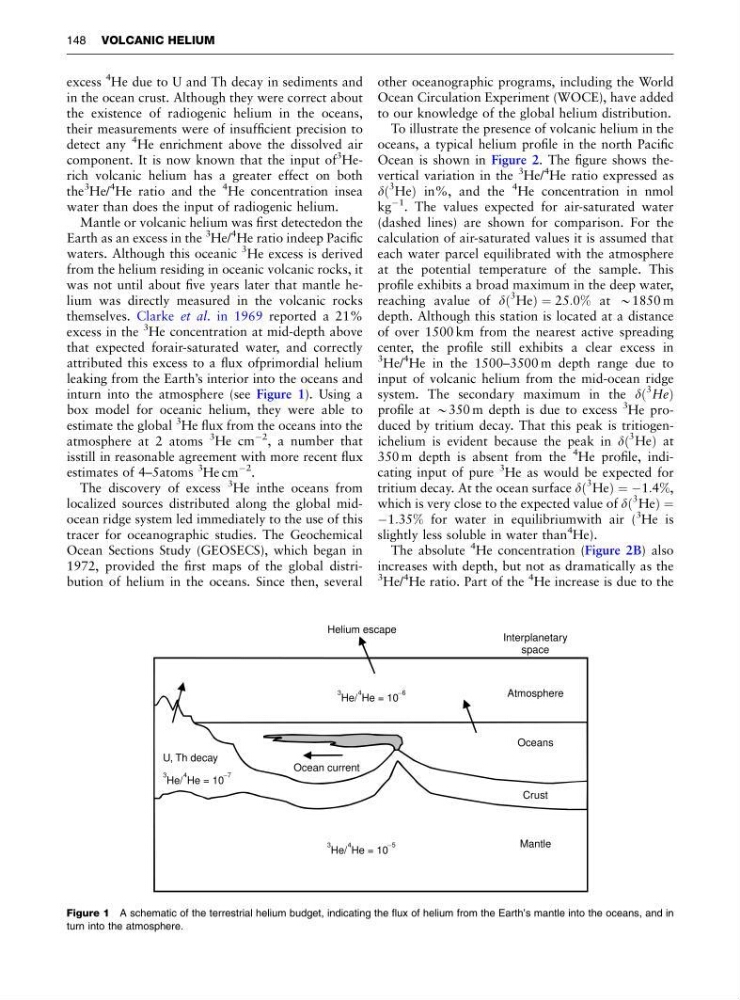
inturn into the atmosphere (see Figure 1). Using a
box model for oceanic helium, they were able to
estimate the global
3
He flux from the oceans into the
atmosphere at 2 atoms
3
He cm
À2 , a number that
isstill in reasonable agreement with more recent flux
estimates of 4–5atoms
3
He cm
À2
.
The discovery of excess
3
He inthe oceans from
localized sources distributed along the global midocean ridge system led immediately to the use of this
tracer for oceanographic studies. The Geochemical
Ocean Sections Study (GEOSECS), which began in
1972, provided the first maps of the global distribution of helium in the oceans. Since then, several
other oceanographic programs, including the World
Ocean Circulation Experiment (WOCE), have added
to our knowledge of the global helium distribution.
To illustrate the presence of volcanic helium in the
oceans, a typical helium profile in the north Pacific
Ocean is shown in Figure 2. The figure shows thevertical variation in the
3
He/
4 He ratio expressed as
dð
3 HeÞ in%, and the
4 He concentration in nmol
kg
À1
. The values expected for air-saturated water
(dashed lines) are shown for comparison. For the
calculation of air-saturated values it is assumed that
each water parcel equilibrated with the atmosphere
at the potential temperature of the sample. This
profile exhibits a broad maximum in the deep water,
reaching avalue of dð
3 HeÞ ¼ 25:0% at B1850 m
depth. Although this station is located at a distance
of over 1500 km from the nearest active spreading
center, the profile still exhibits a clear excess in
3 He/
4
He in the 1500–3500 m depth range due to
input of volcanic helium from the mid-ocean ridge
system. The secondary maximum in the dð
3 HeÞ
profile at B350 m depth is due to excess
3
He produced by tritium decay. That this peak is tritiogenichelium is evident because the peak in dð
3 HeÞ at
350 m depth is absent from the
4
He profile, indicating input of pure
3
He as would be expected for
tritium decay. At the ocean surface dð
3 HeÞ ¼ À1:4%,
which is very close to the expected value of dð
3 HeÞ ¼
À1:35% for water in equilibriumwith air (
3
He is
slightly less soluble in water than
4
He).
The absolute
4
He concentration (Figure 2B) also
increases with depth, but not as dramatically as the
3 He/
4
He ratio. Part of the
4
He increase is due to the
Helium escape
Interplanetary
space
Ocean current
Atmosphere
Oceans
Crust
Mantle
3
4
_ 6
He/ He = 10
3
4
_ 7
He/ He = 10
3
4
_ 5
He/ He = 10
U, Th decay
Figure 1 A schematic of the terrestrial helium budget, indicating the flux of helium from the Earth’s mantle into the oceans, and in
turn into the atmosphere.
148 VOLCANIC HELIUM
4 He due to U and Th decay in sediments and
in the ocean crust. Although they were correct about
the existence of radiogenic helium in the oceans,
their measurements were of insufficient precision to
detect any
4 He enrichment above the dissolved air
component. It is now known that the input of
3
Herich volcanic helium has a greater effect on both
the
3 He/
4 He ratio and the
4 He concentration insea
water than does the input of radiogenic helium.
Mantle or volcanic helium was first detectedon the
Earth as an excess in the
3
He/
4 He ratio indeep Pacific
waters. Although this oceanic
3 He excess is derived
from the helium residing in oceanic volcanic rocks, it
was not until about five years later that mantle helium was directly measured in the volcanic rocks
themselves. Clarke et al. in 1969 reported a 21%
excess in the
3 He concentration at mid-depth above
that expected forair-saturated water, and correctly
attributed this excess to a flux ofprimordial helium
leaking from the Earth’s interior into the oceans and
inturn into the atmosphere (see Figure 1). Using a
box model for oceanic helium, they were able to
estimate the global
3
He flux from the oceans into the
atmosphere at 2 atoms
3
He cm
À2 , a number that
isstill in reasonable agreement with more recent flux
estimates of 4–5atoms
3
He cm
À2
.
The discovery of excess
3
He inthe oceans from
localized sources distributed along the global midocean ridge system led immediately to the use of this
tracer for oceanographic studies. The Geochemical
Ocean Sections Study (GEOSECS), which began in
1972, provided the first maps of the global distribution of helium in the oceans. Since then, several
other oceanographic programs, including the World
Ocean Circulation Experiment (WOCE), have added
to our knowledge of the global helium distribution.
To illustrate the presence of volcanic helium in the
oceans, a typical helium profile in the north Pacific
Ocean is shown in Figure 2. The figure shows thevertical variation in the
3
He/
4 He ratio expressed as
dð
3 HeÞ in%, and the
4 He concentration in nmol
kg
À1
. The values expected for air-saturated water
(dashed lines) are shown for comparison. For the
calculation of air-saturated values it is assumed that
each water parcel equilibrated with the atmosphere
at the potential temperature of the sample. This
profile exhibits a broad maximum in the deep water,
reaching avalue of dð
3 HeÞ ¼ 25:0% at B1850 m
depth. Although this station is located at a distance
of over 1500 km from the nearest active spreading
center, the profile still exhibits a clear excess in
3 He/
4
He in the 1500–3500 m depth range due to
input of volcanic helium from the mid-ocean ridge
system. The secondary maximum in the dð
3 HeÞ
profile at B350 m depth is due to excess
3
He produced by tritium decay. That this peak is tritiogenichelium is evident because the peak in dð
3 HeÞ at
350 m depth is absent from the
4
He profile, indicating input of pure
3
He as would be expected for
tritium decay. At the ocean surface dð
3 HeÞ ¼ À1:4%,
which is very close to the expected value of dð
3 HeÞ ¼
À1:35% for water in equilibriumwith air (
3
He is
slightly less soluble in water than
4
He).
The absolute
4
He concentration (Figure 2B) also
increases with depth, but not as dramatically as the
3 He/
4
He ratio. Part of the
4
He increase is due to the
Helium escape
Interplanetary
space
Ocean current
Atmosphere
Oceans
Crust
Mantle
3
4
_ 6
He/ He = 10
3
4
_ 7
He/ He = 10
3
4
_ 5
He/ He = 10
U, Th decay
Figure 1 A schematic of the terrestrial helium budget, indicating the flux of helium from the Earth’s mantle into the oceans, and in
turn into the atmosphere.
148 VOLCANIC HELIUM