

scale in the deep Pacific Ocean, where plumes of this
helium extend across the basin (Figure 9). These
plumes provide compelling evidence of ocean–crust
interaction, terrestrial degassing, and trace deep
ocean circulation (see Volcanic Helium).
As this helium tends to be enriched in
3
He compared to atmospheric helium, it may be confused
with tritiugenic
3
He. Such injections tend to occur in
deeper waters, away from the surface where one
would tend to use tritium–
3
He dating. Moreover,
calculations indicate that despite the impressive signature in abyssal waters, the actual flux of volcanic
3 He is smaller than the tritiugenic production rate
due to bomb tests. Clearly, however, caution should
be exercised in areas where the two signals can
interfere. The shallow North Atlantic, in particular,
is well suited to tritium–
3 He dating, partly because
water masses tend to be younger there, and partly
because seafloor spreading rates (and hence the rate
of injection of volcanic
3
He into the deep water) are
low. (One would expect, on average, that volcanic
activity would be related to seafloor spreading rates.)
A second concern arises from the behavior of the
tritium–
3
He age in response to mixing. Returning to
the model concept discussed earlier, it must be recognized that water does not circulate in discrete ‘parcels’
but is subjected to mixing. In general, this manifests
itself in a ‘nonlinear’ response in the tritium–
3
He age.
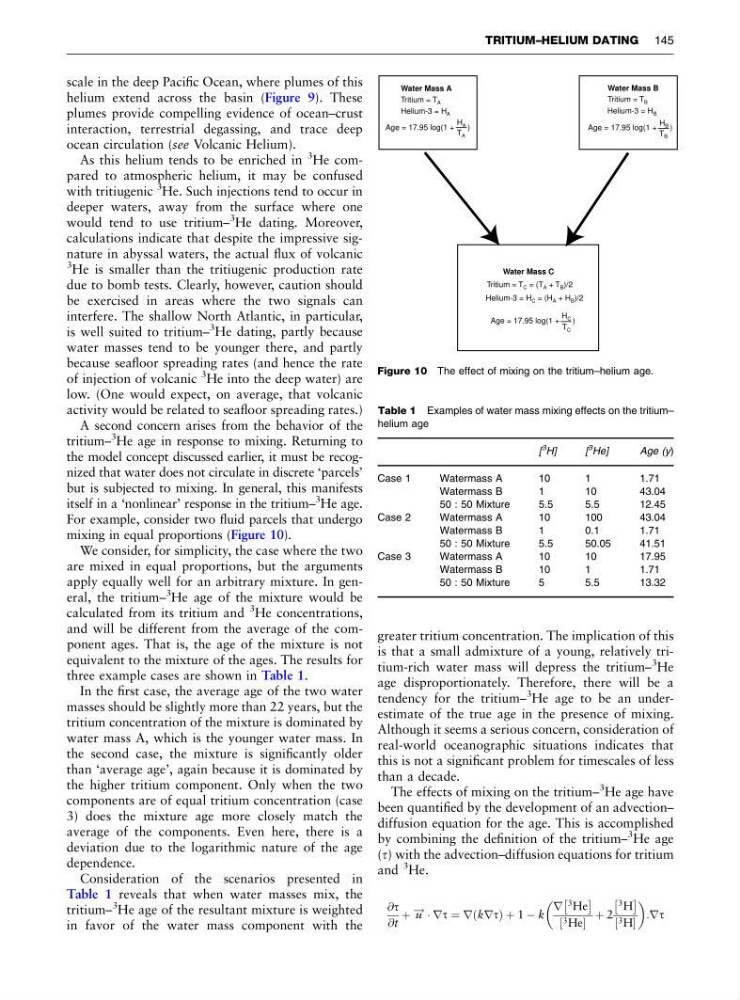
For example, consider two fluid parcels that undergo
mixing in equal proportions (Figure 10).
We consider, for simplicity, the case where the two
are mixed in equal proportions, but the arguments
apply equally well for an arbitrary mixture. In general, the tritium–
3
He age of the mixture would be
calculated from its tritium and
3
He concentrations,
and will be different from the average of the component ages. That is, the age of the mixture is not
equivalent to the mixture of the ages. The results for
three example cases are shown in Table 1.
In the first case, the average age of the two water
masses should be slightly more than 22 years, but the
tritium concentration of the mixture is dominated by
water mass A, which is the younger water mass. In
the second case, the mixture is significantly older
than ‘average age’, again because it is dominated by
the higher tritium component. Only when the two
components are of equal tritium concentration (case
3) does the mixture age more closely match the
average of the components. Even here, there is a
deviation due to the logarithmic nature of the age
dependence.
Consideration of the scenarios presented in
Table 1 reveals that when water masses mix, the
tritium–
3 He age of the resultant mixture is weighted
in favor of the water mass component with the
greater tritium concentration. The implication of this
is that a small admixture of a young, relatively tritium-rich water mass will depress the tritium–
3
He
age disproportionately. Therefore, there will be a
tendency for the tritium–
3 He age to be an underestimate of the true age in the presence of mixing.
Although it seems a serious concern, consideration of
real-world oceanographic situations indicates that
this is not a significant problem for timescales of less
than a decade.
The effects of mixing on the tritium–
3
He age have
been quantified by the development of an advection–
diffusion equation for the age. This is accomplished
by combining the definition of the tritium–
3 He age
(t) with the advection–diffusion equations for tritium
and
3
He.
@t
@t
þ u
! Á rt ¼ r krt
ð
Þþ1 À k
r
3 He
Â
Ã
3 He
½
þ 2
3 H
 Ã
3 H
½
:rt
Water Mass C
Tritium = T = (T + T )/2
C
A
B
Helium-3 = H = (H + H )/2
C
A
B
Age = 17.95 log(1 +
)
H C
T C
Water Mass A
Tritium = T A
Helium-3 = H A
Water Mass B
Tritium = T B
Helium-3 = H B
Age = 17.95 log(1 +
)
H A
Age = 17.95 log(1 +
)
H B
T B
T A
Figure 10 The effect of mixing on the tritium–helium age.
Table 1 Examples of water mass mixing effects on the tritium–
helium age
[
3 H]
[
3 He]
Age (y)
Case 1
Watermass A
10
1
1.71
Watermass B
1
10
43.04
50 : 50 Mixture
5.5
5.5
12.45
Case 2
Watermass A
10
100
43.04
Watermass B
1
0.1
1.71
50 : 50 Mixture
5.5
50.05
41.51
Case 3
Watermass A
10
10
17.95
Watermass B
10
1
1.71
50 : 50 Mixture
5
5.5
13.32
TRITIUM–HELIUM DATING 145
helium extend across the basin (Figure 9). These
plumes provide compelling evidence of ocean–crust
interaction, terrestrial degassing, and trace deep
ocean circulation (see Volcanic Helium).
As this helium tends to be enriched in
3
He compared to atmospheric helium, it may be confused
with tritiugenic
3
He. Such injections tend to occur in
deeper waters, away from the surface where one
would tend to use tritium–
3
He dating. Moreover,
calculations indicate that despite the impressive signature in abyssal waters, the actual flux of volcanic
3 He is smaller than the tritiugenic production rate
due to bomb tests. Clearly, however, caution should
be exercised in areas where the two signals can
interfere. The shallow North Atlantic, in particular,
is well suited to tritium–
3 He dating, partly because
water masses tend to be younger there, and partly
because seafloor spreading rates (and hence the rate
of injection of volcanic
3
He into the deep water) are
low. (One would expect, on average, that volcanic
activity would be related to seafloor spreading rates.)
A second concern arises from the behavior of the
tritium–
3
He age in response to mixing. Returning to
the model concept discussed earlier, it must be recognized that water does not circulate in discrete ‘parcels’
but is subjected to mixing. In general, this manifests
itself in a ‘nonlinear’ response in the tritium–
3
He age.
For example, consider two fluid parcels that undergo
mixing in equal proportions (Figure 10).
We consider, for simplicity, the case where the two
are mixed in equal proportions, but the arguments
apply equally well for an arbitrary mixture. In general, the tritium–
3
He age of the mixture would be
calculated from its tritium and
3
He concentrations,
and will be different from the average of the component ages. That is, the age of the mixture is not
equivalent to the mixture of the ages. The results for
three example cases are shown in Table 1.
In the first case, the average age of the two water
masses should be slightly more than 22 years, but the
tritium concentration of the mixture is dominated by
water mass A, which is the younger water mass. In
the second case, the mixture is significantly older
than ‘average age’, again because it is dominated by
the higher tritium component. Only when the two
components are of equal tritium concentration (case
3) does the mixture age more closely match the
average of the components. Even here, there is a
deviation due to the logarithmic nature of the age
dependence.
Consideration of the scenarios presented in
Table 1 reveals that when water masses mix, the
tritium–
3 He age of the resultant mixture is weighted
in favor of the water mass component with the
greater tritium concentration. The implication of this
is that a small admixture of a young, relatively tritium-rich water mass will depress the tritium–
3
He
age disproportionately. Therefore, there will be a
tendency for the tritium–
3 He age to be an underestimate of the true age in the presence of mixing.
Although it seems a serious concern, consideration of
real-world oceanographic situations indicates that
this is not a significant problem for timescales of less
than a decade.
The effects of mixing on the tritium–
3
He age have
been quantified by the development of an advection–
diffusion equation for the age. This is accomplished
by combining the definition of the tritium–
3 He age
(t) with the advection–diffusion equations for tritium
and
3
He.
@t
@t
þ u
! Á rt ¼ r krt
ð
Þþ1 À k
r
3 He
Â
Ã
3 He
½
þ 2
3 H
 Ã
3 H
½
:rt
Water Mass C
Tritium = T = (T + T )/2
C
A
B
Helium-3 = H = (H + H )/2
C
A
B
Age = 17.95 log(1 +
)
H C
T C
Water Mass A
Tritium = T A
Helium-3 = H A
Water Mass B
Tritium = T B
Helium-3 = H B
Age = 17.95 log(1 +
)
H A
Age = 17.95 log(1 +
)
H B
T B
T A
Figure 10 The effect of mixing on the tritium–helium age.
Table 1 Examples of water mass mixing effects on the tritium–
helium age
[
3 H]
[
3 He]
Age (y)
Case 1
Watermass A
10
1
1.71
Watermass B
1
10
43.04
50 : 50 Mixture
5.5
5.5
12.45
Case 2
Watermass A
10
100
43.04
Watermass B
1
0.1
1.71
50 : 50 Mixture
5.5
50.05
41.51
Case 3
Watermass A
10
10
17.95
Watermass B
10
1
1.71
50 : 50 Mixture
5
5.5
13.32
TRITIUM–HELIUM DATING 145