

In the subtropics, where wind-stress is convergent,
water tends to be forced downward from the surface
ocean into the thermocline. This downwelling is an
important process for ventilation of the thermocline,
and for driving the shallow gyre circulation. Figure 8
shows the measured tritium–helium age as measured
on a constant density surface (1024 kg m
À3
) in the
eastern subtropical North Atlantic in the early
1990s. Water is youngest in the north-east, where the
horizon rises toward the ocean surface. In fact, this
horizon intercepts the base of the wintertime mixing
layer, and the tritium–helium age of the water is less
than one year, indicating that it was in active contact
with the previous winter’s surface mixed layer. The
age of the water increases monotonically as the layer
deepens to the southwest, consistent with a southwestward flow associated with the large-scale circulation of the gyre. The next logical step would be to
use the observed age-gradients to compute fluid
velocities.
Before applying this technique quantitatively,
however, there are two significant concerns that need
to be considered. The first is the possible release of
volcanic helium from submarine hydrothermal activity. This injection occurs at active volcanic centers,
predominantly along midocean ridges, and to a lesser
extent at near-axial seamounts. This helium is a
mixture of primordial helium inherited during the
earth’s formation from the presolar nebula and
radiogenic helium produced by the decay of longlived radioactive U and Th isotopes in the deep earth.
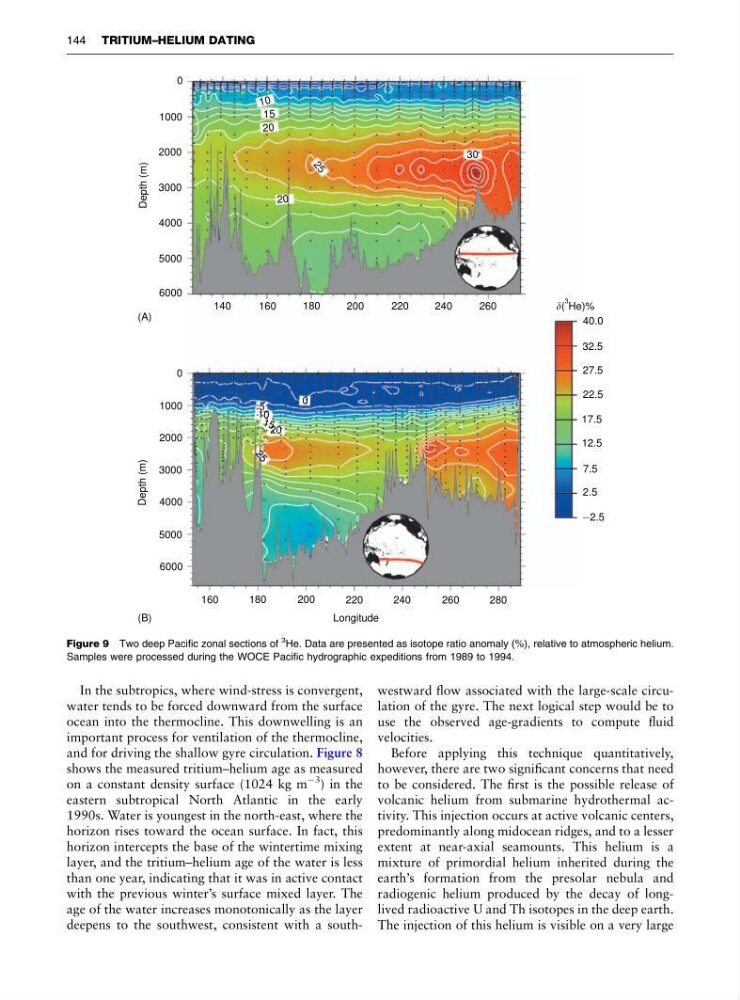
The injection of this helium is visible on a very large
0
1000
2000
3000
4000
5000
6000
Depth (m)
160
180
200
220
240
260
280
Longitude
_ 2.5
2.5
7.5
12.5
17.5
22.5
27.5
32.5
40.0
0
1000
2000
3000
4000
5000
6000
Depth (m)
140
160
180
200
220
240
260
1 0
15
20
20
2 5
30
( He)%
3
0
5
10
1 5
20
2
5
(B)
(A)
Figure 9 Two deep Pacific zonal sections of
3 He. Data are presented as isotope ratio anomaly (%), relative to atmospheric helium.
Samples were processed during the WOCE Pacific hydrographic expeditions from 1989 to 1994.
144 TRITIUM–HELIUM DATING
water tends to be forced downward from the surface
ocean into the thermocline. This downwelling is an
important process for ventilation of the thermocline,
and for driving the shallow gyre circulation. Figure 8
shows the measured tritium–helium age as measured
on a constant density surface (1024 kg m
À3
) in the
eastern subtropical North Atlantic in the early
1990s. Water is youngest in the north-east, where the
horizon rises toward the ocean surface. In fact, this
horizon intercepts the base of the wintertime mixing
layer, and the tritium–helium age of the water is less
than one year, indicating that it was in active contact
with the previous winter’s surface mixed layer. The
age of the water increases monotonically as the layer
deepens to the southwest, consistent with a southwestward flow associated with the large-scale circulation of the gyre. The next logical step would be to
use the observed age-gradients to compute fluid
velocities.
Before applying this technique quantitatively,
however, there are two significant concerns that need
to be considered. The first is the possible release of
volcanic helium from submarine hydrothermal activity. This injection occurs at active volcanic centers,
predominantly along midocean ridges, and to a lesser
extent at near-axial seamounts. This helium is a
mixture of primordial helium inherited during the
earth’s formation from the presolar nebula and
radiogenic helium produced by the decay of longlived radioactive U and Th isotopes in the deep earth.
The injection of this helium is visible on a very large
0
1000
2000
3000
4000
5000
6000
Depth (m)
160
180
200
220
240
260
280
Longitude
_ 2.5
2.5
7.5
12.5
17.5
22.5
27.5
32.5
40.0
0
1000
2000
3000
4000
5000
6000
Depth (m)
140
160
180
200
220
240
260
1 0
15
20
20
2 5
30
( He)%
3
0
5
10
1 5
20
2
5
(B)
(A)
Figure 9 Two deep Pacific zonal sections of
3 He. Data are presented as isotope ratio anomaly (%), relative to atmospheric helium.
Samples were processed during the WOCE Pacific hydrographic expeditions from 1989 to 1994.
144 TRITIUM–HELIUM DATING