

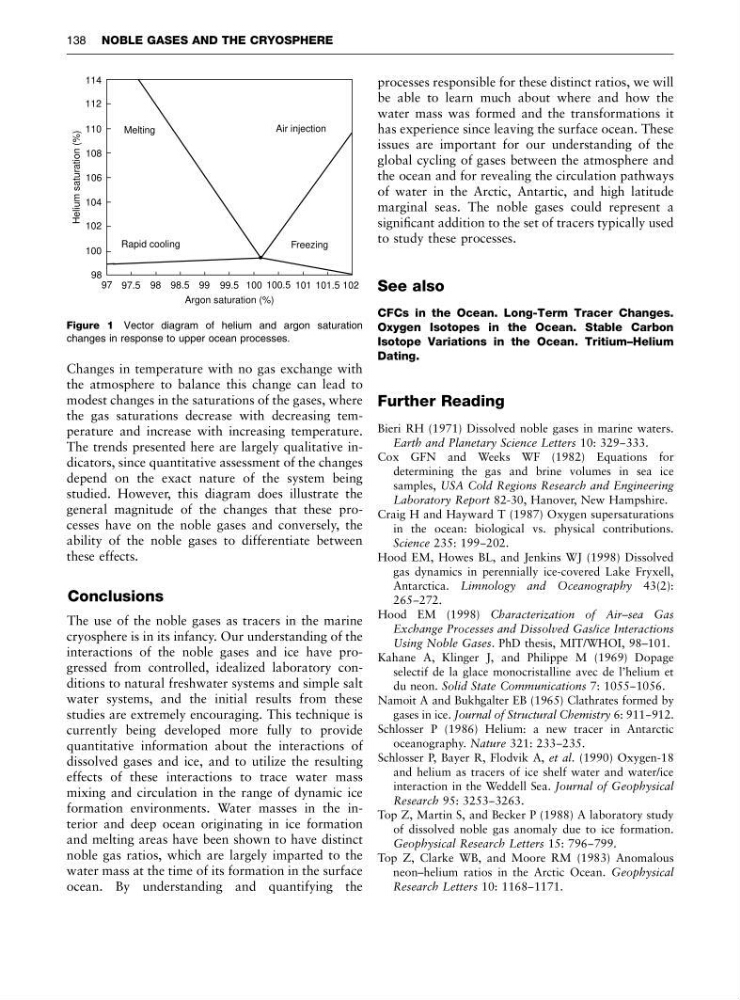
Changes in temperature with no gas exchange with
the atmosphere to balance this change can lead to
modest changes in the saturations of the gases, where
the gas saturations decrease with decreasing temperature and increase with increasing temperature.
The trends presented here are largely qualitative indicators, since quantitative assessment of the changes
depend on the exact nature of the system being
studied. However, this diagram does illustrate the
general magnitude of the changes that these processes have on the noble gases and conversely, the
ability of the noble gases to differentiate between
these effects.
Conclusions
The use of the noble gases as tracers in the marine
cryosphere is in its infancy. Our understanding of the
interactions of the noble gases and ice have progressed from controlled, idealized laboratory conditions to natural freshwater systems and simple salt
water systems, and the initial results from these
studies are extremely encouraging. This technique is
currently being developed more fully to provide
quantitative information about the interactions of
dissolved gases and ice, and to utilize the resulting
effects of these interactions to trace water mass
mixing and circulation in the range of dynamic ice
formation environments. Water masses in the interior and deep ocean originating in ice formation
and melting areas have been shown to have distinct
noble gas ratios, which are largely imparted to the
water mass at the time of its formation in the surface
ocean. By understanding and quantifying the
processes responsible for these distinct ratios, we will
be able to learn much about where and how the
water mass was formed and the transformations it
has experience since leaving the surface ocean. These
issues are important for our understanding of the
global cycling of gases between the atmosphere and
the ocean and for revealing the circulation pathways
of water in the Arctic, Antartic, and high latitude
marginal seas. The noble gases could represent a
significant addition to the set of tracers typically used
to study these processes.
See also
CFCs in the Ocean. Long-Term Tracer Changes.
Oxygen Isotopes in the Ocean. Stable Carbon
Isotope Variations in the Ocean. Tritium–Helium
Dating.
Further Reading
Bieri RH (1971) Dissolved noble gases in marine waters.
Earth and Planetary Science Letters 10: 329--333.
Cox GFN and Weeks WF (1982) Equations for
determining the gas and brine volumes in sea ice
samples, USA Cold Regions Research and Engineering
Laboratory Report 82-30, Hanover, New Hampshire.
Craig H and Hayward T (1987) Oxygen supersaturations
in the ocean: biological vs. physical contributions.
Science 235: 199--202.
Hood EM, Howes BL, and Jenkins WJ (1998) Dissolved
gas dynamics in perennially ice-covered Lake Fryxell,
Antarctica. Limnology and Oceanography 43(2):
265--272.
Hood EM (1998) Characterization of Air–sea Gas
Exchange Processes and Dissolved Gas/ice Interactions
Using Noble Gases. PhD thesis, MIT/WHOI, 98–101.
Kahane A, Klinger J, and Philippe M (1969) Dopage
selectif de la glace monocristalline avec de l’helium et
du neon. Solid State Communications 7: 1055--1056.
Namoit A and Bukhgalter EB (1965) Clathrates formed by
gases in ice. Journal of Structural Chemistry 6: 911--912.
Schlosser P (1986) Helium: a new tracer in Antarctic
oceanography. Nature 321: 233--235.
Schlosser P, Bayer R, Flodvik A, et al. (1990) Oxygen-18
and helium as tracers of ice shelf water and water/ice
interaction in the Weddell Sea. Journal of Geophysical
Research 95: 3253--3263.
Top Z, Martin S, and Becker P (1988) A laboratory study
of dissolved noble gas anomaly due to ice formation.
Geophysical Research Letters 15: 796--799.
Top Z, Clarke WB, and Moore RM (1983) Anomalous
neon–helium ratios in the Arctic Ocean. Geophysical
Research Letters 10: 1168--1171.
Melting
Air injection
Rapid cooling
Freezing
114
112
110
108
106
104
102
100
98
Helium saturation (%)
97 97.5 98 98.5 99 99.5 100 100.5 101 101.5 102
Argon saturation (%)
Figure 1 Vector diagram of helium and argon saturation
changes in response to upper ocean processes.
138 NOBLE GASES AND THE CRYOSPHERE
the atmosphere to balance this change can lead to
modest changes in the saturations of the gases, where
the gas saturations decrease with decreasing temperature and increase with increasing temperature.
The trends presented here are largely qualitative indicators, since quantitative assessment of the changes
depend on the exact nature of the system being
studied. However, this diagram does illustrate the
general magnitude of the changes that these processes have on the noble gases and conversely, the
ability of the noble gases to differentiate between
these effects.
Conclusions
The use of the noble gases as tracers in the marine
cryosphere is in its infancy. Our understanding of the
interactions of the noble gases and ice have progressed from controlled, idealized laboratory conditions to natural freshwater systems and simple salt
water systems, and the initial results from these
studies are extremely encouraging. This technique is
currently being developed more fully to provide
quantitative information about the interactions of
dissolved gases and ice, and to utilize the resulting
effects of these interactions to trace water mass
mixing and circulation in the range of dynamic ice
formation environments. Water masses in the interior and deep ocean originating in ice formation
and melting areas have been shown to have distinct
noble gas ratios, which are largely imparted to the
water mass at the time of its formation in the surface
ocean. By understanding and quantifying the
processes responsible for these distinct ratios, we will
be able to learn much about where and how the
water mass was formed and the transformations it
has experience since leaving the surface ocean. These
issues are important for our understanding of the
global cycling of gases between the atmosphere and
the ocean and for revealing the circulation pathways
of water in the Arctic, Antartic, and high latitude
marginal seas. The noble gases could represent a
significant addition to the set of tracers typically used
to study these processes.
See also
CFCs in the Ocean. Long-Term Tracer Changes.
Oxygen Isotopes in the Ocean. Stable Carbon
Isotope Variations in the Ocean. Tritium–Helium
Dating.
Further Reading
Bieri RH (1971) Dissolved noble gases in marine waters.
Earth and Planetary Science Letters 10: 329--333.
Cox GFN and Weeks WF (1982) Equations for
determining the gas and brine volumes in sea ice
samples, USA Cold Regions Research and Engineering
Laboratory Report 82-30, Hanover, New Hampshire.
Craig H and Hayward T (1987) Oxygen supersaturations
in the ocean: biological vs. physical contributions.
Science 235: 199--202.
Hood EM, Howes BL, and Jenkins WJ (1998) Dissolved
gas dynamics in perennially ice-covered Lake Fryxell,
Antarctica. Limnology and Oceanography 43(2):
265--272.
Hood EM (1998) Characterization of Air–sea Gas
Exchange Processes and Dissolved Gas/ice Interactions
Using Noble Gases. PhD thesis, MIT/WHOI, 98–101.
Kahane A, Klinger J, and Philippe M (1969) Dopage
selectif de la glace monocristalline avec de l’helium et
du neon. Solid State Communications 7: 1055--1056.
Namoit A and Bukhgalter EB (1965) Clathrates formed by
gases in ice. Journal of Structural Chemistry 6: 911--912.
Schlosser P (1986) Helium: a new tracer in Antarctic
oceanography. Nature 321: 233--235.
Schlosser P, Bayer R, Flodvik A, et al. (1990) Oxygen-18
and helium as tracers of ice shelf water and water/ice
interaction in the Weddell Sea. Journal of Geophysical
Research 95: 3253--3263.
Top Z, Martin S, and Becker P (1988) A laboratory study
of dissolved noble gas anomaly due to ice formation.
Geophysical Research Letters 15: 796--799.
Top Z, Clarke WB, and Moore RM (1983) Anomalous
neon–helium ratios in the Arctic Ocean. Geophysical
Research Letters 10: 1168--1171.
Melting
Air injection
Rapid cooling
Freezing
114
112
110
108
106
104
102
100
98
Helium saturation (%)
97 97.5 98 98.5 99 99.5 100 100.5 101 101.5 102
Argon saturation (%)
Figure 1 Vector diagram of helium and argon saturation
changes in response to upper ocean processes.
138 NOBLE GASES AND THE CRYOSPHERE