

NOBLE GASES AND THE CRYOSPHERE
M. Hood, Intergovernmental Oceanographic
Commission, Paris, France
Copyright & 2001 Elsevier Ltd.
Introduction
Ice formation and melting strongly influence a wide
range of water properties and processes, such as
dissolved gas concentrations, exchange of gases between the atmosphere and the ocean, and dense
water formation. As water freezes, salt and gases
dissolved in the water are expelled from the growing
ice lattice and become concentrated in the residual
water. As a result of the increased salt content, this
residual water becomes more dense than underlying
waters and sinks to a level of neutral buoyancy,
carrying with it the dissolved gas load. Dense water
formation is one of the primary mechanisms by
which atmospheric and surface water properties are
transported into the interior and deep ocean, and
observation of the effects of this process can answer
fundamental questions about ocean circulation and
the ocean–atmosphere cycling of biogeochemically
important gases such as oxygen and carbon dioxide.
Because it is not possible to determine exactly when
and where dense water formation will occur, it is not
an easy process to observe directly, and thus information about the rates of dense water formation and
circulation is obtained largely through the observation of tracers. However, when dense water formation is triggered by ice formation, interaction of
surface water properties with the ice and the lack of
full equilibration between the atmosphere and the
water beneath the growing ice can significantly
modify the concentrations of the tracers in ways that
are not yet fully understood. Consequently, the information provided by tracers in these ice formation
areas is often ambiguous.
A suite of three noble gases, helium, neon, and
argon, have the potential to be excellent tracers in
the marine cryosphere, providing new information
about the interactions of dissolved gases and ice,
the cycling of gases between the atmosphere and
ocean, and mixing and circulation pathways in high
latitude regions of the world’s oceans and marginal
seas. The physical chemistry properties of these
three gases span a wide range of values, and these
differences cause them to respond to varying degrees
to physical processes such as ice formation and
melting or the transfer of gas between the water and
air. By observing the changes of the three tracers as
they respond to these processes, it is possible to
quantify the effect the process has on the gases as a
function of the physical chemistry of the gases.
Subsequently, this ‘template’ of behavior can be used
to determine the physical response of any gas to the
process, using known information about the physical
chemistry of the gas. Although this tracer technique
is still being developed, results from laboratory experiments and field programs have demonstrated the
exciting potential of the nobel gases to provide
unique, quantitative information on a range of
processes that it is not possible to obtain using conventional tracers.
Noble Gases in the Marine
Environment
The noble gases are naturally occurring gases
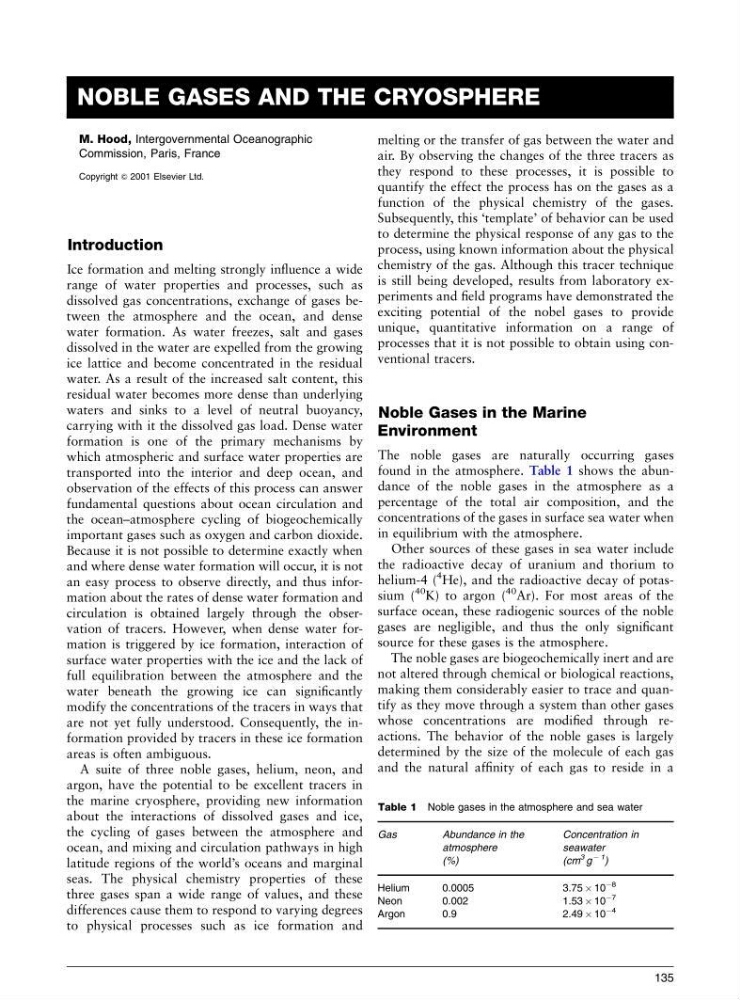
found in the atmosphere. Table 1 shows the abundance of the noble gases in the atmosphere as a
percentage of the total air composition, and the
concentrations of the gases in surface sea water when
in equilibrium with the atmosphere.
Other sources of these gases in sea water include
the radioactive decay of uranium and thorium to
helium-4 (
4 He), and the radioactive decay of potassium (
40
K) to argon (
40 Ar). For most areas of the
surface ocean, these radiogenic sources of the noble
gases are negligible, and thus the only significant
source for these gases is the atmosphere.
The noble gases are biogeochemically inert and are
not altered through chemical or biological reactions,
making them considerably easier to trace and quantify as they move through a system than other gases
whose concentrations are modified through reactions. The behavior of the noble gases is largely
determined by the size of the molecule of each gas
and the natural affinity of each gas to reside in a
Table 1 Noble gases in the atmosphere and sea water
Gas
Abundance in the
atmosphere
Concentration in
seawater
(%)
(cm
3 g
À 1
)
Helium
0.0005
3.75 Â 10
À8
Neon
0.002
1.53 Â 10
À7
Argon
0.9
2.49 Â 10
À4
135
M. Hood, Intergovernmental Oceanographic
Commission, Paris, France
Copyright & 2001 Elsevier Ltd.
Introduction
Ice formation and melting strongly influence a wide
range of water properties and processes, such as
dissolved gas concentrations, exchange of gases between the atmosphere and the ocean, and dense
water formation. As water freezes, salt and gases
dissolved in the water are expelled from the growing
ice lattice and become concentrated in the residual
water. As a result of the increased salt content, this
residual water becomes more dense than underlying
waters and sinks to a level of neutral buoyancy,
carrying with it the dissolved gas load. Dense water
formation is one of the primary mechanisms by
which atmospheric and surface water properties are
transported into the interior and deep ocean, and
observation of the effects of this process can answer
fundamental questions about ocean circulation and
the ocean–atmosphere cycling of biogeochemically
important gases such as oxygen and carbon dioxide.
Because it is not possible to determine exactly when
and where dense water formation will occur, it is not
an easy process to observe directly, and thus information about the rates of dense water formation and
circulation is obtained largely through the observation of tracers. However, when dense water formation is triggered by ice formation, interaction of
surface water properties with the ice and the lack of
full equilibration between the atmosphere and the
water beneath the growing ice can significantly
modify the concentrations of the tracers in ways that
are not yet fully understood. Consequently, the information provided by tracers in these ice formation
areas is often ambiguous.
A suite of three noble gases, helium, neon, and
argon, have the potential to be excellent tracers in
the marine cryosphere, providing new information
about the interactions of dissolved gases and ice,
the cycling of gases between the atmosphere and
ocean, and mixing and circulation pathways in high
latitude regions of the world’s oceans and marginal
seas. The physical chemistry properties of these
three gases span a wide range of values, and these
differences cause them to respond to varying degrees
to physical processes such as ice formation and
melting or the transfer of gas between the water and
air. By observing the changes of the three tracers as
they respond to these processes, it is possible to
quantify the effect the process has on the gases as a
function of the physical chemistry of the gases.
Subsequently, this ‘template’ of behavior can be used
to determine the physical response of any gas to the
process, using known information about the physical
chemistry of the gas. Although this tracer technique
is still being developed, results from laboratory experiments and field programs have demonstrated the
exciting potential of the nobel gases to provide
unique, quantitative information on a range of
processes that it is not possible to obtain using conventional tracers.
Noble Gases in the Marine
Environment
The noble gases are naturally occurring gases
found in the atmosphere. Table 1 shows the abundance of the noble gases in the atmosphere as a
percentage of the total air composition, and the
concentrations of the gases in surface sea water when
in equilibrium with the atmosphere.
Other sources of these gases in sea water include
the radioactive decay of uranium and thorium to
helium-4 (
4 He), and the radioactive decay of potassium (
40
K) to argon (
40 Ar). For most areas of the
surface ocean, these radiogenic sources of the noble
gases are negligible, and thus the only significant
source for these gases is the atmosphere.
The noble gases are biogeochemically inert and are
not altered through chemical or biological reactions,
making them considerably easier to trace and quantify as they move through a system than other gases
whose concentrations are modified through reactions. The behavior of the noble gases is largely
determined by the size of the molecule of each gas
and the natural affinity of each gas to reside in a
Table 1 Noble gases in the atmosphere and sea water
Gas
Abundance in the
atmosphere
Concentration in
seawater
(%)
(cm
3 g
À 1
)
Helium
0.0005
3.75 Â 10
À8
Neon
0.002
1.53 Â 10
À7
Argon
0.9
2.49 Â 10
À4
135