

Hf
+8
+ 6
+ 5
+1
+3
+4
+6
+ 1
+3
+ 2
(D)
206
Pb/
204
Pb
19 .2
1 9 .1
1 9 .0
18.8
18.6
18.8
1 8 .8
18 .8
1 8 .8
1 8 .9
18. 7
(E)
10
Be/
9 Be
1 .3 x 1 0 _
7
1 .3 x 1 0
_
7
1x10
_ 7
1x10
_ 7
0.5x10
_ 7
0
.5
x
1
0 _
7
0 .8
x 1 0 _
7
0.9x10
_ 7
1
x
1
0 _
7
(F)
87
Sr/
86 Sr
0.70918
0.70918
0.70918
(A)
187
Os/
188 Os
1.03
1.03
1.03
1.06
(B)
Nd
_
5
_
6
_
6
_ 9
_ 9
_ 8
_
4
_ 13
_
1 3
_
8
_ 10
_ 20
_ 1 2
(C)
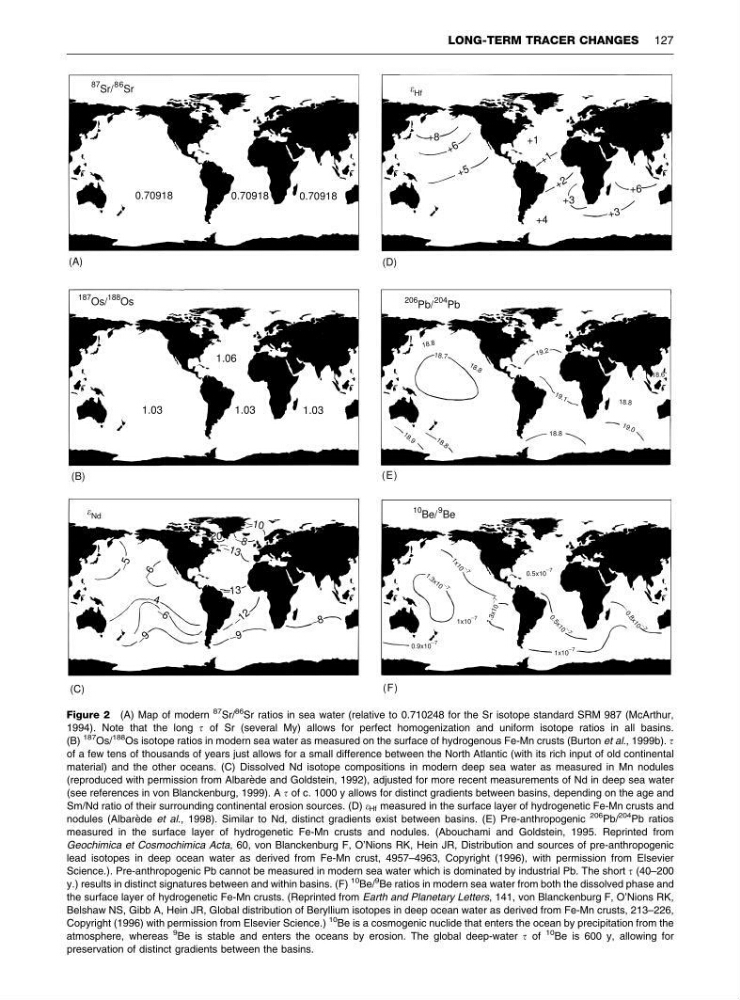
Figure 2 (A) Map of modern
87 Sr/
86 Sr ratios in sea water (relative to 0.710248 for the Sr isotope standard SRM 987 (McArthur,
1994). Note that the long t of Sr (several My) allows for perfect homogenization and uniform isotope ratios in all basins.
(B)
187
Os/
188
Os isotope ratios in modern sea water as measured on the surface of hydrogenous Fe-Mn crusts (Burton et al., 1999b). t
of a few tens of thousands of years just allows for a small difference between the North Atlantic (with its rich input of old continental
material) and the other oceans. (C) Dissolved Nd isotope compositions in modern deep sea water as measured in Mn nodules
(reproduced with permission from Albare ` de and Goldstein, 1992), adjusted for more recent measurements of Nd in deep sea water
(see references in von Blanckenburg, 1999). A t of c. 1000 y allows for distinct gradients between basins, depending on the age and
Sm/Nd ratio of their surrounding continental erosion sources. (D) e Hf measured in the surface layer of hydrogenetic Fe-Mn crusts and
nodules (Albare ` de et al., 1998). Similar to Nd, distinct gradients exist between basins. (E) Pre-anthropogenic
206 Pb/
204 Pb ratios
measured in the surface layer of hydrogenetic Fe-Mn crusts and nodules. (Abouchami and Goldstein, 1995. Reprinted from
Geochimica et Cosmochimica Acta, 60, von Blanckenburg F, O’Nions RK, Hein JR, Distribution and sources of pre-anthropogenic
lead isotopes in deep ocean water as derived from Fe-Mn crust, 4957–4963, Copyright (1996), with permission from Elsevier
Science.). Pre-anthropogenic Pb cannot be measured in modern sea water which is dominated by industrial Pb. The short t (40–200
y.) results in distinct signatures between and within basins. (F)
10
Be/
9 Be ratios in modern sea water from both the dissolved phase and
the surface layer of hydrogenetic Fe-Mn crusts. (Reprinted from Earth and Planetary Letters, 141, von Blanckenburg F, O’Nions RK,
Belshaw NS, Gibb A, Hein JR, Global distribution of Beryllium isotopes in deep ocean water as derived from Fe-Mn crusts, 213–226,
Copyright (1996) with permission from Elsevier Science.)
10
Be is a cosmogenic nuclide that enters the ocean by precipitation from the
atmosphere, whereas
9 Be is stable and enters the oceans by erosion. The global deep-water t of
10 Be is 600 y, allowing for
preservation of distinct gradients between the basins.
LONG-TERM TRACER CHANGES 127
+8
+ 6
+ 5
+1
+3
+4
+6
+ 1
+3
+ 2
(D)
206
Pb/
204
Pb
19 .2
1 9 .1
1 9 .0
18.8
18.6
18.8
1 8 .8
18 .8
1 8 .8
1 8 .9
18. 7
(E)
10
Be/
9 Be
1 .3 x 1 0 _
7
1 .3 x 1 0
_
7
1x10
_ 7
1x10
_ 7
0.5x10
_ 7
0
.5
x
1
0 _
7
0 .8
x 1 0 _
7
0.9x10
_ 7
1
x
1
0 _
7
(F)
87
Sr/
86 Sr
0.70918
0.70918
0.70918
(A)
187
Os/
188 Os
1.03
1.03
1.03
1.06
(B)
Nd
_
5
_
6
_
6
_ 9
_ 9
_ 8
_
4
_ 13
_
1 3
_
8
_ 10
_ 20
_ 1 2
(C)
Figure 2 (A) Map of modern
87 Sr/
86 Sr ratios in sea water (relative to 0.710248 for the Sr isotope standard SRM 987 (McArthur,
1994). Note that the long t of Sr (several My) allows for perfect homogenization and uniform isotope ratios in all basins.
(B)
187
Os/
188
Os isotope ratios in modern sea water as measured on the surface of hydrogenous Fe-Mn crusts (Burton et al., 1999b). t
of a few tens of thousands of years just allows for a small difference between the North Atlantic (with its rich input of old continental
material) and the other oceans. (C) Dissolved Nd isotope compositions in modern deep sea water as measured in Mn nodules
(reproduced with permission from Albare ` de and Goldstein, 1992), adjusted for more recent measurements of Nd in deep sea water
(see references in von Blanckenburg, 1999). A t of c. 1000 y allows for distinct gradients between basins, depending on the age and
Sm/Nd ratio of their surrounding continental erosion sources. (D) e Hf measured in the surface layer of hydrogenetic Fe-Mn crusts and
nodules (Albare ` de et al., 1998). Similar to Nd, distinct gradients exist between basins. (E) Pre-anthropogenic
206 Pb/
204 Pb ratios
measured in the surface layer of hydrogenetic Fe-Mn crusts and nodules. (Abouchami and Goldstein, 1995. Reprinted from
Geochimica et Cosmochimica Acta, 60, von Blanckenburg F, O’Nions RK, Hein JR, Distribution and sources of pre-anthropogenic
lead isotopes in deep ocean water as derived from Fe-Mn crust, 4957–4963, Copyright (1996), with permission from Elsevier
Science.). Pre-anthropogenic Pb cannot be measured in modern sea water which is dominated by industrial Pb. The short t (40–200
y.) results in distinct signatures between and within basins. (F)
10
Be/
9 Be ratios in modern sea water from both the dissolved phase and
the surface layer of hydrogenetic Fe-Mn crusts. (Reprinted from Earth and Planetary Letters, 141, von Blanckenburg F, O’Nions RK,
Belshaw NS, Gibb A, Hein JR, Global distribution of Beryllium isotopes in deep ocean water as derived from Fe-Mn crusts, 213–226,
Copyright (1996) with permission from Elsevier Science.)
10
Be is a cosmogenic nuclide that enters the ocean by precipitation from the
atmosphere, whereas
9 Be is stable and enters the oceans by erosion. The global deep-water t of
10 Be is 600 y, allowing for
preservation of distinct gradients between the basins.
LONG-TERM TRACER CHANGES 127