

can be measured in sediments, regardless of the actual tracer partitioning, concentration, or location of
precipitation.
A property describing the behavior of a tracer in
sea water is the residence time t. If the tracer’s fluxes
in and out of an ocean basin are invariant with time,
the tracer is at steady state and the residence time can
be calculated from the tracer’s ocean inventory:
t ¼
Inventory
Flux in
¼
Inventory
Flux out
A tracer suitable as a water mass tracer has a short
global residence time (t) relative to the ocean’s
mixing time. This ensures that isotope ‘fingerprints’
characteristic of a certain water mass are prevented
from being completely dispersed by the global thermohaline circulation. While the global ocean mixing
time is difficult to assess, a meaningful quantity is the
time it takes for one turnover of the global deep
water circulation, which is c. 1500 y. Tracers with t
of this order have the potential to preserve distinct
water mass labels. It can be assumed that a conservative (i.e. nonreactive) tracer would be almost
perfectly homogenized within 10 000–20 000 years.
Tracers with t in excess of this period will only
record changes in the global flux of this tracer, regardless of the water mass, the location of the input,
or the location of the samples taken.
Isotope Tracers Used
Much use is made of the stable isotopes of carbon as
a paleo-water mass isotope ‘fingerprint’. The
13 C/
12
C
ratio in the tests of foraminifera depends on the
relative position of the overlying water mass within
the thermohaline circulation system. However, these
isotope ratios are modified during the incorporation
into organisms, depend on availability of nutrients,
and like the isotopes of oxygen, also depend on
seawater temperature. (These tracers are dealt with
in the relevant articles; please refer to the See also
section.)
Isotope ratios of inorganic trace metals which are
the topic of this chapter are not modified when incorporated into the sediment (note that some minor
isotope fractionation might occur on incorporation
into the sediment, but usually such shifts are either
smaller than analytical precision or they are removed
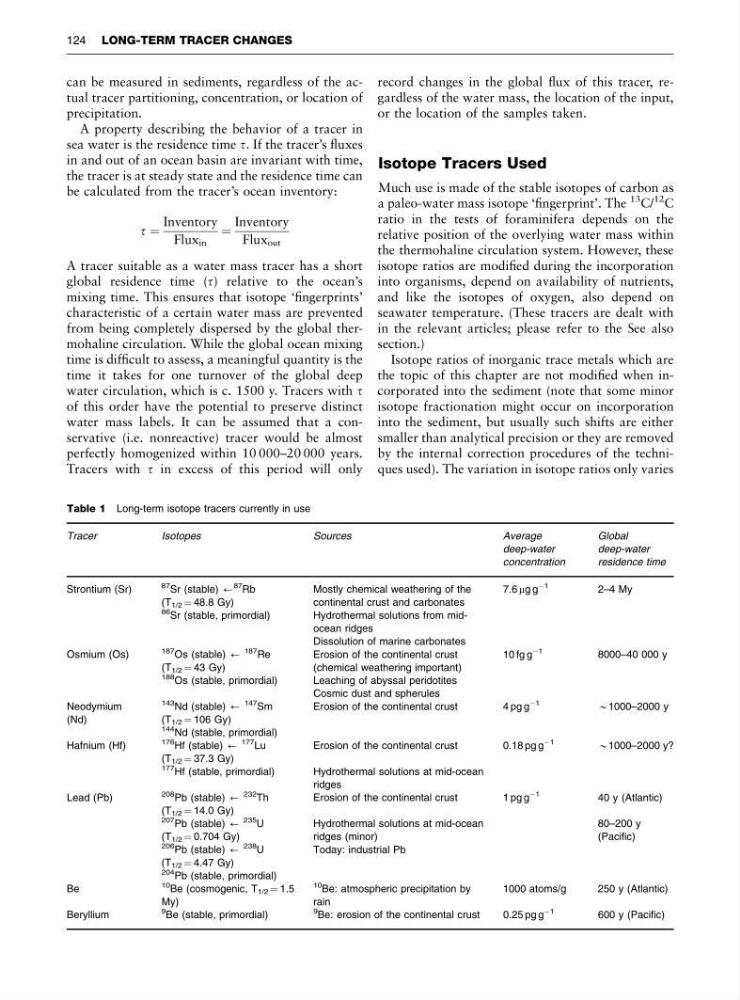
by the internal correction procedures of the techniques used). The variation in isotope ratios only varies
Table 1 Long-term isotope tracers currently in use
Tracer
Isotopes
Sources
Average
deep-water
concentration
Global
deep-water
residence time
Strontium (Sr)
87 Sr (stable) ’
87
Rb
(T 1/2 ¼ 48.8 Gy)
Mostly chemical weathering of the
continental crust and carbonates
7.6 mg g
À1
2–4 My
86 Sr (stable, primordial)
Hydrothermal solutions from midocean ridges
Dissolution of marine carbonates
Osmium (Os)
187 Os (stable) ’
187 Re
(T 1/2 ¼ 43 Gy)
Erosion of the continental crust
(chemical weathering important)
10 fg g
À1
8000–40 000 y
188 Os (stable, primordial)
Leaching of abyssal peridotites
Cosmic dust and spherules
Neodymium
(Nd)
143 Nd (stable) ’
147
Sm
(T 1/2 ¼ 106 Gy)
Erosion of the continental crust
4 pg g
À1
B1000–2000 y
144 Nd (stable, primordial)
Hafnium (Hf)
176 Hf (stable) ’
177 Lu
(T 1/2 ¼ 37.3 Gy)
Erosion of the continental crust
0.18 pg g
À1
B1000–2000 y?
177 Hf (stable, primordial)
Hydrothermal solutions at mid-ocean
ridges
Lead (Pb)
208 Pb (stable) ’
232 Th
(T 1/2 ¼ 14.0 Gy)
Erosion of the continental crust
1 pg g
À1
40 y (Atlantic)
207 Pb (stable) ’
235 U
(T 1/2 ¼ 0.704 Gy)
Hydrothermal solutions at mid-ocean
ridges (minor)
80–200 y
(Pacific)
206 Pb (stable) ’
238 U
(T 1/2 ¼ 4.47 Gy)
Today: industrial Pb
204 Pb (stable, primordial)
Be
10 Be (cosmogenic, T 1/2 ¼ 1.5
My)
10
Be: atmospheric precipitation by
rain
1000 atoms/g
250 y (Atlantic)
Beryllium
9 Be (stable, primordial)
9 Be: erosion of the continental crust
0.25 pg g
À1
600 y (Pacific)
124 LONG-TERM TRACER CHANGES
precipitation.
A property describing the behavior of a tracer in
sea water is the residence time t. If the tracer’s fluxes
in and out of an ocean basin are invariant with time,
the tracer is at steady state and the residence time can
be calculated from the tracer’s ocean inventory:
t ¼
Inventory
Flux in
¼
Inventory
Flux out
A tracer suitable as a water mass tracer has a short
global residence time (t) relative to the ocean’s
mixing time. This ensures that isotope ‘fingerprints’
characteristic of a certain water mass are prevented
from being completely dispersed by the global thermohaline circulation. While the global ocean mixing
time is difficult to assess, a meaningful quantity is the
time it takes for one turnover of the global deep
water circulation, which is c. 1500 y. Tracers with t
of this order have the potential to preserve distinct
water mass labels. It can be assumed that a conservative (i.e. nonreactive) tracer would be almost
perfectly homogenized within 10 000–20 000 years.
Tracers with t in excess of this period will only
record changes in the global flux of this tracer, regardless of the water mass, the location of the input,
or the location of the samples taken.
Isotope Tracers Used
Much use is made of the stable isotopes of carbon as
a paleo-water mass isotope ‘fingerprint’. The
13 C/
12
C
ratio in the tests of foraminifera depends on the
relative position of the overlying water mass within
the thermohaline circulation system. However, these
isotope ratios are modified during the incorporation
into organisms, depend on availability of nutrients,
and like the isotopes of oxygen, also depend on
seawater temperature. (These tracers are dealt with
in the relevant articles; please refer to the See also
section.)
Isotope ratios of inorganic trace metals which are
the topic of this chapter are not modified when incorporated into the sediment (note that some minor
isotope fractionation might occur on incorporation
into the sediment, but usually such shifts are either
smaller than analytical precision or they are removed
by the internal correction procedures of the techniques used). The variation in isotope ratios only varies
Table 1 Long-term isotope tracers currently in use
Tracer
Isotopes
Sources
Average
deep-water
concentration
Global
deep-water
residence time
Strontium (Sr)
87 Sr (stable) ’
87
Rb
(T 1/2 ¼ 48.8 Gy)
Mostly chemical weathering of the
continental crust and carbonates
7.6 mg g
À1
2–4 My
86 Sr (stable, primordial)
Hydrothermal solutions from midocean ridges
Dissolution of marine carbonates
Osmium (Os)
187 Os (stable) ’
187 Re
(T 1/2 ¼ 43 Gy)
Erosion of the continental crust
(chemical weathering important)
10 fg g
À1
8000–40 000 y
188 Os (stable, primordial)
Leaching of abyssal peridotites
Cosmic dust and spherules
Neodymium
(Nd)
143 Nd (stable) ’
147
Sm
(T 1/2 ¼ 106 Gy)
Erosion of the continental crust
4 pg g
À1
B1000–2000 y
144 Nd (stable, primordial)
Hafnium (Hf)
176 Hf (stable) ’
177 Lu
(T 1/2 ¼ 37.3 Gy)
Erosion of the continental crust
0.18 pg g
À1
B1000–2000 y?
177 Hf (stable, primordial)
Hydrothermal solutions at mid-ocean
ridges
Lead (Pb)
208 Pb (stable) ’
232 Th
(T 1/2 ¼ 14.0 Gy)
Erosion of the continental crust
1 pg g
À1
40 y (Atlantic)
207 Pb (stable) ’
235 U
(T 1/2 ¼ 0.704 Gy)
Hydrothermal solutions at mid-ocean
ridges (minor)
80–200 y
(Pacific)
206 Pb (stable) ’
238 U
(T 1/2 ¼ 4.47 Gy)
Today: industrial Pb
204 Pb (stable, primordial)
Be
10 Be (cosmogenic, T 1/2 ¼ 1.5
My)
10
Be: atmospheric precipitation by
rain
1000 atoms/g
250 y (Atlantic)
Beryllium
9 Be (stable, primordial)
9 Be: erosion of the continental crust
0.25 pg g
À1
600 y (Pacific)
124 LONG-TERM TRACER CHANGES