

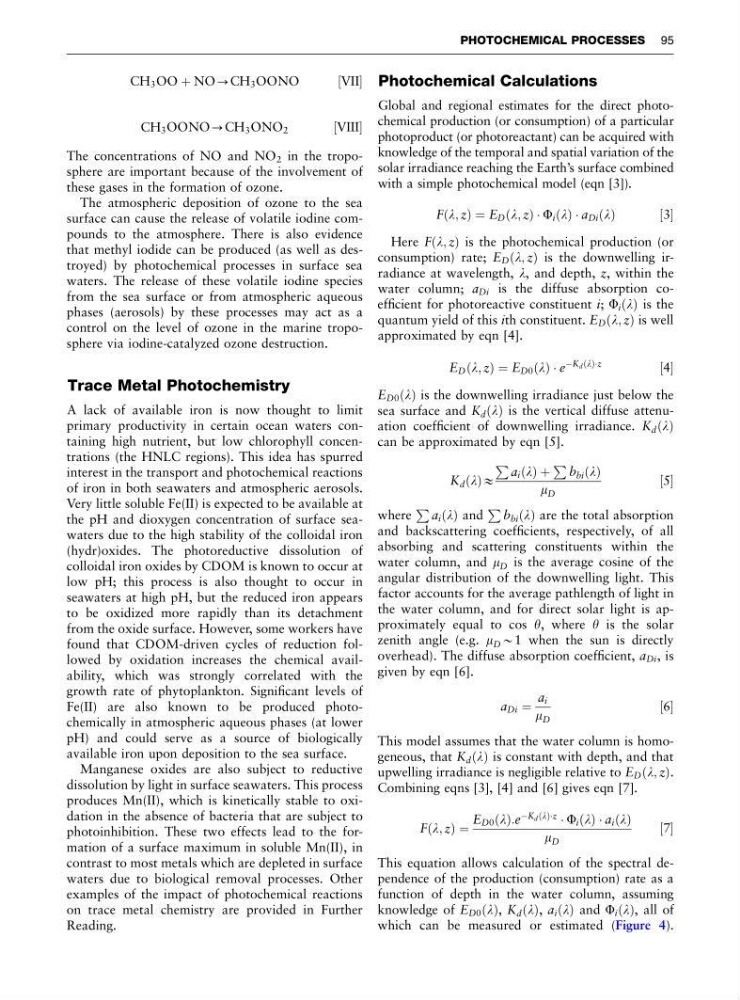
CH 3 OO þ NO-CH 3 OONO
½VII
CH 3 OONO-CH 3 ONO 2
½VIII
The concentrations of NO and NO 2 in the troposphere are important because of the involvement of
these gases in the formation of ozone.
The atmospheric deposition of ozone to the sea
surface can cause the release of volatile iodine compounds to the atmosphere. There is also evidence
that methyl iodide can be produced (as well as destroyed) by photochemical processes in surface sea
waters. The release of these volatile iodine species
from the sea surface or from atmospheric aqueous
phases (aerosols) by these processes may act as a
control on the level of ozone in the marine troposphere via iodine-catalyzed ozone destruction.
Trace Metal Photochemistry
A lack of available iron is now thought to limit
primary productivity in certain ocean waters containing high nutrient, but low chlorophyll concentrations (the HNLC regions). This idea has spurred
interest in the transport and photochemical reactions
of iron in both seawaters and atmospheric aerosols.
Very little soluble Fe(II) is expected to be available at
the pH and dioxygen concentration of surface seawaters due to the high stability of the colloidal iron
(hydr)oxides. The photoreductive dissolution of
colloidal iron oxides by CDOM is known to occur at
low pH; this process is also thought to occur in
seawaters at high pH, but the reduced iron appears
to be oxidized more rapidly than its detachment
from the oxide surface. However, some workers have
found that CDOM-driven cycles of reduction followed by oxidation increases the chemical availability, which was strongly correlated with the
growth rate of phytoplankton. Significant levels of
Fe(II) are also known to be produced photochemically in atmospheric aqueous phases (at lower
pH) and could serve as a source of biologically
available iron upon deposition to the sea surface.
Manganese oxides are also subject to reductive
dissolution by light in surface seawaters. This process
produces Mn(II), which is kinetically stable to oxidation in the absence of bacteria that are subject to
photoinhibition. These two effects lead to the formation of a surface maximum in soluble Mn(II), in
contrast to most metals which are depleted in surface
waters due to biological removal processes. Other
examples of the impact of photochemical reactions
on trace metal chemistry are provided in Further
Reading.
Photochemical Calculations
Global and regional estimates for the direct photochemical production (or consumption) of a particular
photoproduct (or photoreactant) can be acquired with
knowledge of the temporal and spatial variation of the
solar irradiance reaching the Earth’s surface combined
with a simple photochemical model (eqn [3]).
F l; z
ð Þ ¼ E D l; z
ð ÞÁF i l
ð Þ Á a Di l
ð Þ
½3
Here Fðl; zÞ is the photochemical production (or
consumption) rate; E D ðl; zÞ is the downwelling irradiance at wavelength, l, and depth, z, within the
water column; a Di is the diffuse absorption coefficient for photoreactive constituent i; F i ðlÞ is the
quantum yield of this ith constituent. E D ðl; zÞ is well
approximated by eqn [4].
E D l; z
ð Þ ¼ E D0 l
ð Þ Á e
ÀK d l
ð ÞÁz
½4
E D0 ðlÞ is the downwelling irradiance just below the
sea surface and K d ðlÞ is the vertical diffuse attenuation coefficient of downwelling irradiance. K d ðlÞ
can be approximated by eqn [5].
K d l
ð ÞE
P a i l
ð Þ þ
P b bi l
ð Þ
m D
½5
where
P a i ðlÞ and
P b bi ðlÞ are the total absorption
and backscattering coefficients, respectively, of all
absorbing and scattering constituents within the
water column, and m D is the average cosine of the
angular distribution of the downwelling light. This
factor accounts for the average pathlength of light in
the water column, and for direct solar light is approximately equal to cos y, where y is the solar
zenith angle (e.g. m D B1 when the sun is directly
overhead). The diffuse absorption coefficient, a Di , is
given by eqn [6].
a Di ¼
a i
m D
½6
This model assumes that the water column is homogeneous, that K d ðlÞ is constant with depth, and that
upwelling irradiance is negligible relative to E D ðl; zÞ.
Combining eqns [3], [4] and [6] gives eqn [7].
F l; z
ð Þ ¼
E D0 ðlÞ:e
ÀK d l
ð ÞÁz Á F i l
ð Þ Á a i l
ð Þ
m D
½7
This equation allows calculation of the spectral dependence of the production (consumption) rate as a
function of depth in the water column, assuming
knowledge of E D0 ðlÞ, K d ðlÞ, a i ðlÞ and F i ðlÞ, all of
which can be measured or estimated (Figure 4).
PHOTOCHEMICAL PROCESSES 95
½VII
CH 3 OONO-CH 3 ONO 2
½VIII
The concentrations of NO and NO 2 in the troposphere are important because of the involvement of
these gases in the formation of ozone.
The atmospheric deposition of ozone to the sea
surface can cause the release of volatile iodine compounds to the atmosphere. There is also evidence
that methyl iodide can be produced (as well as destroyed) by photochemical processes in surface sea
waters. The release of these volatile iodine species
from the sea surface or from atmospheric aqueous
phases (aerosols) by these processes may act as a
control on the level of ozone in the marine troposphere via iodine-catalyzed ozone destruction.
Trace Metal Photochemistry
A lack of available iron is now thought to limit
primary productivity in certain ocean waters containing high nutrient, but low chlorophyll concentrations (the HNLC regions). This idea has spurred
interest in the transport and photochemical reactions
of iron in both seawaters and atmospheric aerosols.
Very little soluble Fe(II) is expected to be available at
the pH and dioxygen concentration of surface seawaters due to the high stability of the colloidal iron
(hydr)oxides. The photoreductive dissolution of
colloidal iron oxides by CDOM is known to occur at
low pH; this process is also thought to occur in
seawaters at high pH, but the reduced iron appears
to be oxidized more rapidly than its detachment
from the oxide surface. However, some workers have
found that CDOM-driven cycles of reduction followed by oxidation increases the chemical availability, which was strongly correlated with the
growth rate of phytoplankton. Significant levels of
Fe(II) are also known to be produced photochemically in atmospheric aqueous phases (at lower
pH) and could serve as a source of biologically
available iron upon deposition to the sea surface.
Manganese oxides are also subject to reductive
dissolution by light in surface seawaters. This process
produces Mn(II), which is kinetically stable to oxidation in the absence of bacteria that are subject to
photoinhibition. These two effects lead to the formation of a surface maximum in soluble Mn(II), in
contrast to most metals which are depleted in surface
waters due to biological removal processes. Other
examples of the impact of photochemical reactions
on trace metal chemistry are provided in Further
Reading.
Photochemical Calculations
Global and regional estimates for the direct photochemical production (or consumption) of a particular
photoproduct (or photoreactant) can be acquired with
knowledge of the temporal and spatial variation of the
solar irradiance reaching the Earth’s surface combined
with a simple photochemical model (eqn [3]).
F l; z
ð Þ ¼ E D l; z
ð ÞÁF i l
ð Þ Á a Di l
ð Þ
½3
Here Fðl; zÞ is the photochemical production (or
consumption) rate; E D ðl; zÞ is the downwelling irradiance at wavelength, l, and depth, z, within the
water column; a Di is the diffuse absorption coefficient for photoreactive constituent i; F i ðlÞ is the
quantum yield of this ith constituent. E D ðl; zÞ is well
approximated by eqn [4].
E D l; z
ð Þ ¼ E D0 l
ð Þ Á e
ÀK d l
ð ÞÁz
½4
E D0 ðlÞ is the downwelling irradiance just below the
sea surface and K d ðlÞ is the vertical diffuse attenuation coefficient of downwelling irradiance. K d ðlÞ
can be approximated by eqn [5].
K d l
ð ÞE
P a i l
ð Þ þ
P b bi l
ð Þ
m D
½5
where
P a i ðlÞ and
P b bi ðlÞ are the total absorption
and backscattering coefficients, respectively, of all
absorbing and scattering constituents within the
water column, and m D is the average cosine of the
angular distribution of the downwelling light. This
factor accounts for the average pathlength of light in
the water column, and for direct solar light is approximately equal to cos y, where y is the solar
zenith angle (e.g. m D B1 when the sun is directly
overhead). The diffuse absorption coefficient, a Di , is
given by eqn [6].
a Di ¼
a i
m D
½6
This model assumes that the water column is homogeneous, that K d ðlÞ is constant with depth, and that
upwelling irradiance is negligible relative to E D ðl; zÞ.
Combining eqns [3], [4] and [6] gives eqn [7].
F l; z
ð Þ ¼
E D0 ðlÞ:e
ÀK d l
ð ÞÁz Á F i l
ð Þ Á a i l
ð Þ
m D
½7
This equation allows calculation of the spectral dependence of the production (consumption) rate as a
function of depth in the water column, assuming
knowledge of E D0 ðlÞ, K d ðlÞ, a i ðlÞ and F i ðlÞ, all of
which can be measured or estimated (Figure 4).
PHOTOCHEMICAL PROCESSES 95