

material as well. However, the values of S acquired for
this material are usually smaller than those of the
CDOM. In estuarine and near-shore waters, and in
shallow coastal waters subject to resuspension of
bottom sediments, PDM can contribute substantially
to the total water column absorption. However, in
most marine waters, the PDM is a rather minor
constituent. Little is known about its photochemical
reactivity.
Other light-absorbing trace organic compounds
such as flavins, as well as inorganic compounds such
as nitrate, nitrite, and metal complexes, do not
contribute significantly to the total water column
absorption. However, many of these compounds are
quite photoreactive and will undergo rapid transformation under appropriate light fields.
Photochemical Production
of Reactive Oxygen Species
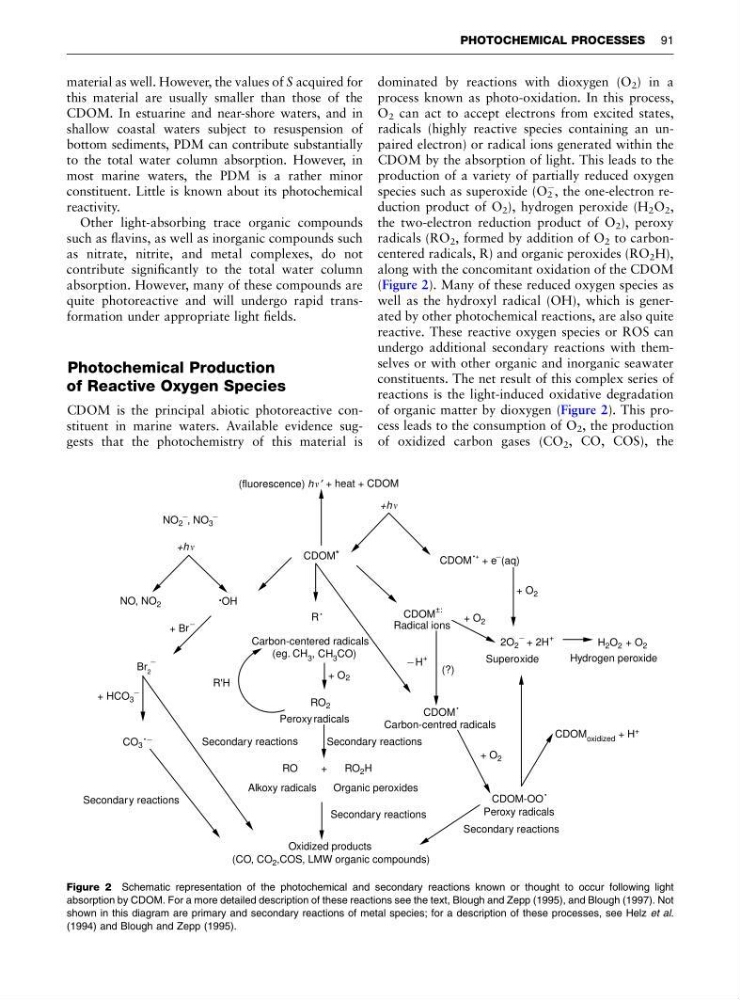
CDOM is the principal abiotic photoreactive constituent in marine waters. Available evidence suggests that the photochemistry of this material is
dominated by reactions with dioxygen (O 2 ) in a
process known as photo-oxidation. In this process,
O 2 can act to accept electrons from excited states,
radicals (highly reactive species containing an unpaired electron) or radical ions generated within the
CDOM by the absorption of light. This leads to the
production of a variety of partially reduced oxygen
species such as superoxide (O 2
À
, the one-electron reduction product of O 2 ), hydrogen peroxide (H 2 O 2 ,
the two-electron reduction product of O 2 ), peroxy
radicals (RO 2 , formed by addition of O 2 to carboncentered radicals, R) and organic peroxides (RO 2 H),
along with the concomitant oxidation of the CDOM
(Figure 2). Many of these reduced oxygen species as
well as the hydroxyl radical (OH), which is generated by other photochemical reactions, are also quite
reactive. These reactive oxygen species or ROS can
undergo additional secondary reactions with themselves or with other organic and inorganic seawater
constituents. The net result of this complex series of
reactions is the light-induced oxidative degradation
of organic matter by dioxygen (Figure 2). This process leads to the consumption of O 2 , the production
of oxidized carbon gases (CO 2 , CO, COS), the
(fluorescence) h ′ + heat + CDOM
+h
+h
+
(?)
+ Br
_
Br 2
_
CDOM *
CDOM ·+ + e (aq)
NO 2
_
, NO 3
_
NO, NO 2
CDOM
±:
Radical ions
CDOM ·
Carbon-centred radicals
CDOM-OO ·
Peroxy radicals
CDOM oxidized + H
+
+ O 2
·OH
R'H
R ·
RO 2
Peroxy radicals
RO
+
RO 2 H
Alkoxy radicals
Organic peroxides
Oxidized products
(CO, CO 2 ,COS, LMW organic compounds)
Carbon-centered radicals
(eg. CH
H
3 , C
H
3 CO)
2O 2 + 2H
+
Superoxide
H 2 O 2 + O 2
Hydrogen peroxide
+ HCO 3
CO 3
·
Secondary reaction
Secondary reactions
Secondary reactions
Secondary reactions
Secondar y reactions
+ O 2
+ O 2
+ O 2
s
_
_
_
_
_
Figure 2 Schematic representation of the photochemical and secondary reactions known or thought to occur following light
absorption by CDOM. For a more detailed description of these reactions see the text, Blough and Zepp (1995), and Blough (1997). Not
shown in this diagram are primary and secondary reactions of metal species; for a description of these processes, see Helz et al.
(1994) and Blough and Zepp (1995).
PHOTOCHEMICAL PROCESSES 91
this material are usually smaller than those of the
CDOM. In estuarine and near-shore waters, and in
shallow coastal waters subject to resuspension of
bottom sediments, PDM can contribute substantially
to the total water column absorption. However, in
most marine waters, the PDM is a rather minor
constituent. Little is known about its photochemical
reactivity.
Other light-absorbing trace organic compounds
such as flavins, as well as inorganic compounds such
as nitrate, nitrite, and metal complexes, do not
contribute significantly to the total water column
absorption. However, many of these compounds are
quite photoreactive and will undergo rapid transformation under appropriate light fields.
Photochemical Production
of Reactive Oxygen Species
CDOM is the principal abiotic photoreactive constituent in marine waters. Available evidence suggests that the photochemistry of this material is
dominated by reactions with dioxygen (O 2 ) in a
process known as photo-oxidation. In this process,
O 2 can act to accept electrons from excited states,
radicals (highly reactive species containing an unpaired electron) or radical ions generated within the
CDOM by the absorption of light. This leads to the
production of a variety of partially reduced oxygen
species such as superoxide (O 2
À
, the one-electron reduction product of O 2 ), hydrogen peroxide (H 2 O 2 ,
the two-electron reduction product of O 2 ), peroxy
radicals (RO 2 , formed by addition of O 2 to carboncentered radicals, R) and organic peroxides (RO 2 H),
along with the concomitant oxidation of the CDOM
(Figure 2). Many of these reduced oxygen species as
well as the hydroxyl radical (OH), which is generated by other photochemical reactions, are also quite
reactive. These reactive oxygen species or ROS can
undergo additional secondary reactions with themselves or with other organic and inorganic seawater
constituents. The net result of this complex series of
reactions is the light-induced oxidative degradation
of organic matter by dioxygen (Figure 2). This process leads to the consumption of O 2 , the production
of oxidized carbon gases (CO 2 , CO, COS), the
(fluorescence) h ′ + heat + CDOM
+h
+h
+
(?)
+ Br
_
Br 2
_
CDOM *
CDOM ·+ + e (aq)
NO 2
_
, NO 3
_
NO, NO 2
CDOM
±:
Radical ions
CDOM ·
Carbon-centred radicals
CDOM-OO ·
Peroxy radicals
CDOM oxidized + H
+
+ O 2
·OH
R'H
R ·
RO 2
Peroxy radicals
RO
+
RO 2 H
Alkoxy radicals
Organic peroxides
Oxidized products
(CO, CO 2 ,COS, LMW organic compounds)
Carbon-centered radicals
(eg. CH
H
3 , C
H
3 CO)
2O 2 + 2H
+
Superoxide
H 2 O 2 + O 2
Hydrogen peroxide
+ HCO 3
CO 3
·
Secondary reaction
Secondary reactions
Secondary reactions
Secondary reactions
Secondar y reactions
+ O 2
+ O 2
+ O 2
s
_
_
_
_
_
Figure 2 Schematic representation of the photochemical and secondary reactions known or thought to occur following light
absorption by CDOM. For a more detailed description of these reactions see the text, Blough and Zepp (1995), and Blough (1997). Not
shown in this diagram are primary and secondary reactions of metal species; for a description of these processes, see Helz et al.
(1994) and Blough and Zepp (1995).
PHOTOCHEMICAL PROCESSES 91