

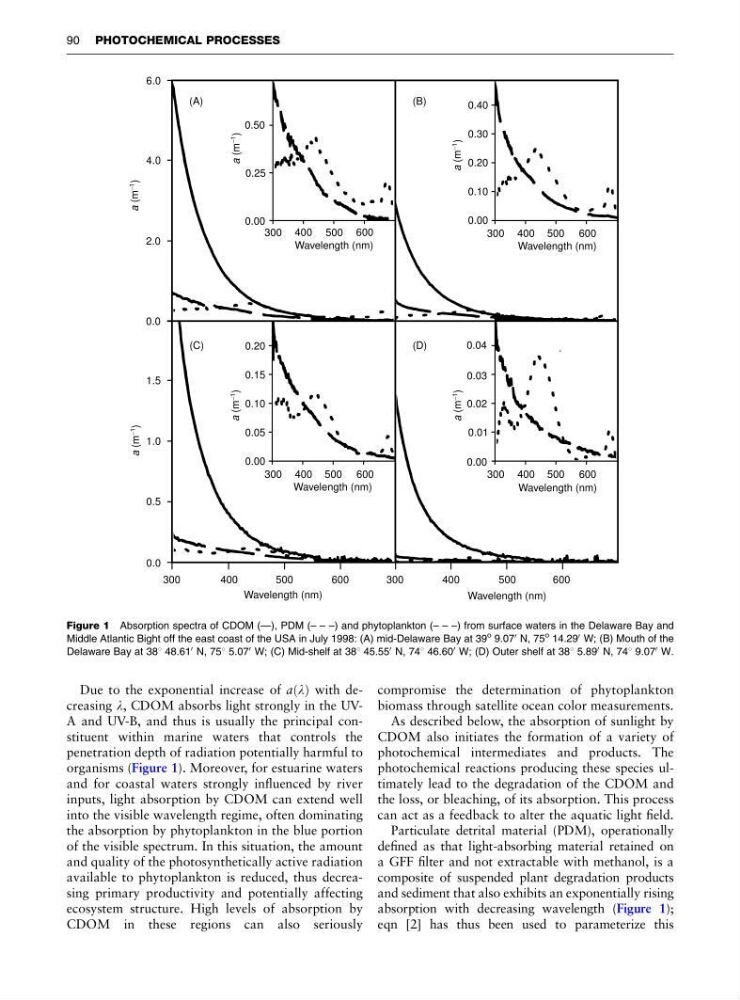
Due to the exponential increase of aðlÞ with decreasing l, CDOM absorbs light strongly in the UVA and UV-B, and thus is usually the principal constituent within marine waters that controls the
penetration depth of radiation potentially harmful to
organisms (Figure 1). Moreover, for estuarine waters
and for coastal waters strongly influenced by river
inputs, light absorption by CDOM can extend well
into the visible wavelength regime, often dominating
the absorption by phytoplankton in the blue portion
of the visible spectrum. In this situation, the amount
and quality of the photosynthetically active radiation
available to phytoplankton is reduced, thus decreasing primary productivity and potentially affecting
ecosystem structure. High levels of absorption by
CDOM in these regions can also seriously
compromise the determination of phytoplankton
biomass through satellite ocean color measurements.
As described below, the absorption of sunlight by
CDOM also initiates the formation of a variety of
photochemical intermediates and products. The
photochemical reactions producing these species ultimately lead to the degradation of the CDOM and
the loss, or bleaching, of its absorption. This process
can act as a feedback to alter the aquatic light field.
Particulate detrital material (PDM), operationally
defined as that light-absorbing material retained on
a GFF filter and not extractable with methanol, is a
composite of suspended plant degradation products
and sediment that also exhibits an exponentially rising
absorption with decreasing wavelength (Figure 1);
eqn [2] has thus been used to parameterize this
6.0
4.0
2.0
0.0
1.5
1.0
0.5
0.0
a (m
_
1
)
a (m
_
1
)
a (m
_
1
)
a (m
_
1
)
a (m
_
1
)
a (m
_
1
)
(A)
0.50
0.25
0.00
0.40
0.30
0.20
0.10
0.00
0.04
0.03
0.02
0.01
0.00
0.20
0.15
0.10
0.05
0.00
Wavelength (nm)
Wavelength (nm)
300 400 500 600
300 400 500 600
Wavelength (nm)
Wavelength (nm)
Wavelength (nm)
Wavelength (nm)
300 400 500 600
300 400 500 600
(B)
(C)
(D)
300
400
400
500
500
600
600
300
Figure 1 Absorption spectra of CDOM (—), PDM (– – –) and phytoplankton (– – –) from surface waters in the Delaware Bay and
Middle Atlantic Bight off the east coast of the USA in July 1998: (A) mid-Delaware Bay at 39
o 9.07
0 N, 75
o 14.29
0 W; (B) Mouth of the
Delaware Bay at 381 48.61
0 N, 751 5.07
0 W; (C) Mid-shelf at 381 45.55
0 N, 741 46.60
0 W; (D) Outer shelf at 381 5.89
0 N, 741 9.07
0 W.
90 PHOTOCHEMICAL PROCESSES
penetration depth of radiation potentially harmful to
organisms (Figure 1). Moreover, for estuarine waters
and for coastal waters strongly influenced by river
inputs, light absorption by CDOM can extend well
into the visible wavelength regime, often dominating
the absorption by phytoplankton in the blue portion
of the visible spectrum. In this situation, the amount
and quality of the photosynthetically active radiation
available to phytoplankton is reduced, thus decreasing primary productivity and potentially affecting
ecosystem structure. High levels of absorption by
CDOM in these regions can also seriously
compromise the determination of phytoplankton
biomass through satellite ocean color measurements.
As described below, the absorption of sunlight by
CDOM also initiates the formation of a variety of
photochemical intermediates and products. The
photochemical reactions producing these species ultimately lead to the degradation of the CDOM and
the loss, or bleaching, of its absorption. This process
can act as a feedback to alter the aquatic light field.
Particulate detrital material (PDM), operationally
defined as that light-absorbing material retained on
a GFF filter and not extractable with methanol, is a
composite of suspended plant degradation products
and sediment that also exhibits an exponentially rising
absorption with decreasing wavelength (Figure 1);
eqn [2] has thus been used to parameterize this
6.0
4.0
2.0
0.0
1.5
1.0
0.5
0.0
a (m
_
1
)
a (m
_
1
)
a (m
_
1
)
a (m
_
1
)
a (m
_
1
)
a (m
_
1
)
(A)
0.50
0.25
0.00
0.40
0.30
0.20
0.10
0.00
0.04
0.03
0.02
0.01
0.00
0.20
0.15
0.10
0.05
0.00
Wavelength (nm)
Wavelength (nm)
300 400 500 600
300 400 500 600
Wavelength (nm)
Wavelength (nm)
Wavelength (nm)
Wavelength (nm)
300 400 500 600
300 400 500 600
(B)
(C)
(D)
300
400
400
500
500
600
600
300
Figure 1 Absorption spectra of CDOM (—), PDM (– – –) and phytoplankton (– – –) from surface waters in the Delaware Bay and
Middle Atlantic Bight off the east coast of the USA in July 1998: (A) mid-Delaware Bay at 39
o 9.07
0 N, 75
o 14.29
0 W; (B) Mouth of the
Delaware Bay at 381 48.61
0 N, 751 5.07
0 W; (C) Mid-shelf at 381 45.55
0 N, 741 46.60
0 W; (D) Outer shelf at 381 5.89
0 N, 741 9.07
0 W.
90 PHOTOCHEMICAL PROCESSES