

MATERIALS AND METHODS
Water from a depth of 1 m and sediment samples were collected with special 2 L : sterile
bottles and Smith-Mclntyre grab respectively. All the samples were processed immediately, on board the B/O “Justo Sierra”. A series of ten fold dilutions were made with
artificial sea water (Lymann and Fleming, 1940), according to the concentration expected. These dilutions were seeded onto Zobell 2216-E medium (Oppenheimer and Zobell,
1952) using the spread plate method, for the enumeration of heterotrophic bacteria. The
most probable number technique, described by Mills et al, (1978), in 5-tube series, was
used for the quantitative determination of hydrocarbonoclastic bacteria, using 20 ml
screw cap bottles containing 0.1 % Ixtoc-I crude oil and artificial sea water, enriched with
phosphate and nitrate. Enumerations were performed after incubations lasting 48 h for
the heterotrophic group, and 2 months for the oil degraders. The incubation temperature
was 28+ 2°C for both methods.
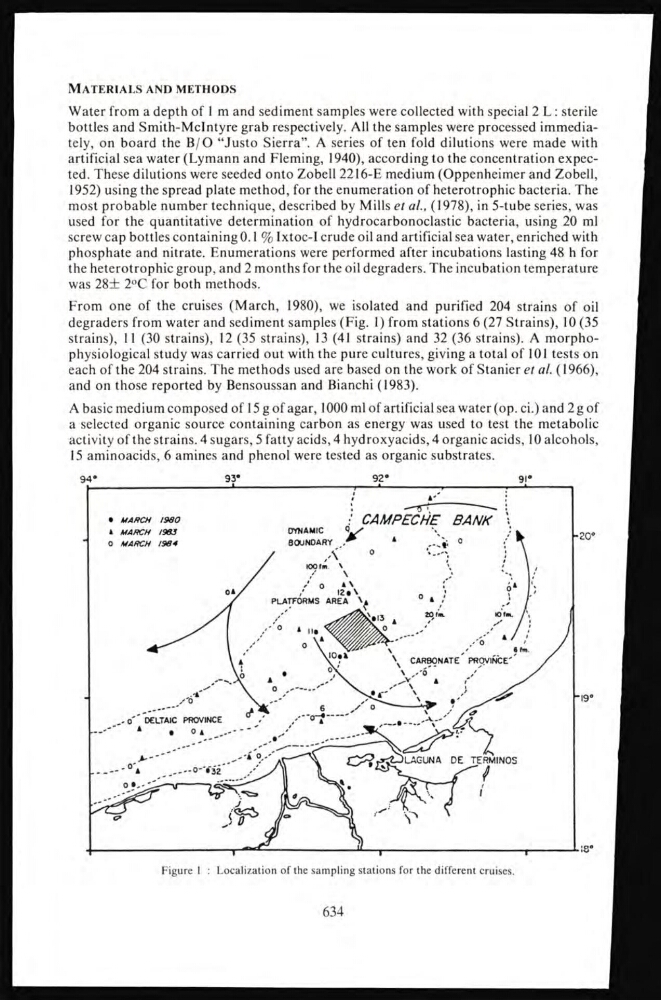
From one of the cruises (March, 1980), we isolated and purified 204 strains of oil
degraders from water and sediment samples (Fig. 1) from stations 6 (27 Strains), 10 (35
strains), 11 (30 strains), 12 (35 strains), 13 (41 strains) and 32 (36 strains). A morphophysiological study was carried out with the pure cultures, giving a total of 101 tests on
each of the 204 strains. The methods used are based on the work of Stanier et al. (1966),
and on those reported by Bensoussan and Bianchi (1983).
A basic medium composed of 15 g of agar, 1000 ml of artificial sea water (op. ci.) and 2 g of
a selected organic source containing carbon as energy was used to test the metabolic
activity of the strains. 4 sugars, 5 fatty acids, 4 hydroxyacids, 4 organic acids, 10 alcohols,
15 aminoacids, 6 amines and phenol were tested as organic substrates.
634