

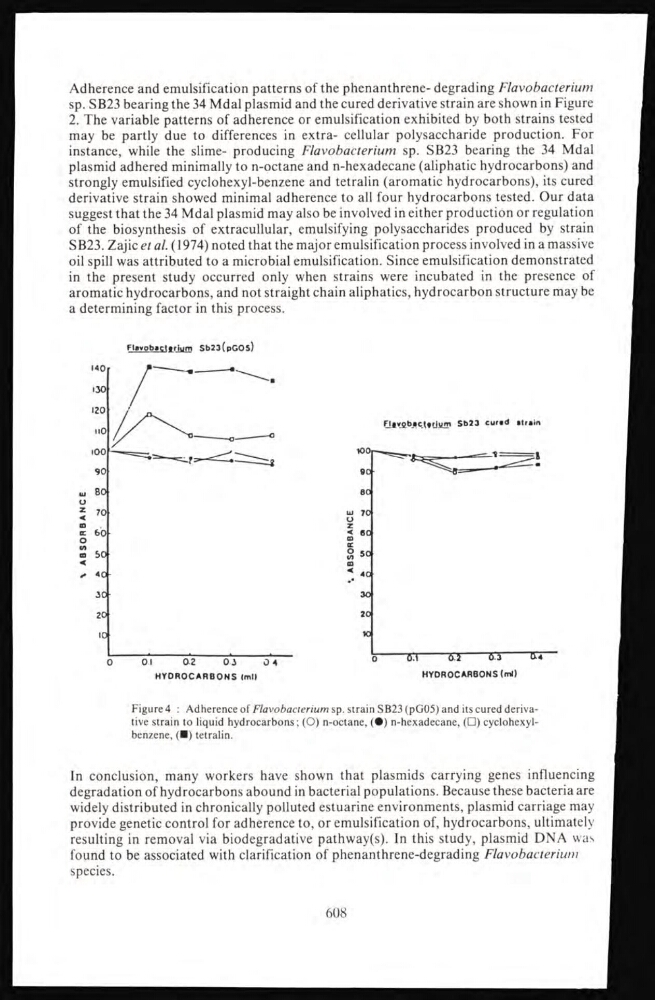
Adherence and emulsification patterns of the phenanthrene- degrading Flavobacterium
sp. SB23 bearing the 34 Mdal plasmid and the cured derivative strain are shown in Figure
2. The variable patterns of adherence or emulsification exhibited by both strains tested
may be partly due to differences in extra- cellular polysaccharide production. For
instance, while the slime- producing Flavobacterium sp. SB23 bearing the 34 Mdal
plasmid adhered minimally to n-octane and n-hexadecane (aliphatic hydrocarbons) and
strongly emulsified cyclohexyl-benzene and tetralin (aromatic hydrocarbons), its cured
derivative strain showed minimal adherence to all four hydrocarbons tested. Our data
suggest that the 34 Mdal plasmid may also be involved in either production or regulation
of the biosynthesis of extracullular, emulsifying polysaccharides produced by strain
SB23. Zajic et al. ( 1974) noted that the major emulsification process involved in a massive
oil spill was attributed to a microbial emulsification. Since emulsification demonstrated
in the present study occurred only when strains were incubated in the presence of
aromatic hydrocarbons, and not straight chain aliphatics, hydrocarbon structure may be
a determining factor in this process.
Flavobacterium Sb23(pGO5)
HYDROCARBONS (ml)
Flavobacterium Sb23 cured strain
Figure 4 : Adherence of Flavobacterium sp. strain SB23 (pG05) and its cured derivative strain to liquid hydrocarbons ; (O) n-octane, (•) n-hexadecane, (□) cyclohexylbenzene, (■) tetralin.
In conclusion, many workers have shown that plasmids carrying genes influencing
degradation of hydrocarbons abound in bacterial populations. Because these bacteria are
widely distributed in chronically polluted estuarine environments, plasmid carriage may
provide genetic control for adherence to, or emulsification of, hydrocarbons, ultimately
resulting in removal via biodegradative pathway(s). In this study, plasmid DNA was
found to be associated with clarification of phenanthrene-degrading Flavobacterium
species.
6Ü8
sp. SB23 bearing the 34 Mdal plasmid and the cured derivative strain are shown in Figure
2. The variable patterns of adherence or emulsification exhibited by both strains tested
may be partly due to differences in extra- cellular polysaccharide production. For
instance, while the slime- producing Flavobacterium sp. SB23 bearing the 34 Mdal
plasmid adhered minimally to n-octane and n-hexadecane (aliphatic hydrocarbons) and
strongly emulsified cyclohexyl-benzene and tetralin (aromatic hydrocarbons), its cured
derivative strain showed minimal adherence to all four hydrocarbons tested. Our data
suggest that the 34 Mdal plasmid may also be involved in either production or regulation
of the biosynthesis of extracullular, emulsifying polysaccharides produced by strain
SB23. Zajic et al. ( 1974) noted that the major emulsification process involved in a massive
oil spill was attributed to a microbial emulsification. Since emulsification demonstrated
in the present study occurred only when strains were incubated in the presence of
aromatic hydrocarbons, and not straight chain aliphatics, hydrocarbon structure may be
a determining factor in this process.
Flavobacterium Sb23(pGO5)
HYDROCARBONS (ml)
Flavobacterium Sb23 cured strain
Figure 4 : Adherence of Flavobacterium sp. strain SB23 (pG05) and its cured derivative strain to liquid hydrocarbons ; (O) n-octane, (•) n-hexadecane, (□) cyclohexylbenzene, (■) tetralin.
In conclusion, many workers have shown that plasmids carrying genes influencing
degradation of hydrocarbons abound in bacterial populations. Because these bacteria are
widely distributed in chronically polluted estuarine environments, plasmid carriage may
provide genetic control for adherence to, or emulsification of, hydrocarbons, ultimately
resulting in removal via biodegradative pathway(s). In this study, plasmid DNA was
found to be associated with clarification of phenanthrene-degrading Flavobacterium
species.
6Ü8